On July 7, 2026, the climate group Food and Water Watch published a report calling on New Mexico to stop approving giant AI data centers until the state figures out what they cost. Days earlier, Democratic state lawmakers had announced they'd push a statewide moratorium in next year's legislative session.
Source New Mexico asked both people running to be the next governor what they thought. Whoever wins will be sitting in the Governor's office when that bill comes up.
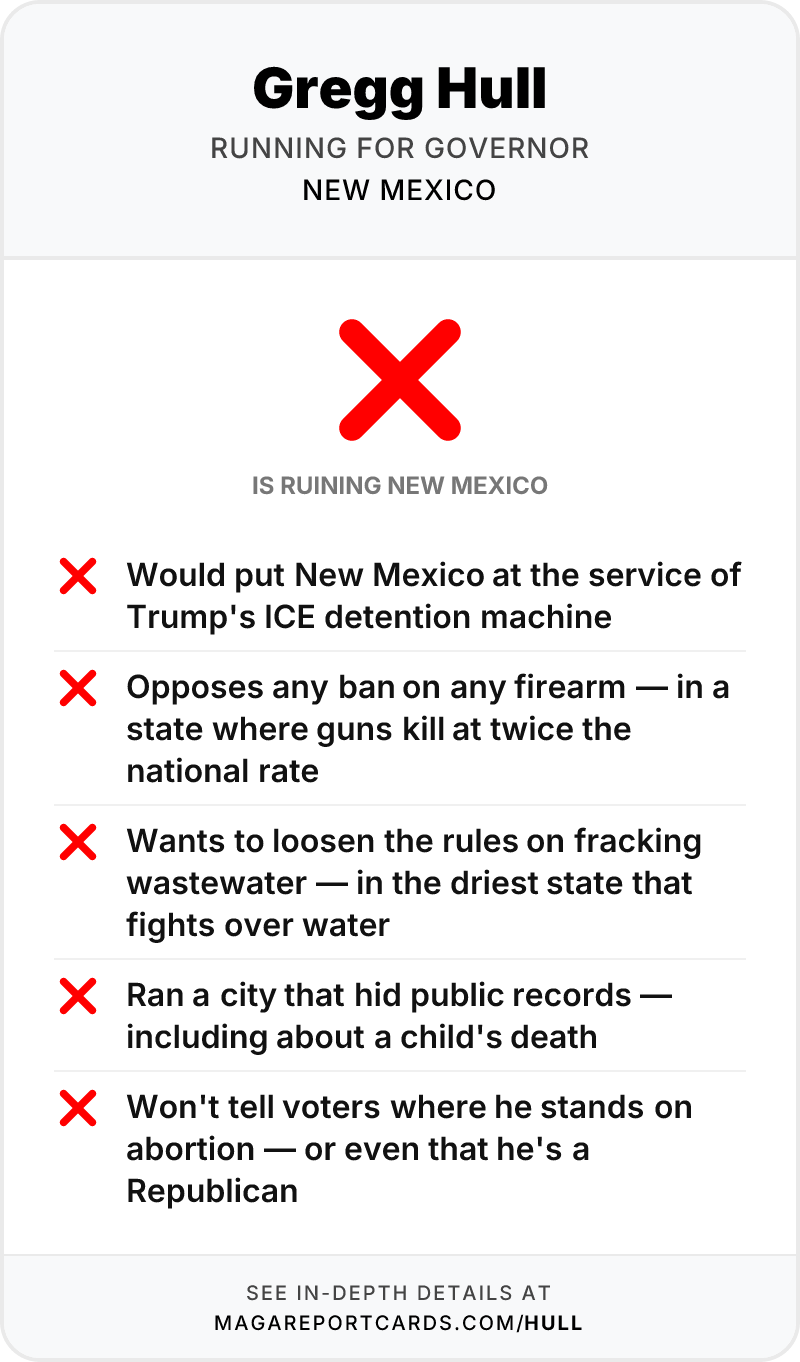
Gregg Hull said no.
"It would tell every business considering New Mexico that we're closed for economic diversification, and that sends the wrong signal at exactly the moment we should be competing for these investments," he wrote. "But I don't support a blank check either. Data centers need to be sited responsibly — with real accountability for water use, energy impact, and community input... As governor, I'd rather fix the guardrails than shut the door on an entire industry."
"Fix the guardrails" sounds reasonable. So let's look at which guardrails Hull actually wants to fix, and what he wants to fill these data centers with.
His plan is to cool them with oil field wastewater
Hull has now said this twice, in two different settings.
At an Albuquerque Journal town hall on May 11, 2026, he faced what Source New Mexico described as "a flurry of questions" from the audience about data center moratoriums. He said he wasn't opposed to data centers, but wanted them to be responsible about water. His idea: the state should explore requiring data center developers to use alternative water sources, "such as brackish water or 'produced' water from oil and gas operations," to cool their servers.
"I think there's some very creative ways we can work with these industries," he said.
He repeated it in writing. Asked by the Albuquerque Journal whether he'd support water use limits on data centers, or ban them outright, Hull answered: "I oppose a blanket ban on data centers — they bring jobs and investment. But location matters. Facilities should be sited where water and power resources can actually support them, like southeastern New Mexico where produced water is available."
Produced water is the wastewater that comes back up an oil well along with the oil. In the Permian Basin of southeastern New Mexico, the oil industry brings up an average of about four barrels of it per barrel of oil, and as much as 12. It is not a spare water supply sitting around waiting for a use. It is the industry's biggest and most expensive garbage problem, and Hull is proposing to solve that problem for them.
New Mexico's own scientists already studied this. They said no.
This isn't an open question in New Mexico. The state spent a year and a half on it.
The New Mexico Environment Department asked the Water Quality Control Commission in December 2023 to ban discharging produced water into the state's ground and surface water. It backed the request with testimony from five of its own scientists. The finding was blunt: produced water contains hundreds of known and unknown chemicals, many toxic to people and the environment — some of them fracking chemicals the industry keeps secret as "trade secrets" — and the technology to treat it safely at scale does not exist. New Mexico doesn't even have surface water quality standards for at least 180 of the potentially toxic chemicals in it.
Even the New Mexico Oil and Gas Association fought the ban — and one of its own primary expert witnesses testified that discharging treated produced water at scale is premature.
In May 2025, after an 18-month process and hundreds of pages of expert testimony, the commission banned it — a full prohibition running through the end of 2030, with research pilot projects allowed but no discharge.
The Legislature backed away from it the same year. When lawmakers wrote the Strategic Water Supply Act — New Mexico's big bet on finding new water — produced water was in the original bill. Objections from lawmakers and stakeholders got it stripped out, and the bill became brackish-only in February 2025. The law now defines "brackish water" to specifically exclude produced water.
New Mexico's environmental agency, its scientists and its water commission all looked at this and said the same thing. Its Legislature took produced water out of its own water bill rather than risk the bill. Hull's platform says the opposite.
The guardrail he actually wants to "fix" is the one protecting the water
On his own campaign website, under Oil & Gas, Hull writes that "some current rules, especially around produced water handling, are overly complex and drive up costs without clear safety benefits. I support streamlining these rules so water can be safely treated and reused only within the industry while protecting our freshwater resources."
"Without clear safety benefits" is a direct contradiction of what the state's own review found.
And this is not theoretical. On May 12, 2026 — the day after Hull's town hall — the Water Quality Control Commission voted 7–4 to open a new rulemaking on a petition from an oil-and-gas-industry-led group that would allow produced water to be discharged into New Mexico's surface and ground water and used in agriculture. As written, it would be one of the most permissive oil and gas wastewater rules in the country. It came less than a year after the ban took effect.
The governor appoints the people who run the Environment Department — the agency that proposed the ban, and that the Western Environmental Law Center says is now "sitting on the sidelines while industry proposes to undo the rule NMED proposed and its scientists supported." Whoever wins in November decides which side that agency is on.
So when Hull promises "real accountability for water use," the accountability rules already on the books for this exact water are the ones he has publicly committed to loosening.
Even the people open to reusing produced water say it isn't ready
New Mexico Water Advocates, a state water nonprofit that calls treating produced water for beneficial reuse "worth considering," looked at whether it can actually be done. It notes that there are only a few full-scale treatment plants anywhere in the U.S. doing this — none in the Permian Basin — and that a number of them have shut down, "leaving legacy environmental issues."
There's also a problem that should stop Hull's pitch cold. Treating produced water at large scale would itself require an estimated 1 to 3 gigawatts of new power generation.
Read that next to the problem it's supposed to solve. Hull's answer to data centers using too much water and too much power is to hand them water that would take another power plant's worth of electricity to clean.
Meanwhile, the water is disappearing
New Mexico's own 50-year water plan projects the state will have approximately 25% less water in its rivers and aquifers within 50 years — a shortage of 750,000 acre-feet if nothing changes.
Into that, the AI industry is arriving at enormous scale. Food and Water Watch's report found that a hyperscale data center — the kind built to train AI models — can use as much energy as 100,000 to 2 million U.S. households, depending on size.
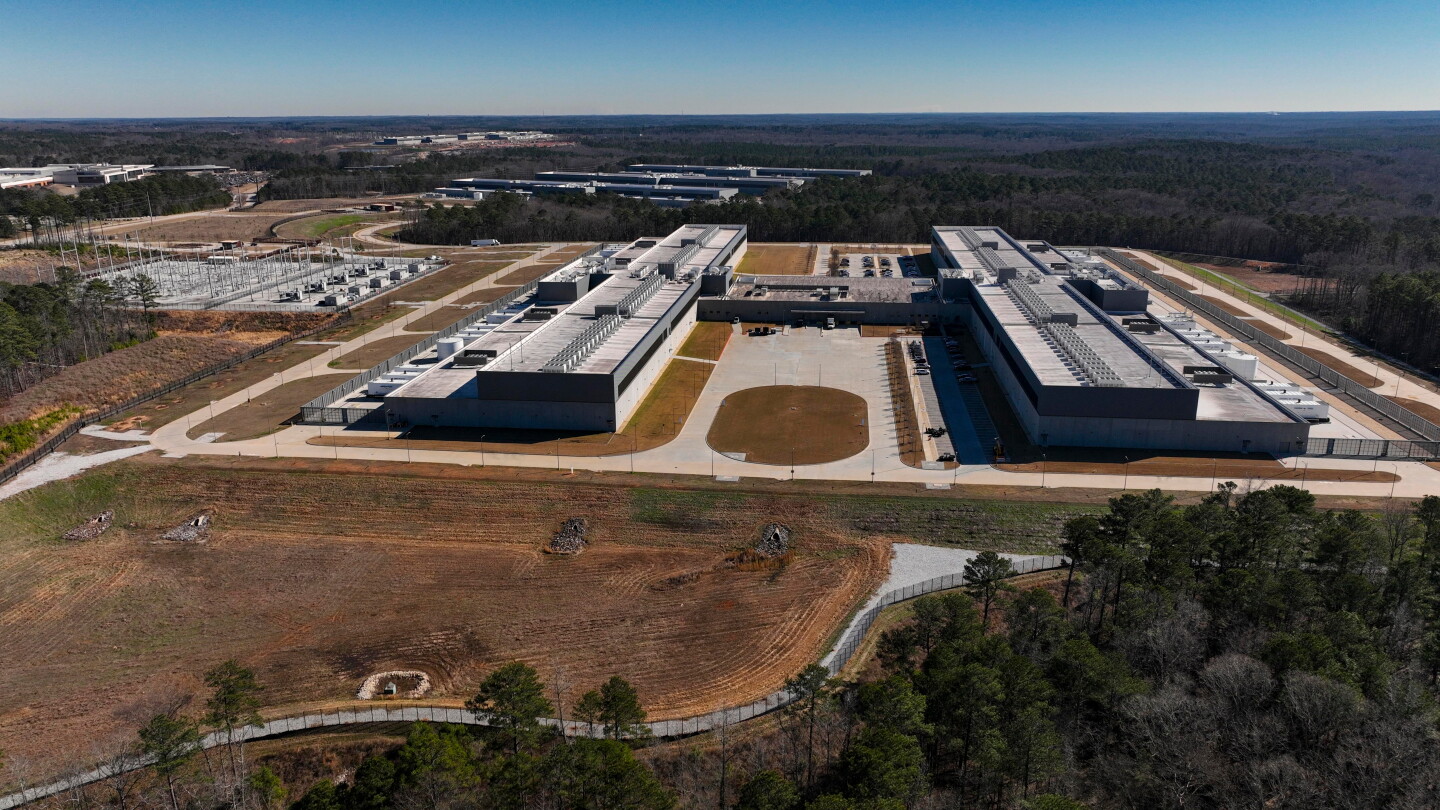
Project Jupiter, the Oracle and OpenAI campus under construction at Santa Teresa in southern New Mexico, is the test case. Its developers first planned to power it with two natural gas plants that would have emitted more greenhouse gases than Albuquerque and Las Cruces combined. A revised proposal swaps in Bloom Energy fuel cells — and documents filed with the New Mexico Environment Department show the emissions would still outpace those two cities combined.
Local officials can't get straight answers. In April 2026, Doña Ana County commissioners directed their own county manager to investigate the project's water use after conflicting statements in news reports.
Counties aren't waiting for the state. Socorro County adopted a yearlong pause on data centers in June 2026 after a proposal for a 10,000-acre site. Santa Fe County commissioners followed in early July, saying they wanted to be "proactive" before developers showed up.
Those are the local guardrails going up right now, put in place by the communities Hull says should have "community input." His position is that the state shouldn't do the same thing.
We've seen this playbook in other states
Hull is running the same argument other Republican candidates have run, and it lands the same way.
In Alabama, Tommy Tuberville called residents' data center objections "bull crap" and blamed Chinese propaganda — after at least ten communities pushed back over water, power, and noise. In Missouri, Eric Burlison wrote a letter supporting a data center that hundreds of his constituents opposed, telling voters that "what the business is doing doesn't matter." And in Texas, Greg Abbott spent years branding the state the "epicenter of AI development" and handing data centers a sales-tax exemption now projected to cost the state billions — then, in an election year, tried to take credit for slowing them down.
The through-line is that the industry gets the certainty and the neighbors get the study.
What this actually is
New Mexico is in the middle of a documented long-term decline in its water supply — a quarter of it, gone, on the state's own projection. And the single largest new industrial demand for water and power in a generation is arriving. Lawmakers want to pause and write rules first. Local governments already are.
Gregg Hull's answer is that pausing sends the wrong signal — and that the way to get the water is to take it from the fracking industry's waste stream, the one substance New Mexico's own scientists and water commission have concluded can't be handled safely, and that its Legislature stripped out of the state's new-water program.
That isn't fixing the guardrails. That's removing two of them at once. We deserve better.
Source
Climate advocacy org urges New Mexico leaders to adopt data center moratorium — Joshua Bowling, Source New Mexico, July 7, 2026. Photo: aerial view of the Project Jupiter construction site, June 26, 2026, courtesy of Alexa Reynaud / Food & Water Watch, with aerial support from LightHawk.