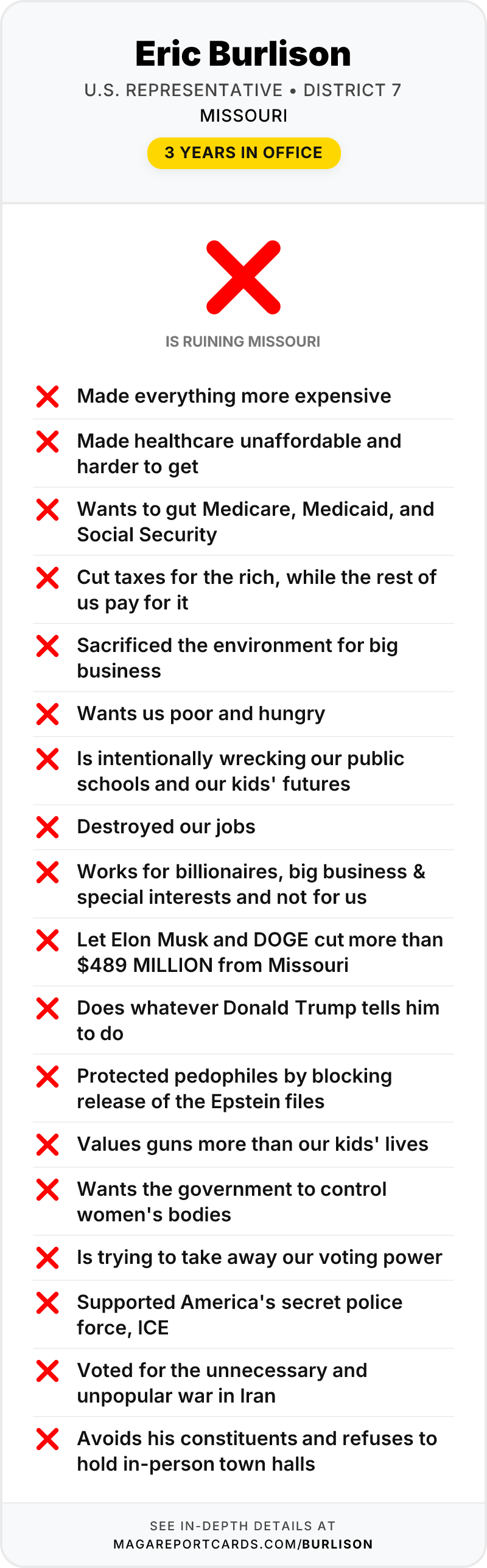
At a Republican candidate forum in Carthage, Missouri on Thursday, July 23, 2026, someone in the audience asked Eric Burlison a question he couldn't really answer.
The congressman had just spent 20 minutes talking about Washington. Then someone in the audience pointed out a contradiction:
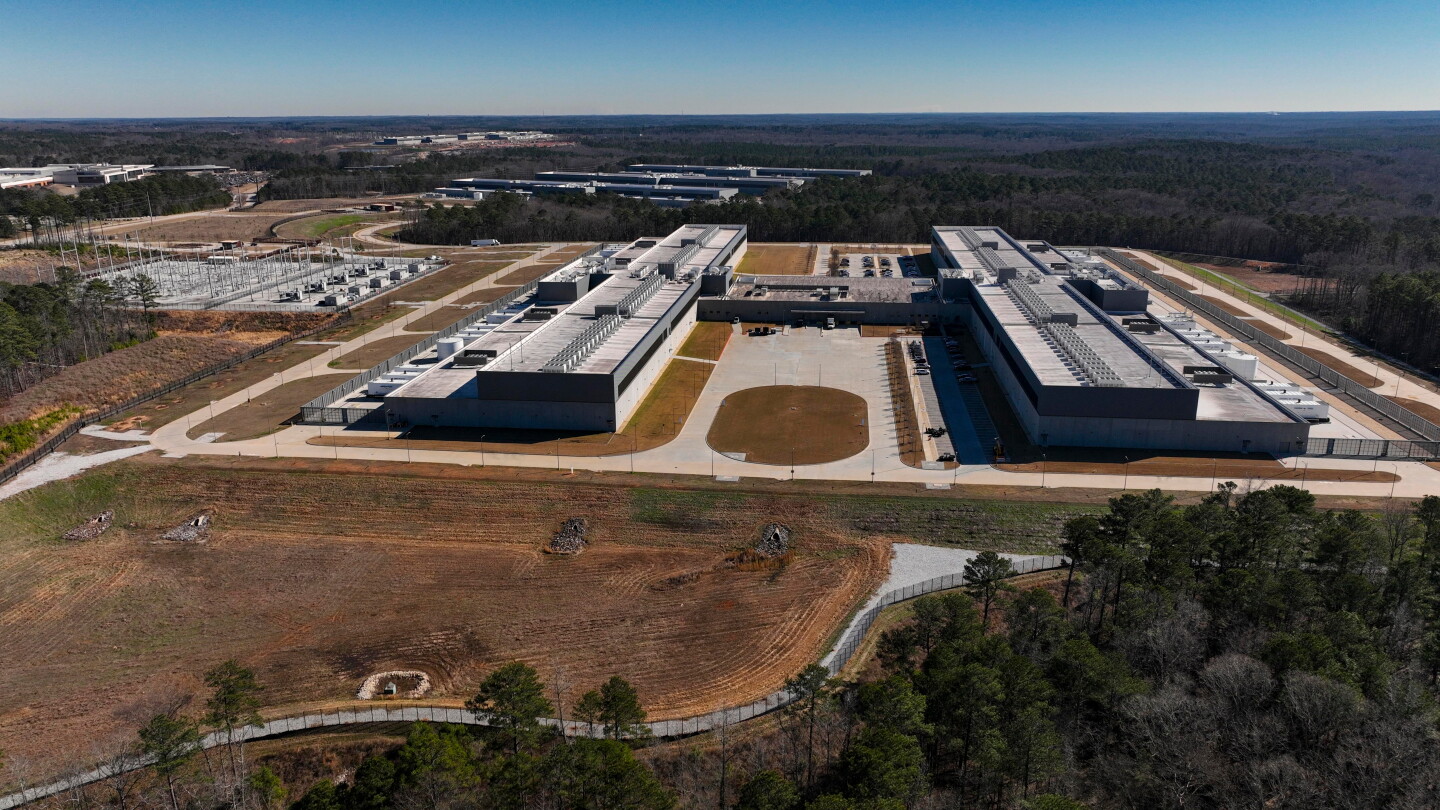
"You spoke earlier in regard to protecting the watershed or the water table or the water supply in the Southwest Missouri, especially Jasper County here. But yet it's reported that you support data centers that are going to suck that water out. ... Most of the rural people in Jasper County do not support the data centers."
That's the whole problem in three sentences. You say you'll protect our water. You back the thing that drinks it. And most of us out here don't want it.
Here's how Missouri's 7th District congressman responded.
"What the business is doing doesn't matter"
"I'm not a socialist central planner," Burlison said. "I'm a free-market Republican. The truth is, if you're a free-market conservative Republican, what the business is doing doesn't matter. How they make money, as long as they're living by the same rules as everybody else, whether it's a golf course that uses a ton of water or a car wash or a manufacturing facility, you name it, whatever the business is, we should not be getting in that kind of ... argument."
Then he added a second thought:
"I think a lot of times we get into that because data centers are an AI (and) an unknown thing and we tend to fear the unknown."
So a neighbor asks about the water table, and the answer is: you're afraid because you don't understand it.
That framing didn't land well with the people actually living there.
"I don't fear the unknown"
Rhys Hine owns land within half a mile of a proposed 3,000-acre data center and solar farm — a project pitched by Geronimo Power, a Minnesota company, for eastern Jasper County around La Russell. He organized a group called Say No to Data Centers: Keep Jasper and Lawrence Counties Rural.
In a phone interview the next day, Hine answered Burlison's "fear of the unknown" line. He said he doesn't fear the unknown. He fears what a water-hungry data center dropped onto rural farmland will do to his property and his life.
"I would just say that there are specific places and areas in the country that data centers belong such as industrial parks and places that have the infrastructure to support them," Hine said. "They don't belong in rural America out on productive farmland, and it's just going to cause a burden to the people who live there and have lived there for generations."
Burlison told the crowd that tax revenue from data centers would strengthen communities. Hine wasn't buying that either. The Sarcoxie site, he pointed out, is more than two miles from town, on farmland:
"It's in the middle of nowhere. I wouldn't really call it a community-growing effort. It's more of a money-growing effort for certain people."
The letter he doesn't talk about at forums
Here's the part of this story that matters most, and it isn't a quote from a forum. It's a document.
A separate data center has been proposed for the west side of Joplin, on land recently annexed into the city and rezoned. Hundreds of residents turned out at meetings earlier this year to oppose it. Some spoke in favor.
The Joplin Globe obtained the emails and letters that Joplin City Council members received after those meetings. Most of them opposed the zoning and annexation changes.
One of those letters, supporting the project, was from Eric Burlison.
Think about what that means. His constituents packed public meetings and wrote to their city council in opposition. Their congressman — who doesn't sit on the Joplin City Council and had no vote in the matter — wrote in on the other side.
In that letter, Burlison argued such projects "are increasingly important to American manufacturing, artificial intelligence, and national security."
This wasn't a one-off, either. Back in January, Burlison declared that "Missouri must lead America's data center revolution," adding that while these projects deserve oversight, "blanket opposition only slows us down."
To be fair, he does have an answer on your power bill
Burlison isn't entirely hand-waving, and it's worth being straight about that.
In the same letter, he wrote: "Families are right to expect that large-scale development does not result in higher utility rates or reduced grid availability." He pointed to Missouri's Senate Bill 4, now law, which he said "requires large energy users to pay rates that reflect the cost of serving them, helping ensure residential customers are not asked to subsidize the new industrial load."
That's a real policy answer to a real worry. Whether it holds up when the bills actually arrive is something Missourians will find out.
But notice what it doesn't address: the water. The question at the forum wasn't about electricity rates. It was about the water table in southwest Missouri, and whether a congressman who promises to protect it should be championing an industry that consumes it.
The pivot to China
Pressed further, Burlison changed the subject to where Americans' data lives.
"I worked a data service," he said. "Your data, your medical records reside in a data center. Where do you want that data located? I'm asking a question: Where would you like it located?"
An audience member had a practical response — put them on land where nobody lives, like federal land near Picher, Oklahoma, an abandoned mining site: "You put them in the places where people aren't living. Put the solar farms or whatever's going to power the data center so it doesn't disturb natural agriculture or people's neighborhoods."
Then came the question that gets to it: "where you live, you think your neighbors would appreciate that?"
Burlison replied that there are "a lot of things I would not want that would be much worse than a data center being next door," and returned to his theme — be "agnostic about the industry," and focus on the water and electricity it uses rather than what it does.
He did allow that impacts on the environment and downstream water use "are all valid and legitimate questions." He just closed by insisting: "we should not be fearful of data centers and AI."
The real question
Nobody at that forum was asking Burlison to be a "socialist central planner." They were asking a much smaller question: when a huge project wants your county's water and your county's farmland, and most of your neighbors say no, whose side is your congressman on?
On the Joplin project, the record already answers it. Most letters said no. His said yes.
Burlison faces John Casey and Grayson Hunt in the August 4 primary. The winner meets Democrat Missi Hesketh in November.
Source
- John Hacker, "Jasper County residents question Eric Burlison about his support for data centers", The Joplin Globe, July 24, 2026.