In April 2025, three southern Republican congressmen got on the Republican Study Committee's Right to the Point podcast to talk about the Masters. It was Masters Week. They picked their golfers — Rick Allen took Rory McIlroy, Mike Collins took Scottie Scheffler — and in between, they talked about what was happening to the federal workforce.
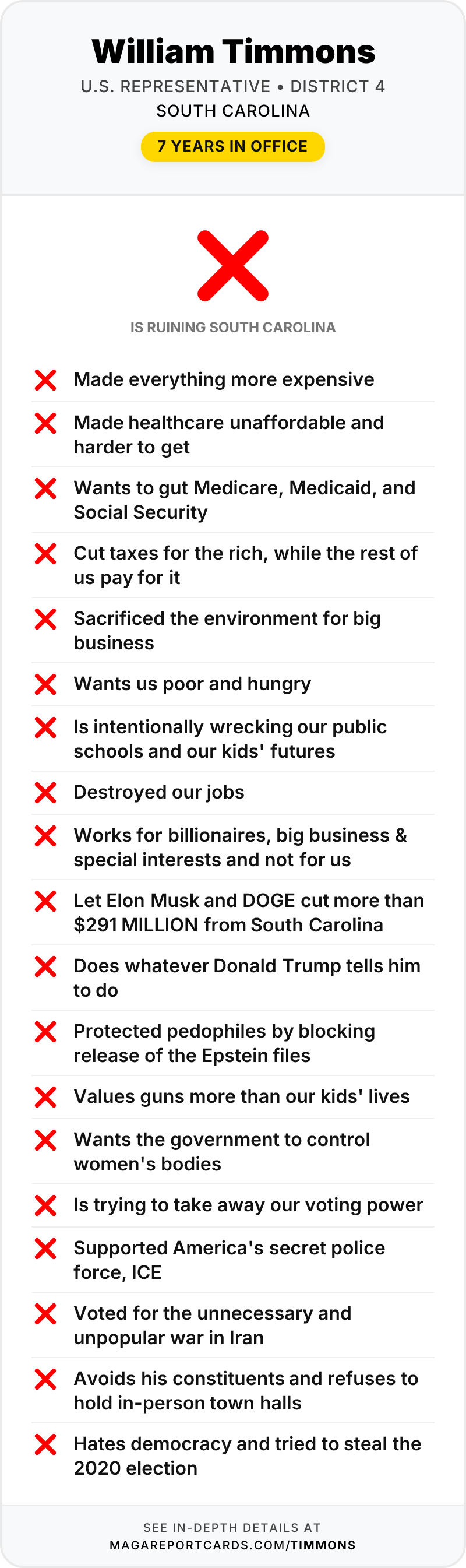
South Carolina's William Timmons put it this way:
"We're freeing the bureaucrats to go and be productive members of the economy. It's just fantastic."
That's from the transcript the Washington Reporter published on April 10, 2025. The "bureaucrats" he was talking about are people with jobs, mortgages, and kids. They were being fired.
A year later
On April 22, 2026, NBC News went and found some of them.
Reporters Fiona Glisson and Gary Grumbach talked to 13 people who lost federal jobs or took the "Fork in the Road" buyout. A year on:
- Seven were still unemployed.
- Two were re-employed and making far less than before.
- Two were getting by on side hustles.
- Four had moved to find work.
One of them, John Burg, had a decadeslong career that took him to Thailand, Kosovo, and El Salvador. He was laid off as a contractor for the U.S. Agency for International Development in January 2025. He applied to his 599th job and stopped counting. He now does carpentry in his Maryland neighborhood — changing lightbulbs for elderly neighbors, building a porch — and makes about 15% of his old salary.
"I feel more connected to my local community than ever. More disconnected from my financial goals," he told NBC.
David Harbourt ran safety and occupational health at the FDA's Center for Veterinary Medicine. He now commutes from Maryland to Kansas two weeks a month as a consultant while his wife works full time and raises their two kids alone half the month.
"The job market, particularly in Maryland, is unforgiving now. ... There's a stigma being a former fed. And that affects your marketability."
Bree Danner found out she'd lost her job at the CDC — in overdose prevention — while she was on her way to say goodbye to her dying grandmother. She has since spent her savings and her severance and run up credit card debt.
WellFed, a group that supports laid-off federal workers, estimates only about 25% of its members have found new jobs. OneAID, a group of former USAID staff and partners, estimates at least half of its members are still unemployed.
That is what "freeing the bureaucrats" looked like a year out. Not a fantastic outcome. A long-term unemployment problem.
He wasn't a bystander. He was on the oversight committee.
This is the part that separates Timmons from a random member giving a hot take.
In January 2025, he was appointed to the House Oversight subcommittee on Delivering on Government Efficiency, chaired by Marjorie Taylor Greene — who said it was "designed to work hand in hand with President Trump, Elon Musk, Vivek Ramaswamy, and the entire DOGE team." He celebrated it:
"I am deeply honored by Congresswoman Greene's confidence in my leadership and dedication to ensuring a more efficient, effective, and accountable federal government."
He spoke at the subcommittee's very first hearing, which the committee itself branded a "war on waste."
Oversight means asking hard questions of the thing you're overseeing. On the podcast, Timmons was not asking questions. He was selling:
"A private company could never get away with what this federal government's getting away with. They'd be fired by the board immediately. We've got these agency headquarters that are 25 percent occupied. It's costing taxpayers ten billion a year."
He described a hearing at the Voice of America building and the plan to sell it: "I bet it'll sell for tens of millions of dollars, and they're going to put up, probably, apartments there... And that's the kind of stuff that we're talking about those subcommittee and it is exciting."
Exciting. Fantastic. Those are the words of a booster, not an auditor.
The numbers he was cheering turned out not to hold up
On August 6, 2026, the Government Accountability Office — the nonpartisan watchdog that works for Congress — published its review of DOGE's public savings list.
CBS News reported the findings: DOGE "did not provide sufficient information to verify the method used to calculate 96 percent" of its claimed grant savings. Of the 264 leases DOGE claimed credit for terminating, 108 were already in the process of being eliminated before DOGE existed. And DOGE "did not respond to GAO's request for information or interviews."
Real property — the very thing Timmons was most excited about — got its own finding: the GAO concluded the Wall of Receipts "Overstated Savings from Real Property Lease Terminations by More than $80 Million."
This is the same pattern we've documented with other Republicans who talked up DOGE instead of checking its work: Alabama's Gary Palmer, who said DOGE had done better oversight in six weeks than Congress had in 40 years, and Texas's Beth Van Duyne, who called it the golden age of DOGE. DOGE itself expired on July 4, 2026 without ever filing a final report.
What it means back home
South Carolina is unusually exposed to this. The state budget includes $13.6 billion in federal funds — nearly a third of all its funding — which is why the Legislature was warned it couldn't just ignore DOGE cuts. State regulators told lawmakers they anticipated close to $700 million in cuts to federal programs that were supposed to pay for broadband expansion and home energy rebates.
Broadband is rural internet — the kind of thing the Upstate's smaller towns had been waiting on for years. Home energy rebates are money that helps people pay to insulate a house or replace a broken heat pump.
Timmons has never had to explain any of that in a room full of his own constituents. He hasn't held an in-person town hall in years, and in January 2026 he told a chamber of commerce crowd he's "very excited to be done with it."
The tell
Read the "freeing the bureaucrats" line one more time and notice what it assumes: that these people's jobs weren't real work, that private employers were waiting for them, and that a firing is a favor.
None of the three turned out to be true. The one thing that was true is that it made for a good line on a golf podcast.
Sources
Washington Reporter, "EXCLUSIVE: Reps. Mike Collins, William Timmons, and Rick Allen talk DOGE, SCOTUS, and golf ahead of Master's Week" — April 10, 2025.
Fiona Glisson and Gary Grumbach, "A year after DOGE, former federal employees are still looking for work" — NBC News, April 22, 2026.