Vonda Robinson and her husband John know a 28-year-old coal miner. He has spent about a decade underground, and he already has black lung disease.
Vonda Robinson is vice president of the National Black Lung Association. This is what she told the Virginia Mercury about the young miners now turning up sick, in its reporting on new research showing black lung among Appalachian coal miners has reached its highest level in nearly 50 years:
"It upsets me because they have small children and they're probably not going to see their children graduate high school or meet grandkids."
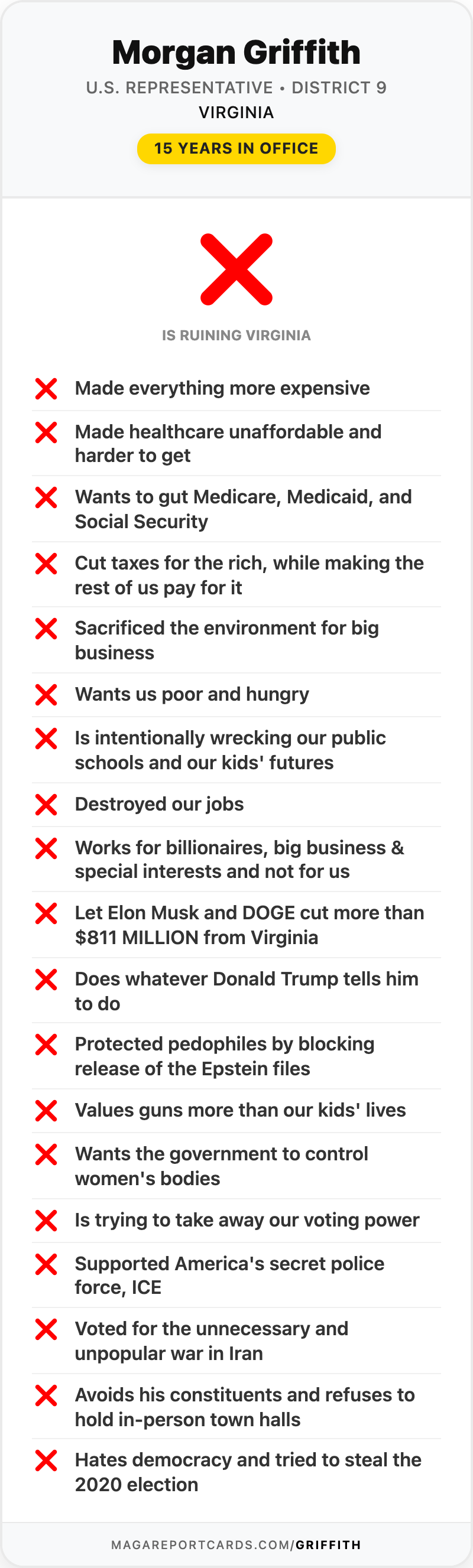
The congressman for that coal country is Morgan Griffith, who has represented Virginia's 9th District since 2011 and chairs the Energy and Commerce Subcommittee on Health.
Asked where he stands on the two bills before Congress to help miners with black lung and their widows, Griffith neither endorsed nor opposed them. He emailed the Virginia Mercury that he looks "forward to studying various proposals and determining the best course of Congressional action on this issue."
Fifteen years in Congress. Miners in his district getting an incurable disease earlier in their careers than they used to. He is studying it.
What the research actually found
The numbers come from a peer-reviewed research letter from the National Institute for Occupational Safety and Health, published in the American Journal of Respiratory and Critical Care Medicine:
- Black lung rates are back where they were in the 1970s.
- A third of central Appalachian miners who have worked 25 or more years underground now have the disease.
- Cases are rising among miners with less experience — meaning, as the researchers wrote, the burden "is affecting younger miners and not confined to the most experienced workers."
Black lung is incurable. It is also preventable — it comes from breathing dust, and dust can be controlled.
The reason younger miners are getting sick is that the work changed. John Robinson, a longtime miner diagnosed a little over a decade ago, described drilling through rock for years before ever reaching coal:
"It took us two and a half years to get to the coal seam. We basically breathed rock for two and a half years."
Cutting rock throws off silica — a carcinogen far more damaging to lungs than coal dust alone.
There was a rule for exactly this. It has been frozen for 16 months.
This is the part Griffith is "studying."
On April 18, 2024, the Mine Safety and Health Administration published a rule lowering the permissible exposure limit for silica dust in coal and other mines — roughly cutting it in half. The Department of Labor estimated at the time that the rule would mean more than 1,000 fewer deaths and 3,746 fewer cases of silica-related illness.
It was set to take effect for coal mines on April 14, 2025.
It never did. The mining industry challenged it, and on April 11, 2025 — three days before the deadline — the Eighth Circuit put the rule on hold. The compliance deadlines have been stayed indefinitely ever since.
Two things about how that happened:
The Trump administration did not defend its own government's rule. As the Virginia Mercury reports, the administration declined to defend the rule in court — and then petitioned the court to block the labor unions and the Black Lung Association from stepping in to defend it themselves. The miners were not allowed to argue for the standard the government had already finalized.
The industry's own lobby says it supports the lower limits. The Mercury notes that a National Mining Association spokesman told The New York Times late last year that the group is "absolutely supportive of the new lower levels." What the association argues for instead is that respirators should be enough. It did not answer the Mercury's questions.
Miners say respirators are not enough. Quenton King of Appalachian Voices explained why: in a mine loud with running drills, workers struggle to keep them on, and "if you aren't trying to have a dust-free environment, respirators will clog up multiple times in a shift."
The program that produced the research is one DOGE tried to shut down
Griffith told the Virginia Mercury that the surge in cases "merit federal attention," and pointed to federal funding for a black lung clinic in his district.
Here is the awkward part. The research letter he is responding to came from NIOSH — and NIOSH's black lung work was nearly destroyed last year.
In March 2025, DOGE announced it would end the leases on as many as three dozen MSHA field offices — the offices that inspect mines for dust. In April, nearly 900 NIOSH workers, about two-thirds of the agency, were terminated. The Coal Workers' Health Surveillance Program, which sends free mobile screening clinics out to miners, stopped operating.
What brought it back was not Congress. It was a lawsuit filed on behalf of Harry Wiley, a West Virginia coal miner diagnosed with black lung in 2024. On May 13, 2025, U.S. District Judge Irene Berger ordered the program restored, and the fired workers went back.
A miner with black lung had to sue the federal government to get his own screening program turned back on.
And Griffith's position on the cuts that did it? He has said he believes the House will codify DOGE's cuts — write them permanently into law. He did not say which ones. "Some of them we will," he said. "Some of them we won't." He called many of the cuts well intentioned, and Elon Musk a "genius."
Where he does move fast
Griffith is not a man without opinions about the coal industry.
On August 7 he wrote to Governor Abigail Spanberger asking her to keep Dominion's Wise County coal plant open — a plant Dominion's own filings say will cost ratepayers at least $472 million this decade while running at a fraction of its capacity. Dominion's PAC has given him $32,500 since 2019.
So the record reads like this. Asked to protect a utility's coal plant: a letter, within days. Asked where he stands on helping miners with an incurable lung disease that is spiking in his own district: he'll study it.
This is the same pattern we found when eight school health clinics closed in his district in July and Virginia's community health centers wrote to ask him to intervene. The chairman of the House health subcommittee has a district full of health emergencies and a habit of arriving after they're over.
What the miners are asking for
Two bills. The Black Lung Benefits Improvement Act, to fix a benefits process that can take years and draws litigation from coal companies. And the Relief for Survivors of Miners Act, for the spouses left behind. Virginia Senators Mark Warner and Tim Kaine have carried both. Neither has passed either chamber.
Vonda Robinson says what's needed is bipartisanship, and she has been in touch with her own congressman about it. That congressman is Griffith. His answer was that he looks forward to studying various proposals.
She has also written to Vice President J.D. Vance, partly because of his family's Appalachian roots, hoping he can get Congress moving. When your own representative gives you a non-answer, you start writing to strangers.
"Trump can say 'drill baby drill,' but if we aren't taking care of our miners, there isn't going to be any drilling going on."
Griffith has been in Congress for 15 years. He runs the health subcommittee. Black lung across the central Appalachian coalfields, his district's included, is at a level not seen since the 1970s, the rule written to stop it is sitting frozen in an appeals court because the administration would not defend it, and the screening program that found the problem had to be restored by a federal judge.
There is nothing left to study.
Source
- Virginia Mercury, "Black lung cases surging again in Southwest Va., Appalachia; miners blame blocked regulations" by Charlotte Rene Woods (August 17, 2026). Photo by Monty Rakusen/Getty Images.