On Thursday, July 9, 2026, the Virginia Community Healthcare Association sent a letter to Morgan Griffith.
The association represents the state's Federally Qualified Health Centers — the clinics that serve people who otherwise have nowhere to go. Its message was that a program in Southwest Virginia had just collapsed, and it wanted the congressman to do something about it.
Eight school-based health clinics had closed. The Virginia Mercury reported the list:
- Northwood Middle School
- Saltville Elementary School
- Chilhowie Elementary School
- Chilhowie Middle/High School
- John S. Battle High School
- Highpoint Elementary School
- Virginia Elementary School
- Virginia High School
All of them in Southwest Virginia — Smyth County, Washington County, Bristol. That's Griffith's territory, which is why the letter went to him. Putting a clinic inside a school is what you do in a region where, as the Mercury put it, "access to primary care is limited."
But the association didn't write to him only because he's the local congressman.
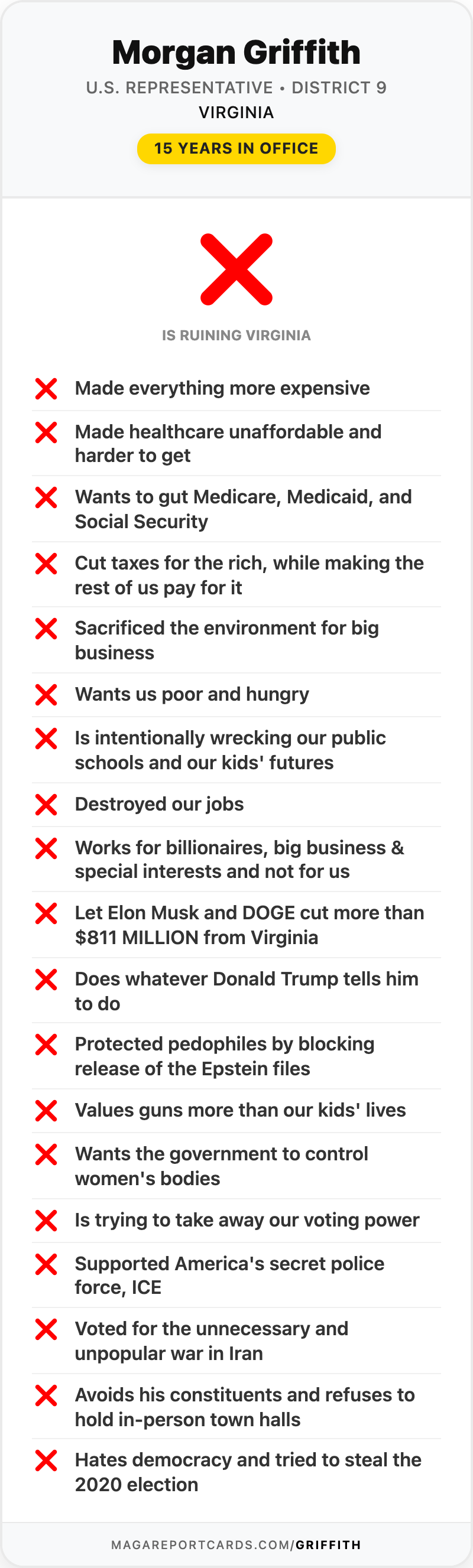
Morgan Griffith chairs the Energy and Commerce Subcommittee on Health — the panel that writes federal drug-pricing and public-health law.
How the money worked, and why it stopped
The clinics were paid for out of savings from a federal drug-pricing program called 340B.
It works like this: hospitals and clinics that serve a lot of low-income patients can buy prescription drugs at a steep discount, bill insurers the normal rate, and keep the difference. The point of the arrangement is that safety-net providers, who operate on very thin margins, get money they can plow back into their communities.
In Southwest Virginia, that's what it paid for — clinics inside schools.
VCHA CEO Tracy Douglas wrote to Griffith about the shrinking 340B savings. The clinics' operator put a number on it. Southwest Virginia Community Health Systems says the money available for these services "has declined from approximately $2.7 million to $400,000" over the past four years — at the same time demand for care is going up. Its July 15 announcement describes the clinics as suspended for the 2026–2027 academic year; both affected school superintendents told WJHL they are looking for another provider for the year after that.
Douglas's summary of the situation:
"Because of the drama around the effectiveness of the program, we're forced to have to make tough decisions."
Demand is rising for a reason the Mercury spelled out. Enhanced Affordable Care Act subsidies have expired, and the budget bill Congress passed last summer changed Medicaid and hospital funding. As people lose coverage, they show up at the clinics that are left — the FQHCs, the free clinics, and the emergency rooms.
So the safety net is being asked to catch more people at the exact moment its funding is shrinking. Eight school clinics are what fell through first.
What the chairman of the health subcommittee actually did
Griffith did not just watch this happen from Washington. He voted for the bill.
On July 3, 2025, he voted for the One Big Beautiful Bill Act — the "Aye" is on the roll call — which cut Medicaid and hospital funding. He was also among the 197 Republicans who voted to let the enhanced ACA premium subsidies lapse rather than extend them.
Both of those decisions are upstream of the letter that landed on his desk in July.
And this is not the first warning he's had about health care in his own district. Three hospitals in Southwest Virginia — Dickenson Community Hospital, Buchanan County General Hospital and Tazewell Community Hospital — have been flagged as at risk of closure because of the same Medicaid cuts.
That is a subcommittee chairman with three hospitals on a closure watchlist and eight school clinics already gone, in the district he represents, from bills he voted for.
What "the drama around 340B" means
Douglas's phrase is diplomatic. Here's the plainer version.
340B is under attack from several directions at once. The Trump administration is pursuing regulatory changes to scale the program back. Sen. Bill Cassidy has released draft legislation that FQHCs say could hurt them by changing reimbursement timelines. Large pharmaceutical companies, pharmacies, hospital systems and smaller clinics are all offering competing views on how the program should be changed.
Drug pricing policy is Energy and Commerce's jurisdiction. The Health Subcommittee is where the House writes it. Griffith holds the gavel.
He is, in other words, one of the few people in the country positioned to settle the uncertainty that Douglas says forced the closures — either by protecting the savings small clinics depend on or by telling them plainly that he won't.
Who else has his ear
It's worth knowing which side of the 340B fight funds his campaigns.
According to FEC-derived contribution data compiled by Who Bought My Rep, which counts money raised from 2020 onward, Griffith has taken $40,000 from the Alliance for Pharmacy Compounding's PAC and $35,000 from the National Community Pharmacists Association's PAC — both with direct stakes in drug pricing policy before his subcommittee. He has also taken $40,000 from Altria's PAC and $30,000 from Reynolds American's PAC, the two largest tobacco companies regulated by his committee.
Overall, 68% of his campaign money comes from PACs — about $2.8 million of the $4.2 million his campaign has taken in over that period. Small grassroots donors account for roughly 3%, ranking him 381st out of 440 House members for grassroots support.
The community health centers that wrote him a letter do not have a PAC on that list.
Nobody can ask him about it in person
There is no in-person meeting where a parent from Chilhowie or Saltville can ask Griffith what happens to their kid's clinic. He calls in-person town halls "inefficient" and hasn't held one in more than a decade. When constituents organized their own in April 2025, they left a chair empty for him.
Griffith is on the ballot in November against Democrat Joy Powers, who won the primary on August 4. Eight clinics closed a month ago. The letter asking him to intervene is a matter of public record.
Source
Reported by Charlotte Rene Woods for the Virginia Mercury: Eight school-based health clinics close in Southwest Virginia as federal funding pressures mount (July 10, 2026). Photo: Charlotte Rene Woods / Virginia Mercury.