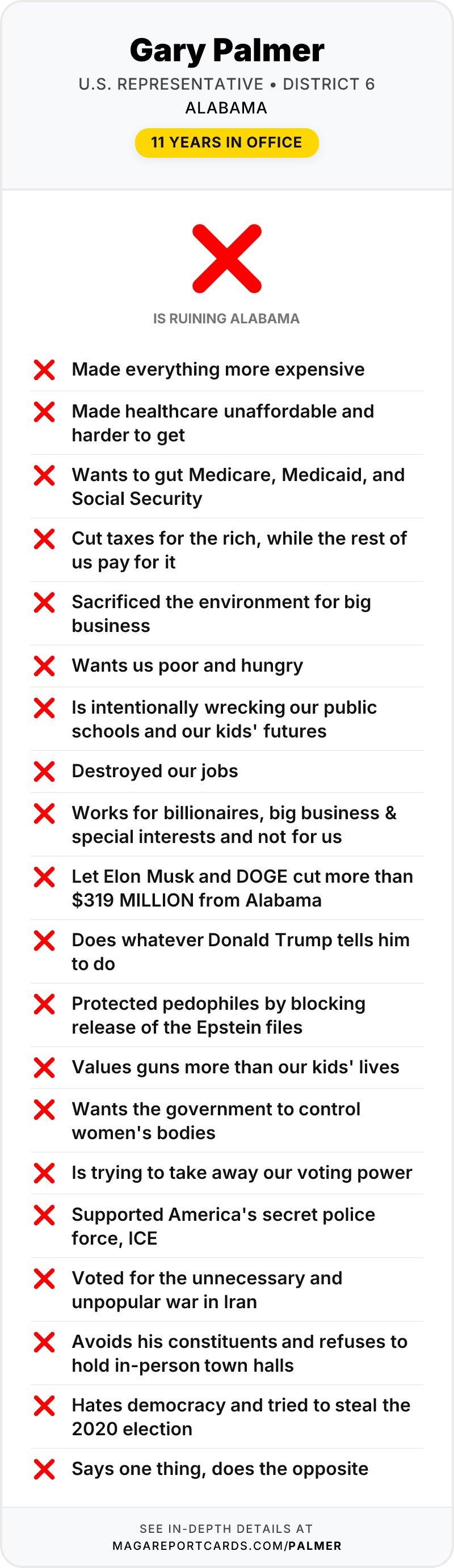
On August 6, 2026, the Government Accountability Office — the nonpartisan watchdog that works for Congress — published its review of the Department of Government Efficiency's public list of taxpayer savings.
Then go back seventeen months and read what Alabama's Gary Palmer said about that same operation.
What Palmer said
In a March 2025 congressional hearing, Palmer defended DOGE against criticism in these words:
"I know there's a lot of consternation about what they're doing, but literally, he's brought in some some computer experts with 21st century technology and done better oversight of the federal government in the last six weeks and we've done the last 40 years."
Better oversight in six weeks than Congress managed in four decades.
And Palmer went further. He laid out an actual theory of the problem: 16 agencies reported $162 billion in improper payments in fiscal year 2024, and roughly 54 to 55% of the improper-payment problem is administrative error, caused by "failure to verify eligibility and antiquated data systems." His prescription:
"So what we need to do is focus on stopping it on the front end. And that's where we need the improvements in technology, where we need the investment in technology."
Hold onto that standard — failure to verify is the disease, better data is the cure. Palmer said it himself.
What the GAO found
Now apply Palmer's own standard to DOGE. The GAO's findings, as reported by CBS News:
- For grants, DOGE "did not provide sufficient information to verify the method used to calculate 96 percent of DOGE-reported savings."
- For contracts, DOGE failed to use its own stated methodology for the "majority of savings associated with the contracts reported as terminated."
- 108 of the 264 leases DOGE claimed credit for terminating were already being eliminated before DOGE existed.
- DOGE claimed $1.7 billion in savings on a Defense Health Agency IT contract that was never actually terminated or defunded.
- Its public savings page "does not sufficiently disclose limitations affecting data quality."
- And DOGE "did not respond to GAO's request for information or interviews."
The man who told Congress the problem was a failure to verify was cheering an operation whose numbers Congress's auditors could not verify — and that, when Congress's auditors came asking, wouldn't answer the door.
He didn't just praise it. He tried to make it permanent.
Palmer was one of the first members of Congress to join the House DOGE Caucus, according to a 1819 News story his office reposts on its own website.
And when Elon Musk left the government at the end of May 2025, Palmer moved to institutionalize the project. On June 4, 2025, Chip Roy of Texas introduced H.R. 3733, the Make DOGE Permanent Act — a bill to give members of Congress real-time access to federal spending data, including payments to individual aid recipients and federal employees. Palmer signed on the same day, as an original cosponsor.
The bill was referred to the House Oversight and Government Reform Committee on June 4, 2025. That is the last thing that has happened to it in more than a year.
And he voted for the actual cuts. Twice.
Praise is cheap. Palmer's votes weren't.
He voted Yea on H.R. 4, the Rescissions Act of 2025 on June 12, 2025 — the bill that cancelled $9.4 billion Congress had already approved for foreign aid and public broadcasting. When the Senate sent back a narrower version, he voted Aye again on July 18 to finish the job.
So the sequence is: praise the operation, cosponsor the bill to make it permanent, vote twice to lock in the cuts — and then, when the GAO reports the numbers behind it couldn't be verified, issue no statement.
What it cost his own district
Palmer represents Alabama's 6th District. He is not a spectator to what these cuts do.
Democrats on the Joint Economic Committee estimate that 19,869 people in AL-06 will lose health coverage by 2034 — 18,200 losing Affordable Care Act coverage, and 1,669 losing Medicaid under the cuts in Trump's budget bill, which Palmer voted for. And 22,024 households in his district — about 8% of them — rely on SNAP for food, including 12,136 households with children and 6,774 with someone 60 or older, according to USDA data.
That's the ledger Palmer never audits: real coverage and real groceries on one side, and on the other, savings figures the GAO says can't be checked.
None of those constituents get to ask him about it in a public forum, either. Palmer has said he won't hold a town hall — the crowds, he said, "are not constituents, most of them. They bring in paid agitators." His office offers a monthly pastries-and-coffee meet-and-greet in Washington.
He's not the only one who vouched for it
Texas's Beth Van Duyne wrote an op-ed titled "Embracing the Golden Age of DOGE" and a bill to give outside auditors a permanent role in choosing what to close. Arizona's Eli Crane moved to impeach the judge who blocked DOGE from Americans' Treasury records, and got a maximum campaign check from Musk weeks later.
Palmer's version is the one with the cleanest contradiction, because he stated the test himself. Verification matters. Data quality matters. Stopping problems on the front end matters.
DOGE failed every one of those tests, and the man who wrote them has issued no statement about it. Alabama's 6th District votes in a special Republican primary on August 11.
We deserve better.
Sources
"DOGE's 'wall of receipts' riddled with inaccuracies and unsubstantiated claims, congressional watchdog says" — Kathryn Watson, CBS News, August 6, 2026 (linked above). Palmer's March 2025 remarks: Yellowhammer News (linked above). Official portrait via Wikimedia Commons.