Here is the sequence, in order.
February 8, 2025. A federal judge in New York issues an order keeping Elon Musk's DOGE team out of the Treasury Department's payment and data systems — the systems that hold Americans' personal financial records. More than a dozen state attorneys general had sued, arguing that handing an outside team unilateral access to those systems risked exposing confidential information and leaving it open to hackers. Judge Paul Engelmayer agreed the states were likely to win, finding they had shown a likelihood of success on claims that the effort broke federal law and violated the separation of powers.
Ten days later. Eli Crane, the Republican congressman from Arizona's 2nd District, publishes articles of impeachment against Engelmayer and announces on X that he'll file them Friday.
Musk replies to him with a single word: "Good."
One month later. Musk sends Crane $5,800 — $3,500 of it the most a person could legally give toward his primary, the rest toward the general.
That's the whole story. A judge ruled against Musk's team. A congressman moved to throw the judge off the federal bench. The billionaire cheered, and then paid him.
What the judge actually did
It's worth being clear about the "high crime" here, because there wasn't one.
Engelmayer issued a temporary order. That's it. Not a final ruling — a pause, while a court sorted out whether an unvetted team of outside staffers should have unrestricted access to the pipes that carry Social Security checks, tax refunds, and veterans' benefits.
And Engelmayer is not some partisan warrior. The Senate confirmed him to the bench in 2011 by a vote of 98 to 0. Not a single Republican bothered to show up to his Judiciary Committee confirmation hearing, because there was nothing to fight about.
Carl Tobias, a law professor at the University of Richmond, told Courthouse News what every first-year law student knows: "Allegedly incorrect decisions are not grounds for impeachment." In the entire history of the United States, federal judges have been impeached 15 times, and only eight of those ended in conviction. It is reserved for corruption and crime — not for rulings a congressman dislikes.
Even the Chief Justice of the United States said so out loud. In March 2025, as Republicans and Trump called for impeaching another judge, John Roberts issued a rare public statement: "For more than two centuries, it has been established that impeachment is not an appropriate response to disagreement concerning a judicial decision." He noted that the appeals process exists for exactly that purpose.
Crane filed anyway.
The money
In March 2025, The New York Times reported that Musk had given "what had been until recently the legal maximum hard-dollar donation — $6,600" to seven Republicans who had backed impeaching judges or demanded "action" against them — Crane, Lauren Boebert, Andy Ogles, Andrew Clyde, Derrick Van Orden, Brandon Gill, and Sen. Chuck Grassley. Crane's campaign reported $5,800 from Musk on March 19 — $3,500 to the primary, the most an individual could give for that election, and $2,300 toward the general.
Others on that list were aimed at a different judge. Gill had introduced articles of impeachment against Judge James Boasberg, who'd blocked Trump's use of a 1798 law to deport Venezuelans; Boebert said she supported them. Grassley hadn't called for impeaching Boasberg — he'd condemned the deportation ruling and said the Senate Judiciary Committee was "taking action."
Crane's target was closer to home. The judge he moved to impeach had ruled directly against Musk's own operation — the one that wanted the Treasury data. There is no degree of separation to explain away here. Musk had a specific problem with a specific judge, and Crane volunteered to remove that judge from the bench. (Wisconsin's Derrick Van Orden, another of the seven, filed his own articles against Engelmayer the same week.)
In an interview shortly after he learned of the donation, Crane's answer was this:
"We didn't do it so Elon Musk would give us a campaign donation. But I think it's great that individuals like Elon are throwing support behind those of us willing to take action."
Read that twice. The defense isn't that the money is unconnected to the impeachment — it's that the money came after, and he's glad to have it. That is not a denial. That's a description of the arrangement.
The Times also noted a detail worth holding onto: Democrats consider Crane vulnerable in his 2026 re-election campaign.
This is a pattern, and Crane is at the front of it
Attacking judges who rule the wrong way has become routine on the right, and we've documented how far it goes.
Tennessee's Andy Ogles — one of the same seven who took Musk's $6,600 — is still at it in 2026, filing to impeach a judge who paused the removal of legal status from about 1,100 Somali immigrants, on a legal theory his own citation contradicts. Florida's Greg Steube managed to file articles of impeachment against a judge who had already died.
These stunts are funny until you notice what they're for. Courts are the one part of the government a president can't order around. Impeachment threats are a way of telling every other federal judge what happens if they rule against this administration. That's the point of doing it loudly and repeatedly, and it's why it doesn't matter much to the people filing whether any of it ever passes.
Crane isn't a bystander to that project. He's a builder of it. He's also an original cosponsor of the "Make DOGE Permanent Act" — a bill to write Musk's operation permanently into the federal government.
Which is a curious thing to have signed, given how the story ended. DOGE's charter expired on July 4, 2026 with no final report, no accounting, and nobody in the White House willing to say whether it had formally folded. It promised $2 trillion in savings. It claimed $215 billion, a number its own website stopped updating. Musk himself was long gone.
What this costs Arizona
It is easy to file this under Washington theater. It isn't.
The state attorneys general who sued weren't making an abstract argument about the separation of powers. They were arguing something concrete: that the confidential information sitting inside the federal government's payment systems shouldn't be handed to an outside team on somebody's say-so, and that opening those systems up made them easier to hack. Every Arizonan who has ever been paid by, or paid, the federal government has records in there.
A judge agreed that argument was likely to win. Crane's response was to try to end that judge's career, and to accept the maximum legal check from the billionaire who benefited.
Courthouse News noted at the time that it was unclear whether the impeachment push had the political momentum to clear the bar the Constitution sets. But removing Engelmayer was never really the measure of whether it worked.
He has never had to answer for it in a room full of his own constituents, because he doesn't hold in-person town halls.
We deserve better.
Source
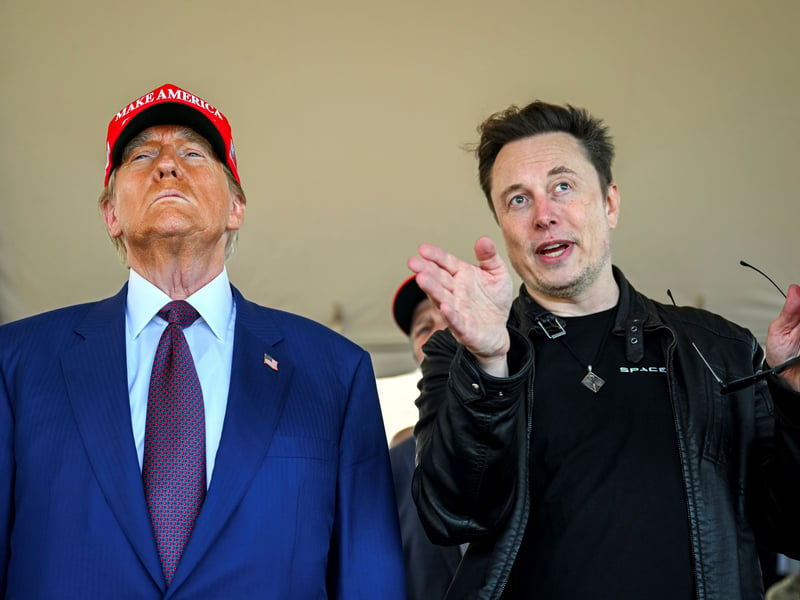
GOP lawmaker moves to impeach judge who blocked DOGE from Treasury data — Benjamin S. Weiss, Courthouse News Service, February 19, 2025. Photo: Brandon Bell/Pool via AP.