In October, Claudia Tenney debated her Democratic challenger, Alissa Ellman, on live TV. The debate aired on News 8 WROC in Rochester and was streamed on Nexstar's New York stations.
When the subject turned to prices, Tenney told voters in New York's 24th District that things were getting better. According to the Lockport Journal's write-up of the debate, she said:
"Right now inflation is at a 50-year low; it's actually less than 3%. We've actually brought costs down in many cases."
Then she blamed gas prices on the last president: "under Joe Biden, he shut off the Keystone Pipeline, they shut down our oil and gas refineries."
We checked each of those claims against the government's own numbers. None of them holds up.
Inflation is not under 3%. It hasn't been since March.
The government agency that measures inflation is the Bureau of Labor Statistics. On October 14, it put out its report for September 2026. Prices were up 3.7% over the past year. The month before, the number was 3.4%.
That is not "less than 3%." And it's going the wrong way. The bureau's own report says 3.7% was a bigger increase than the 3.4% for the year ending in August.
The bureau's monthly data show inflation has been above 3% in every month since March 2026, the first full month after the Iran war began. In May it hit 4.2%.
It is also not a "50-year low." It's not even a low for this decade:
- In May 2020, the bureau reported prices were up just 0.1% over the year.
- In January 2025 — Joe Biden's last month in office — the number was 3.0%.
So inflation today is higher than it was the month Biden left. Tenney told voters the opposite.
"We've actually brought costs down"
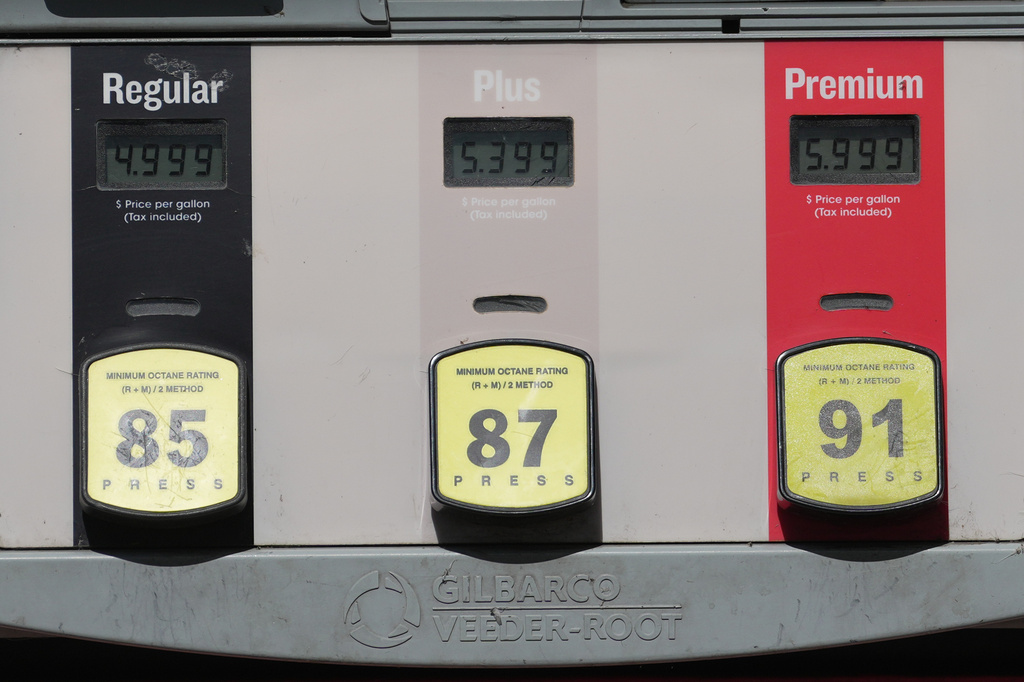
Look at what drove that 3.7%. The September report says the price of gasoline jumped 9.1% in a single month, and that gas alone was more than half of that month's rise in prices.
Over the full year, the same report shows:
- Gasoline: up 34.2%
- Fuel oil: up 74.2%
- Energy overall: up 20.4%
The Energy Department's own price tracker tells the same story. In the week of October 19, 2026, the average price of a gallon of regular gas was $4.28. A year earlier it was $3.02. Before the Iran war started, in the last week of February, it was $2.94.
Diesel was worse: $6.28 a gallon that week, up from $3.62 a year earlier and $3.81 before the war. In late September it hit $6.53.
Ellman made this point in the debate. She said a farmer in the district needs diesel "that's now $6 a gallon," and that gas is "over $4.50." The government's figures back her up on diesel. Gas peaked at $4.50 in May and has been above $4 every week since July 20.
That's a 73% jump in diesel in one year, in a district that stretches across 14 mostly rural counties from the North Country through the Finger Lakes.
Tenney voted six times to keep the war going
Ellman said in the debate that "the fuel prices are skyrocketing" because of the war in Iran, and called it "a self-inflicted wound."
Tenney had six chances to vote for a resolution telling the president to end it. She voted no every time:
- March 5, 2026 — H. Con. Res. 38
- April 16, 2026 — H. Con. Res. 40, which failed by one vote
- May 14, 2026 — H. Con. Res. 75, which failed on a tie
- June 3, 2026 — H. Con. Res. 86
- July 23, 2026 — H. Con. Res. 89
- September 15, 2026 — H. Con. Res. 93
Each one directed the president, in its text, to remove U.S. forces from hostilities with Iran. None of them could have ended the war on its own — a concurrent resolution never goes to the president — but each was the House saying so. Two of them came one vote from passing — and Tenney was one of the Republicans who could have tipped either one.
She isn't the only Republican who voted to keep the war going and then complained about the prices it caused. Rick Crawford did the same thing. But Tenney went further. She told voters prices were coming down.
Biden didn't shut down our refineries
Tenney blamed high gas prices on Biden: "they shut down our oil and gas refineries."
The Energy Department's statistics office tells a different story. In June 2026, it reported that U.S. refining capacity went down during 2025. Here is when the big refineries it named stopped working:
- LyondellBasell, Houston — ended refining in March 2025
- Phillips 66, Los Angeles — ceased operations in October 2025
- Valero, Benicia, California — stopped refining, and was taken out of the government's monthly capacity count as of March 2026
All three stopped refining after Trump took office in January 2025, not while Biden was president.
As for Keystone: on his first day in office in 2021, Biden canceled the permit for the Keystone XL — a pipeline that was still under construction. You can't shut off a pipeline that was never finished.
What Ellman said about her — and what checks out
Ellman opened the debate by saying Tenney voted to "defund rural hospitals, to slash SNAP," and "voted against the PACT Act that treated my own cancer."
Ellman is an Army veteran who served in Afghanistan. The PACT Act is the 2022 law that expanded VA health care and benefits for veterans exposed to burn pits and other toxins.
We checked the House records. Ellman is right. Tenney voted no on the PACT Act in March 2022, and no again in July 2022, when it passed the House 342 to 88. She was one of the 88. Idaho's Jim Risch is another Republican who voted against the burn pits law over and over.
The hospital and SNAP charges are about Trump's budget bill. Tenney voted for it when it first passed the House in May 2025 and again for the final version on July 3, 2025. Democrats on Congress's Joint Economic Committee estimate its Medicaid cuts will cost more than 32,000 people in her district their insurance — an estimate the committee says may not exactly match New York's redrawn district lines. More than 43,000 households in her district rely on SNAP to buy groceries.
What the numbers show
In her October debate, Claudia Tenney said inflation was at a 50-year low and under 3%. The government's latest report said 3.7%, and it has been over 3% every month since the Iran war began. She said Republicans brought costs down while gasoline prices were up 34% and diesel 73% from a year earlier — after she voted six times against resolutions to end the war that drove those prices up. And she blamed Biden for refinery shutdowns, when the closures the government lists all happened after Trump took office.