For twenty years, Mike Rogers (MI) has been telling Americans that Iran was building a nuclear bomb. For most of those twenty years, America's own spy agencies were telling Congress it wasn't.
On August 27, 2026, Jacobin published a review of Rogers's entire public record on Iran, going back to when George W. Bush was still president. It is not a flattering picture. Michigan's Republican candidate for U.S. Senate spent two decades hyping a threat the intelligence community kept knocking down, attacking every attempt at a deal, and pushing for exactly the war we are now in — the one currently showing up in Michigan gas tanks.
He is not shy about it. Since Trump launched the war six months ago, Rogers has called Iran "an imminent threat to our country," said the war was "absolutely right" and "a win-win-win for us," and told the Detroit News that "we are better off today than we were when it started."
Last summer, after Trump's first round of strikes, Rogers told Jewish Insider: "I couldn't have supported [the operation] more. I was for all of this when it wasn't very cool to be for all of this."
That part is true. Here is what the record actually shows.
2006: the report the U.N. called "outrageous and dishonest"
Rogers sat on the House intelligence committee whose staff produced a report in August 2006 declaring that "Iran is seeking nuclear weapons." It said Iran could have a bomb "sometime in the beginning to the middle of the next decade," and that Iran "probably" had a biological weapons program.
The International Atomic Energy Agency — the U.N. inspectors who were actually on the ground in Iran — wrote to the committee to knock it down. The agency objected to the report's claim that Iran "is currently enriching uranium to weapons grade," saying Iran had produced material "only in small quantities that is far below the level that can be used in nuclear arms." And it called the report's suggestion that an inspector had been removed for telling the truth about Iran "an outrageous and dishonest suggestion."
Rogers did not back down much. Asked about the weapons-grade claim, he told CNN the report was "very clear": "It says that we don't believe that they've gotten there. But the point of that whole section is, they are trying to enrich uranium to weapons grade." On the accusation that U.N. inspectors were covering for Tehran, he stood by it flat out.
So the inspectors said the report was wrong. Rogers said the report was fine.
2007: America's own spy agencies said the opposite
Fifteen months after that report, every U.S. intelligence agency put out a National Intelligence Estimate saying the reverse. They concluded with "high confidence" that Iran had halted its nuclear weapons program in 2003 — years before his committee's report told the country it was racing for a bomb.
That assessment has held up. In early 2011, the Director of National Intelligence told Congress that the intelligence community did not know if Iran eventually would decide to build nuclear weapons, and that it was not clear Tehran would decide to do so. And in March 2025, Trump's own Director of National Intelligence testified that "the IC continues to assess that Iran is not building a nuclear weapon and Supreme Leader Khamenei has not authorized the nuclear weapons program that he suspended in 2003."
Rogers said it anyway. By Jacobin's count, he publicly claimed Iran had, was pursuing, or was close to a nuclear weapon dozens of times between 2006 and 2026 — on the intelligence committee, later as its chairman, and then for another decade on television. In 2012, a year after that briefing, he told CNN "we know that [Iran is] aggressively pursuing a nuclear weapon program." In 2013 he told CNN "everybody agrees" Iran was doing it. In 2023 he claimed Iran had "helped plan" the October 7 attack, a claim Israel's own military said it had no evidence for.
And last summer, he told Jewish Insider that on the day Trump attacked, Iran "had all three components" of a nuclear weapon — "they just didn't have them assembled." His own party's DNI had testified to the opposite three months earlier.
He took Netanyahu's side against two American presidents
In 2012, Israeli Prime Minister Benjamin Netanyahu ran a public pressure campaign to get President Obama to attack Iran, and threatened to go it alone. Obama refused and pushed for talks instead. Rogers spent that year criticizing him for it.
"I believe that if this is going to work we have to have a credible military option," Rogers told CNN in March 2012. "We can't say all options on the table, oh, by the way, Israel, we don't want you to do anything. That's not very credible."
He went further than that. He said on NPR that the United States and Israel have a defense pact under which "we will defend them if attacked under any circumstances." There is no such treaty. Rogers, the sitting chairman of the House Intelligence Committee, was telling the public America was legally bound to fight a war Israel might start.
Three years later, when Netanyahu came to Congress to attack Obama's Iran deal in a speech many in both countries saw as raw foreign interference, Rogers cowrote a Politico op-ed defending it. He accused Obama of trying "to hobble the prime minister," and called Netanyahu's speech "the act of a true and courageous friend."
The terrorist group he helped get off the terror list
There is one more thing in Rogers's Iran file. In 2012, a Guardian investigation into the campaign to delist the Mojahedin-e-Khalq — a group of Iranian exiles pushing for regime change, and at that time a U.S.-designated terrorist organization — found that Rogers "has also received the backing of individuals and groups that support the unbanning of the MEK," and that he "has been among the strongest supporters in Congress of delisting the group, sponsoring resolutions and pressing other members of Congress to support the cause."
The MEK was on that list because it had been responsible for the deaths of Americans. Killing Americans is the exact thing Rogers has spent twenty years saying justifies going to war with Iran.
He fought the deal, then changed his story about it
When Obama reached the interim agreement that became the Iran nuclear deal, Rogers went after it hard. "We've taken away the one thing that brought them to the table," he said on CNN in November 2013. "We have just rewarded very bad and dangerous behavior." He kept it up on Twitter for years after leaving Congress, and he demanded Iran be allowed zero enrichment — a condition Iran hawks have long used to make a deal impossible.
While the deal was in force, Iran's stockpile of enriched uranium shrank to almost nothing. Trump pulled out in 2018, and it grew back. According to Jacobin's review, Rogers claimed on CNN the following summer that he had opposed that unilateral withdrawal. But in a September 2022 op-ed in The Hill, he wrote that the deal was "an agreement that should never have been made in the first place and withdrawing from it made sense, even if the way in which it was handled left much to be desired." His objection, in other words, was the manner — never the result.
The result is the part Michiganders should care about. Pulling out of that deal is what let Iran's uranium stockpile build back up, and that buildup is the thing Rogers now cites to justify the war.
Rogers is not the only Republican whose Iran positions move with whoever is in the White House — Arkansas's senator spent a decade attacking an Iran deal and went quiet the moment Trump signed one. And he is running in a race where an outside group is weighing tens of millions of dollars to put him in the Senate.
What it is costing Michigan right now
This is not a foreign policy debate anymore. It is a bill.
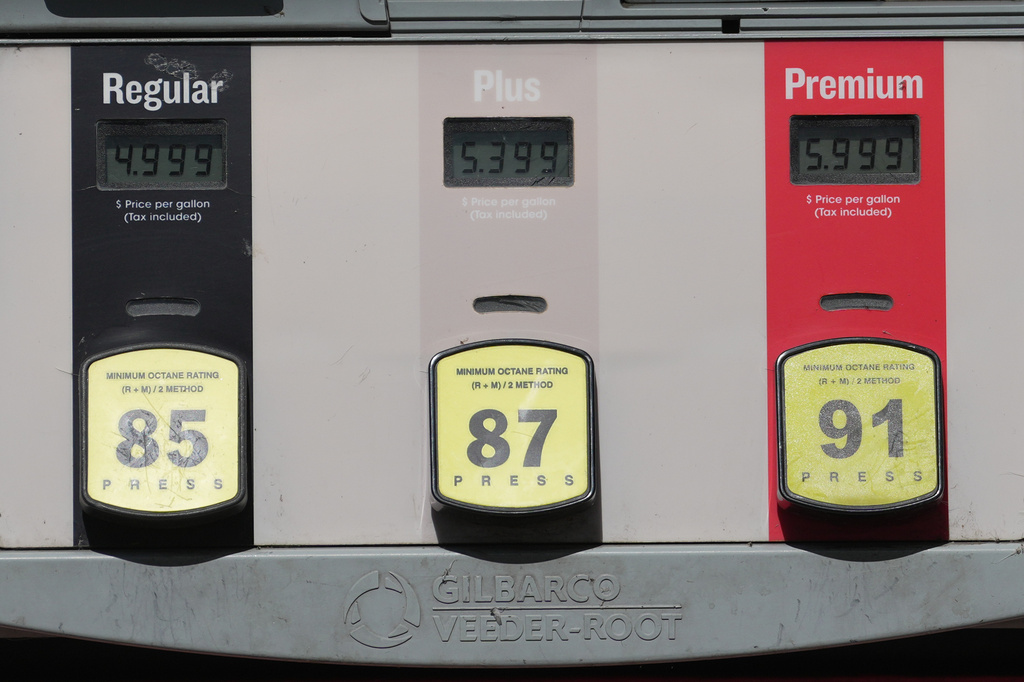
In late March, with the war in its fourth week, Michigan drivers were paying $3.92 a gallon, the highest since August 2023 and up $1.07 in a single month. By late June the state average was about $4.11 a gallon, roughly a third higher than a year earlier — and that same outlet, adding up Pentagon spending estimates, consumer energy costs and Michigan's share of the population, estimated the state's slice of the war's economic hit could top $2 billion. A mid-Michigan farmer said nitrogen fertilizer was "up 40 percent" since the war began.
When an attendee at a March campaign stop raised gas prices with him, Rogers waved it off: "We're gonna be fine, we got plenty of oil." He went on: "You'll get your oil, because we're going to pump our oil right here in America, and we got plenty."
Talking to a local reporter earlier this year, he was a little more honest. The war, he allowed, "brought some costs that are hard to live with, you know, when you're trying to pay your higher electric rate that's gone up the last eight years." Jacobin reports he said it with a chuckle.
Meanwhile Congress still has not voted on any of this. Trump's team argues it does not have to, and House Republicans have been happy to agree. Rogers has said he "doesn't mind" the idea of Congress formally authorizing the war so Trump can keep it going. He is asking Michigan to send him to the chamber that would cast that vote.
What the record shows
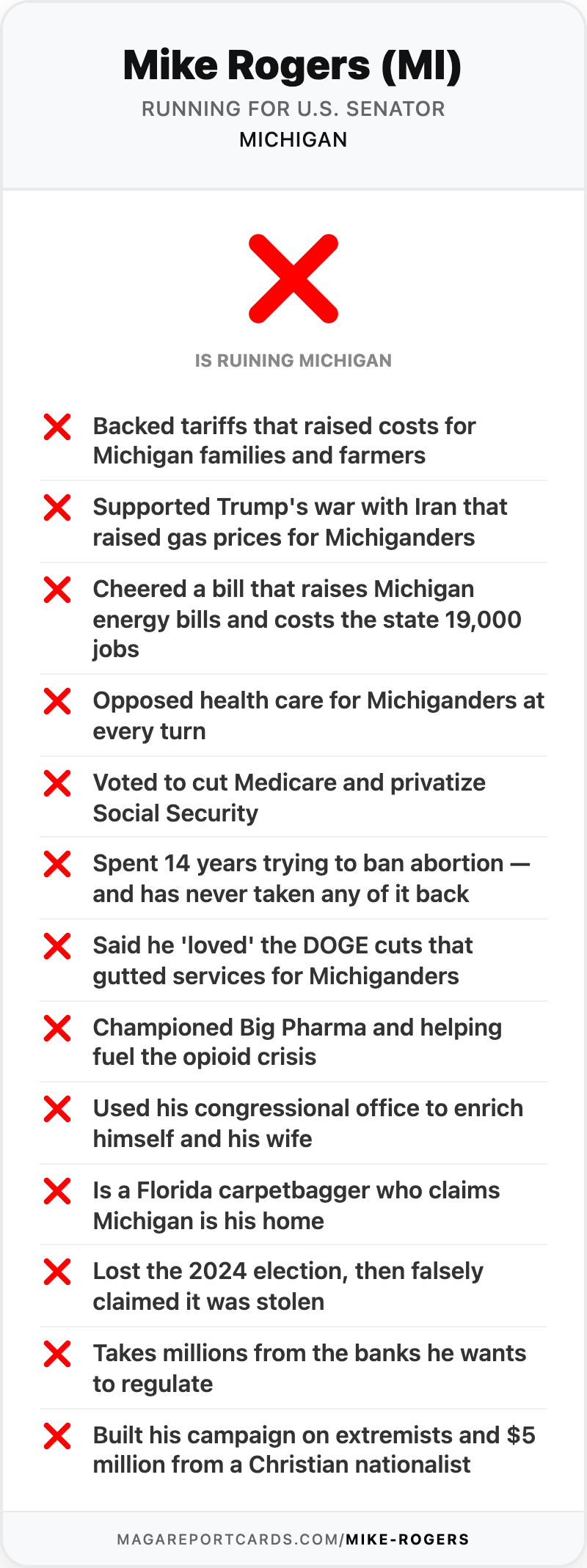
For twenty years Mike Rogers (MI) pushed for war with Iran on a claim U.S. intelligence contradicted in 2007 and again in March 2025 — that Iran was building a nuclear weapon. U.N. inspectors called part of his committee's 2006 case "outrageous and dishonest," and he stood by it. He spent years attacking the deal that shrank Iran's uranium stockpile to nothing, and later wrote that withdrawing from it "made sense." The war he wanted started in February. Michigan gas ran about $4.11 a gallon by late June, roughly a third more than a year earlier, one estimate says the state's share of the cost could top $2 billion, and when an attendee raised the prices with Rogers he said, "We're gonna be fine."
Source
Mike Rogers Pushed for War With Iran for Two Decades — Branko Marcetic, Jacobin, August 27, 2026.