For decades, veterans came home from Iraq and Afghanistan sick from burning trash pits the military lit on their own bases — pits full of plastic, batteries, medical waste and jet fuel. Vietnam veterans came home sick from Agent Orange. When they filed for care, the VA told them to prove the illness came from the service.
The PACT Act ended that. It says that if you served near those hazards and you got one of the listed illnesses, the VA presumes it's connected. You get care. You stop fighting your own government while you're dying.
It passed the Senate 86 to 11.
Jim Risch was one of the 11.
And that final vote was not a one-time slip. Risch voted against the PACT Act on five separate roll calls over two months — both times it passed the Senate, and on all three votes to cut off debate on it.
The five votes
Every one of these is a public record on senate.gov. Every one of them is a Nay from Idaho's junior senator.
| Date | Vote | Result | Risch |
|---|---|---|---|
| June 13, 2022 | Cloture on the PACT Act amendment | 78–17 | Nay |
| June 15, 2022 | Cloture on the bill itself | 76–23 | Nay |
| June 16, 2022 | Passage of H.R. 3967, as amended | 84–14 | Nay |
| July 27, 2022 | Cloture — the vote that blocked it | 55–42, failed | Nay |
| August 2, 2022 | Final passage | 86–11 | Nay |
In between, on August 2, he twice voted for alternative versions that would have changed the bill and kicked it back to the House instead of sending it to the president's desk. Both failed. Then he voted no on the real thing.
He did vote yes twice early on: on June 7, to start debate, and on June 15, to adopt the PACT Act's text as an amendment. Every vote after that which would have moved the bill toward becoming law, Jim Risch voted no.
The July 27 vote is the one people remember
The bill had already passed the Senate in June. It came back for a routine final vote after a technical fix — the kind of vote that is usually a formality.
Then 41 Senate Republicans blocked it. Cloture needed 60. It got 55.
Veterans and their families had come to Capitol Hill to celebrate. What they got instead was the bill dying on the floor, and some senators celebrating.
Jon Stewart, who had spent years pushing the bill, was outside the Capitol the next day:
"I'm used to the hypocrisy…I'm used to the lies…I'm used to the cowardice…I'm used to all of it, but I am not used to the cruelty."
Later, Task & Purpose asked him about the video of Republican senators fist-bumping after the vote:
"Your stomach drops. I mean, to be honest, the vote itself was a gut punch."
The blockade held for six days. Veterans camped out on the Senate steps around the clock. Then most of the Republicans who blocked it switched.
Risch didn't. On August 2, when the bill finally passed 86 to 11, he was still voting no.
Who this was for
Look at what the law has actually done in his state.
Idaho is home to about 126,000 veterans. Since the PACT Act took effect, veterans living in Idaho have filed more than 11,500 claims under it. More than 9,500 of those had been fully processed as of August 2024, and more than 7,500 were granted.
Seventy-five hundred Idaho veterans got benefits from a law their own senator voted against five times.
Nationally, more than a million veterans and over 10,000 survivors of veterans who died had begun receiving disability benefits under the law by that point — about $6.8 billion in earned benefits.
That is what "no" meant. Not an abstraction about spending levels. Care for people who got sick doing what the country asked them to do.
He is not shy about veterans otherwise
Risch's public record is full of veterans' causes. He introduced a bill in March 2026 to correct veteran burial benefits. His office has put out statements on Veterans Day and Memorial Day.
The gap between that and this is the point. When honoring veterans costs nothing, he is there. When it required a vote that spent money on their health care, he voted no — when it passed in June, when it was blocked in July, and when it finally passed in August.
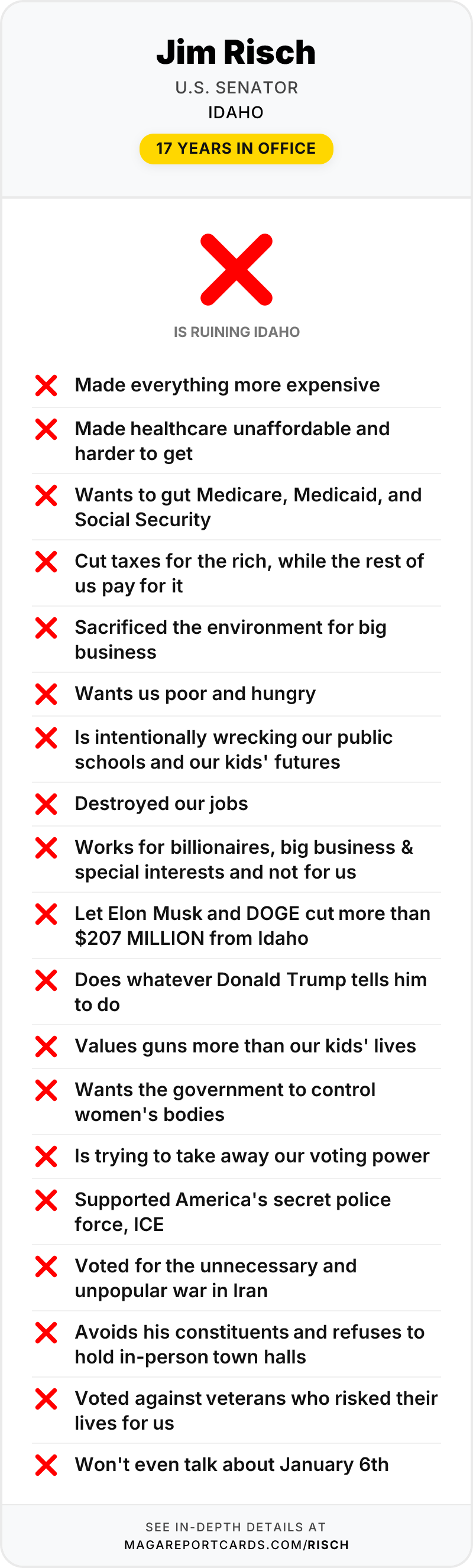
It fits a wider pattern in how he treats the machinery of accountability. As chairman of the Senate Foreign Relations Committee he refused to hold public hearings on the Iran war for more than three months, insisting classified briefings were enough. The common thread is a senator who is comfortable with the parts of the job that happen out of view and reluctant about the parts where he has to put his name on something in public.
As of March 2025, he had not held a public town hall since 2020, by the Idaho Democratic Party's count. So Idaho veterans who want to ask him why he voted against their toxic exposure bill five times have nowhere to do it.
Risch has been in the Senate since 2009. He is on the ballot again this year.
We deserve better.
Sources
- Jon Stewart blasts Senate Republicans for blocking veterans PACT Act — Task & Purpose, August 1, 2022.
- More than 1 million veterans receiving benefits via PACT Act ahead of anniversary — Jennifer Shutt, Idaho Capital Sun, August 9, 2024.
- Roll call votes: U.S. Senate roll call vote index, 117th Congress, 2nd session.