For twenty years, the American military burned its garbage in open pits on bases in Iraq and Afghanistan. Plastic, batteries, paint, medical waste, human waste — doused in jet fuel and set on fire, sometimes a few hundred yards from where troops slept. People came home with cancers and lung diseases. When they filed for care, the VA made them prove, claim by claim, that the smoke had caused it.
The Honoring our PACT Act ended that argument. It says if you served near those hazards and you got one of the listed illnesses, the VA presumes the two are connected. You get treated. You stop fighting your own government while you're sick. The VA calls it "perhaps the largest health care and benefit expansion in VA history," and lists the places that trigger the presumption: Iraq, Afghanistan, Kuwait, Qatar, Saudi Arabia, Syria, Yemen and nine more.
On July 13, 2022, the House passed it. The vote was 342 to 88. 123 Republicans voted yes.
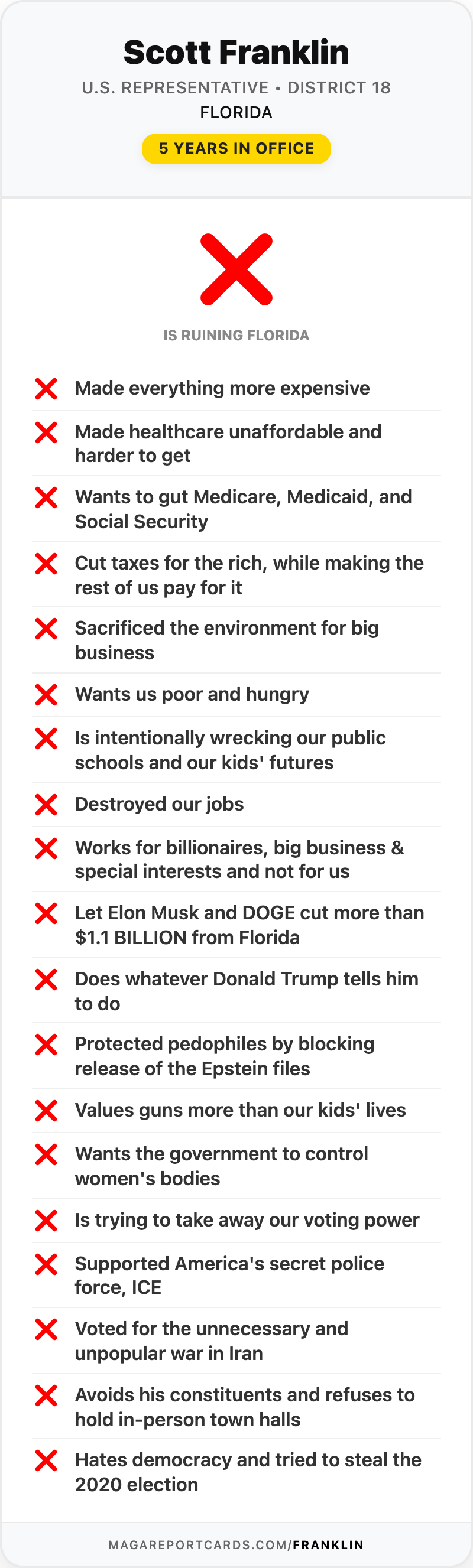
Scott Franklin voted no.
Who was voting
This is the part that's hard to get past.
Franklin's own congressional biography describes a first career as a Naval Aviator who "flew jets from the decks of 13 aircraft carriers during 26 years of service, including 14 years on active duty, followed by 12 years in the reserves." It lists deployments to the Mediterranean, the Persian Gulf and the North Atlantic, and combat operations in the Gulf, Bosnia and Kosovo. And this line: "He was recalled to active duty twice after 9/11 with U.S. Central Command."
Central Command is the combatant command that ran the wars in Iraq and Afghanistan — the same theater on the VA's presumption list.
Franklin came home. Then he voted against the bill that pays for the medical care of the people who came home sicker than he did.
He voted no twice
That July vote was the second one.
On March 3, 2022, the House passed the same legislation in its original form as H.R. 3967. It carried 256 to 174. Franklin voted no then too.
Four months later the House took the same package up again on a different bill number — S. 3373, a Senate-passed shell that had been sitting at the House desk since February and still carried the title "Protecting Our Gold Star Families Education Act" on the House roll call. That was the House's last word on it; the Senate agreed three weeks later, and the bill became law on August 10. Franklin voted no again.
Two chances. Two no votes.
Eleven Florida Republicans voted yes
The March vote split along party lines — 174 Republicans opposed it, only 34 in favor. Nothing distinguishes Franklin there.
July is different. By July, most of his party had moved. Of the 211 Republicans who voted, 123 were for the bill and 88 were against it. Franklin picked the smaller side.
He also picked the smaller side of his own state. Twenty-one members of Florida's House delegation voted yes, including eleven Florida Republicans — Gus Bilirakis, Kat Cammack, Mario Diaz-Balart, Byron Donalds, Matt Gaetz, Carlos Gimenez, Brian Mast, Bill Posey, John Rutherford, Maria Elvira Salazar and Michael Waltz.
Five Florida Republicans voted no: Vern Buchanan, Neal Dunn, Franklin, Greg Steube and Daniel Webster.
Brian Mast, whose official biography describes the improvised explosive device in Afghanistan that cost him both of his legs, voted yes.
The next Congress, he joined the Veterans' Affairs Committee
In the Congress that began six months after that vote, Franklin took a seat on the House Committee on Veterans' Affairs — the committee that writes veterans' health and benefits law. The committee's own membership page from 2023 lists him among its Republican members as "Scott Franklin, FL-18."
He is not on that committee now. He has something more powerful. His committees page lists him as Vice Chairman of the House Appropriations Committee, sitting on its Military Construction and Veterans Affairs subcommittee — the panel that decides how much money the VA actually gets each year.
That includes the Toxic Exposures Fund, the account the PACT Act created to pay for all of this. It runs through the MilCon-VA bill his subcommittee writes; when the committee approved the 2026 version, one of the adopted amendments was specifically about keeping that fund whole.
So the sequence is: vote against creating the benefit, then help decide what it's worth.
What he says about veterans' health care
In February 2025, Franklin reintroduced a bill on veterans' community care with Senator Tommy Tuberville. Here is how he opened his statement:
"Those who bravely served our nation deserve a healthcare system that provides timely access to quality care."
That's his own press release, February 12, 2025.
Nobody would argue with the sentence. The problem is that the expansion the VA itself calls perhaps the largest in its history came up for a vote twice while he was in the room, and he was against it both times.
50,903 people
Florida's 18th District is not a place where this is abstract. Census data counts 50,903 veterans living there — 7.3% of the population, higher than Florida's rate and about 25% above the national rate.
Some of them are the people the PACT Act was written for: the ones who breathed the smoke, got sick years later, and would otherwise be filing paperwork trying to prove a burn pit in Balad gave them a rare cancer.
They have a congressman who flew combat missions, who was recalled to CENTCOM after 9/11, who sits on the subcommittee that funds the VA — and who voted no.
He's not the only one, and that's the point
This wasn't a fluke of one member's judgment. Oregon's Cliff Bentz was the only member of his state's delegation to vote against the PACT Act, twice. In the Senate, Idaho's Jim Risch voted against it at every single stage — five separate roll calls, including the July 2022 blockade that left veterans camped on the Capitol steps.
What's different about Franklin is the résumé, and the seat he holds now.
There is also the question of who gets to ask him about it. In March 2025, more than 100 constituents protested outside his Lakeland office and handed out flyers with his face under the word "MISSING" — because he doesn't hold in-person town halls. He holds telephone ones, which his own office runs.
A veteran in Lakeland with a burn-pit claim cannot walk into a room and ask him why he voted no. That is by design.
We deserve better.
Sources
The votes are public record: Roll Call 57, March 3, 2022 (H.R. 3967, Honoring our PACT Act, 256–174), and Roll Call 309, July 13, 2022 (S. 3373, the Senate vehicle that sent the PACT Act to the president, 342–88). Biography, committee assignments and the February 2025 statement are from Franklin's own House website; his 2023 Veterans' Affairs Committee membership is from the committee's archived roster. Photo: official congressional portrait via Wikimedia Commons.