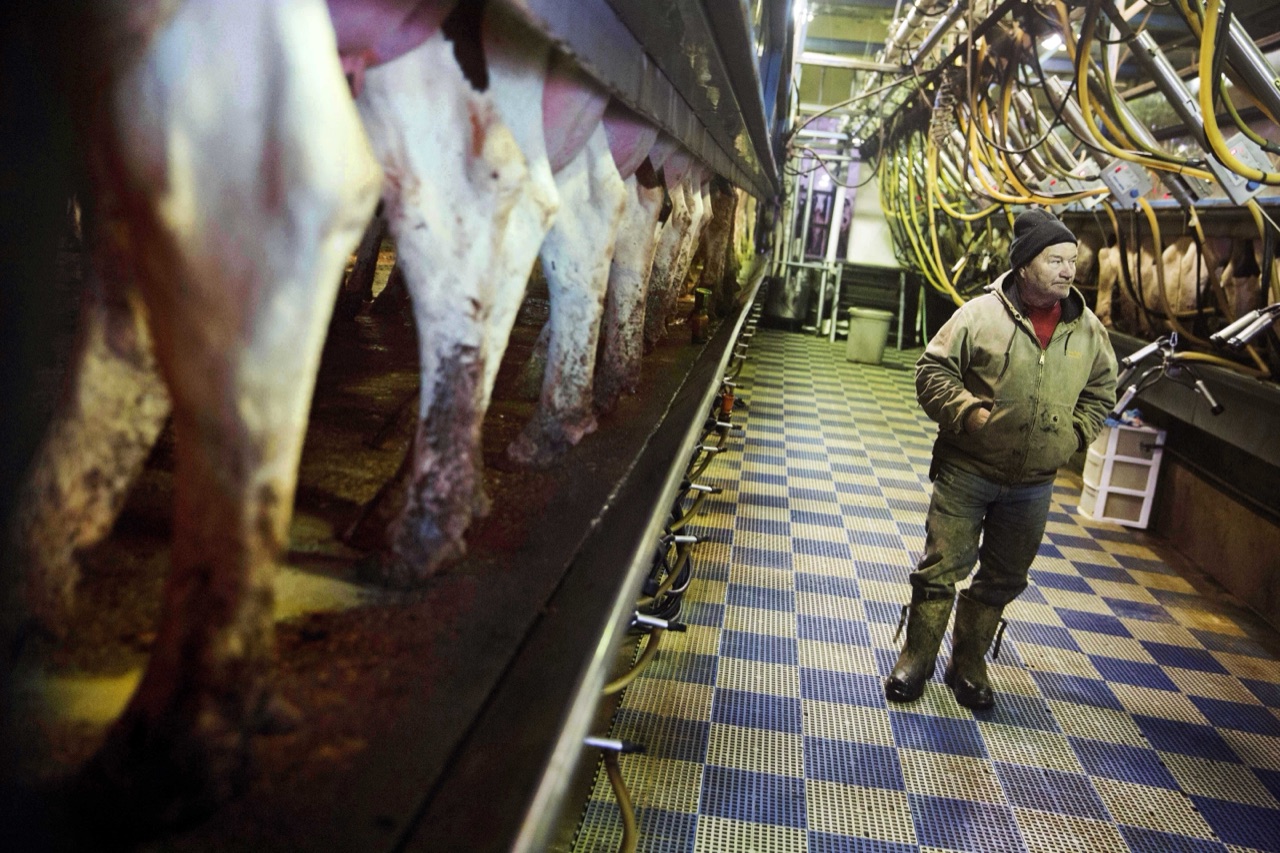
Marlin Stutzman is not a lawyer or a career staffer. He is a fourth-generation farmer from Howe, in the Michiana corner of the state. His House financial disclosure lists a farm business worth between $1 million and $5 million, a farm mortgage he has carried since 2012, and stakes in a meat processor, a truck manufacturer and a lawn-and-garden company. Northeast Indiana sent a farmer to Congress.
So it is worth asking what that farmer has done for Indiana farmers.
$607 million, gone
North Dakota State University published a one-year retrospective on China's retaliatory tariffs in 2026. Indiana's share of the damage, between March 2025 and February 2026:
- $607 million in lost agricultural exports
- $347 million of it in soybeans
- $104 million in corn
Indiana was among the states the report found most affected — ninth on its list, behind Iowa, California and Illinois at roughly $1.2 billion each. Nationally, China's retaliation cut U.S. agricultural exports by about $14.9 billion in that same twelve months.
The Fort Wayne Journal Gazette — the daily paper in Stutzman's own district — ran an editorial on it in June 2026, arguing the administration's trade policy was "hurting America and, especially, its farmers." It quoted Todd Davis, chief economist of the Indiana Farm Bureau:
"Our farmers are looking at the fourth consecutive year of losses, and it's hard to point your finger at one issue. There are a lot of contributing factors."
Four consecutive years of losses. That's not a rough patch. That's a business model coming apart.
What Stutzman said while it was happening
Go back to March 2025, right as the tariffs were landing. Stutzman went on NewsNation to talk about Trump's 25% auto tariffs. He acknowledged "there's some uncertainty," and then said this:
"But my hope is that these other countries will realize that they need us as a partner. But we're also going to look out for the American people and the America-first agenda that President Trump has laid out is really important for us."
"It's just going to take some time. And I would just say that these other countries really should be careful on how they respond to President Trump's tariff discussion and really start partnering with us rather than being adversarial."
He offered his constituents a theory: hold on, other countries will fold.
"We knew it was going to be a little rocky, but I think that in the long run, there's going to be deregulation coming from the Trump administration out of the bureaucracies in Washington. There's going to be tax policy that's going to be beneficial, and, of course, there's going to be energy policy that's going to be very positive for the United States. So there will be some offsets."
"A little rocky." "There will be some offsets."
China did not fold. China bought its soybeans from Brazil. Indiana farmers ate $607 million.
Then the Supreme Court threw the tariffs out — and he wanted them back
In February 2026, the Supreme Court struck down the tariffs Trump had imposed under a 1977 emergency law, ruling the statute never gave a president that power. The government wound up owing roughly $166 billion in refunds — money that went to Apple, Ford, Nike, Amazon and General Motors, the importers who paid it. Not to farmers. Not to anyone who paid more at the grocery store.
Stutzman went on Bloomberg TV the day of the ruling. Bloomberg's own description of the segment: he "discusses the Supreme Court ruling on tariffs and says it is not good for farmers in Indiana, and that he would be happy to help President Trump if Congressional help is needed."
Read that again with the numbers in front of you. Twelve months of trade war had just cost Indiana farmers $607 million in exports China stopped buying. The Court ended the tariffs that set the retaliation off. And Indiana's farmer-congressman's position was that the ruling was bad for Indiana farmers — and that he would be happy to help the president if Congress was needed.
He's not the only one
Other Republicans in farm districts are running the same script. Minnesota's Brad Finstad spent ten months calling the damage "short term". Michelle Fischbach got booed at Farmfest defending tariffs the Supreme Court had already thrown out. Michigan's John Moolenaar, who chairs the House China committee, wrote a bill to put tariffs of 35% to 100% on Chinese goods while his own state's soybean growers entered year three of losses.
What makes Stutzman's version different is that he farms. He knows what a fourth consecutive losing year does to a balance sheet, because he keeps one.
The rest of the bill
The trade war is not the only thing Stutzman has voted to send home. From the budget bill he voted for in July 2025:
- An estimated 24,639 people in IN-03 are projected to lose health coverage from the Medicaid and Affordable Care Act cuts, according to the Joint Economic Committee's House minority staff — 12,939 of them on Medicaid.
- 23,057 households in the district rely on SNAP for groceries — in farm country, where the food comes from.
Rural hospitals, food aid, and export markets are the three legs a farm community stands on. He voted to weaken all three, and then asked farmers to be patient while other countries came around.
They didn't come around. The bill came due in Indiana.
Sources
- Report: Indiana farmers lost $607M in exports during latest China trade dispute — Clayton Baumgarth, WFIU, via WFYI, June 10, 2026
- China trade dispute predictably results in massive state, federal agriculture losses — Editorial Board, Fort Wayne Journal Gazette, June 17, 2026
- "There is some uncertainty," GOP lawmaker says of auto tariffs — Sean Noone, NewsNation, March 27, 2025. Photo: Hoosier Ag Today.