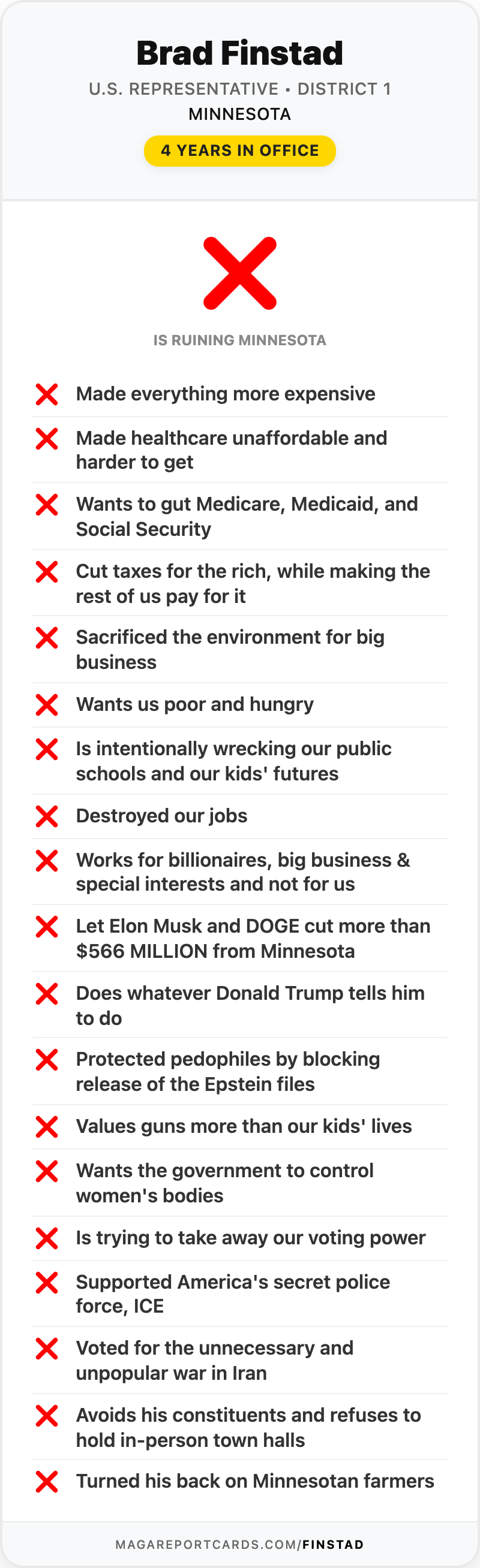
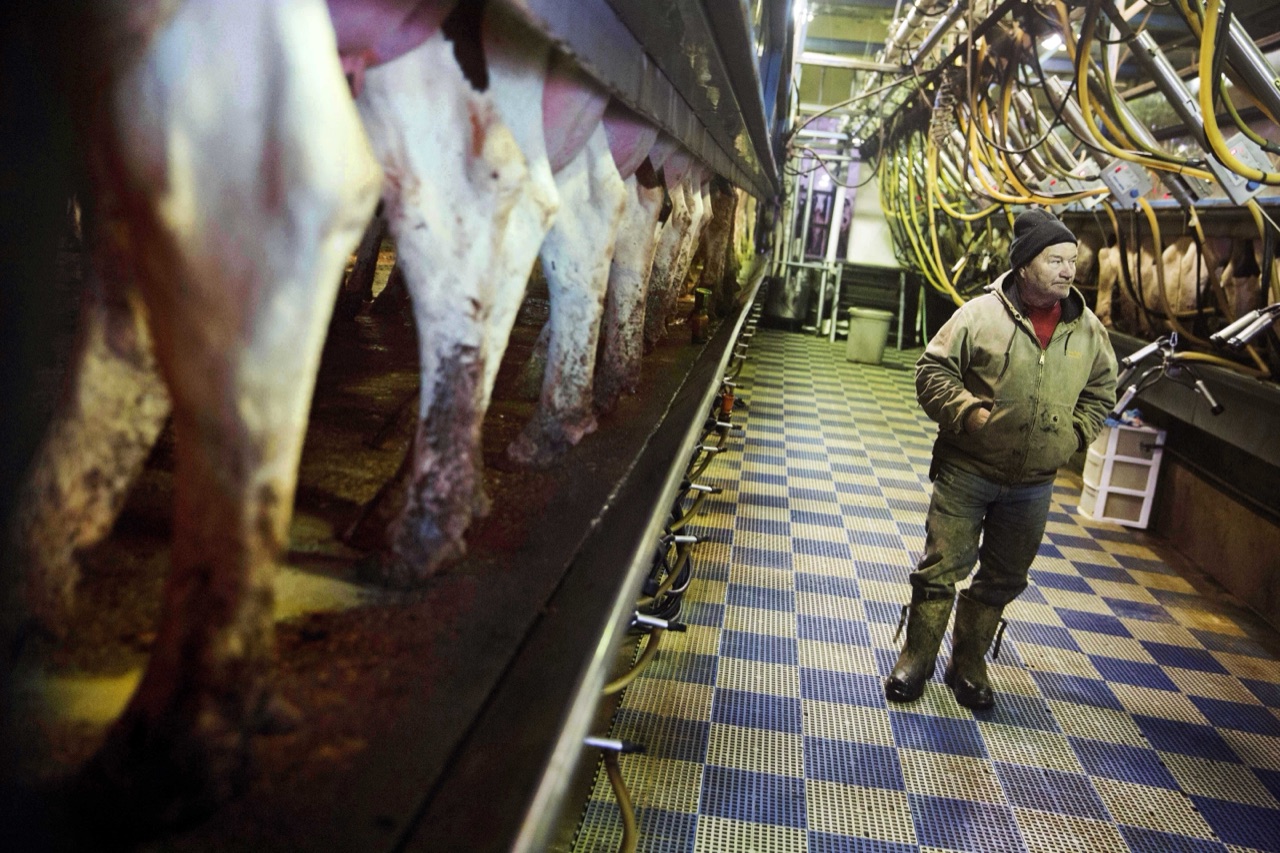
Agriculture is a $26 billion industry in Minnesota, and the southern part of the state is where most of it happens. When the price of fertilizer goes up and the price of soybeans goes down, that's the region where it shows up first.
Brad Finstad represents it in Congress. And for ten months, every time somebody asked him about Trump's tariffs, he gave them a version of the same answer: hang on, it's short term, it'll be worth it.
American Journal News pulled his quotes together this week. Lined up next to each other, they're something to see.
The same answer, over and over
April 2025, weeks after the tariffs landed, asked about fertilizer prices:
"In the short term, there's a lot of uneasiness and unknowns. That is tough to navigate, but it's my hope we'll come through this with better trade partners."
August 2025, to a room of small business owners. He admitted the tariffs were causing "disruption and uncertainty" — then framed that as the point, calling Trump "the ultimate disruptor in chief."
"I completely am sympathetic and aware, because we all feel and see it."
February 2026, on the Made in Minnesota podcast:
"The big lever of tariffs that the president pulled created a little bit of instability and uncertainty in the short term. But what it did is it brought people to the table and we're seeing opportunities we haven't seen before."
Ten months apart, and it's still "short term." At some point "short term" stops being a forecast and starts being an excuse.
What was actually happening to his farmers
While Finstad was describing "a little bit of instability," here's what the reporting from Minnesota looked like.
China — the buyer for the crop that southern Minnesota lives on — stopped buying. CBS Minnesota reported in September 2025 that Minnesota has about 26,000 soybean farmers, that roughly 60% of the state's crop is exported, and that China is the top buyer. In 2024, China bought $12.6 billion worth of American soybeans.
New Chinese orders in 2025: zero.
"Unfortunately, we're bearing a lot of this trade war," Darin Johnson, president of the Minnesota Soybean Growers Association, told the station.
Then the cost side got worse too. KSTP covered the squeeze this spring: fertilizer that a farmer booked at about $560 a ton in January was running closer to $750 a ton — a 20 to 25% jump — while soybean futures dropped the daily limit, down 70 cents a bushel in a single session.
Ryan Mackenthun, vice president of the Minnesota Soybean Growers Association, put it plainly:
"It's going to be about survival. I mean, farmers might not be able to survive this."
Ed Usset, a grain market economist at the University of Minnesota, called it "the worst of both worlds" — fuel and fertilizer up, grain prices down, at the same time.
That's the thing about a farm. You can't wait out a bad year the way a business can trim hours. You buy the seed and the fertilizer in the spring, before you know what the crop will sell for in the fall. If input costs spike and prices collapse in the same season, you eat the difference — or you don't plant.
He didn't just talk. He voted.
Talking optimistically about a policy is one thing. Finstad had two chances in February 2026 to actually do something, and he used both of them to protect the tariffs.
February 10, 2026 — the House voted on a rule that would have shielded Trump's tariffs from a floor challenge. Finstad voted yes. Three Republicans broke ranks and the rule went down, 214 to 217. He wasn't one of the three.
February 11, 2026 — the House voted on a resolution to end the national emergency Trump used to impose 25% tariffs on Canada. Finstad voted no. Six Republicans crossed over and it passed anyway, 219 to 211. He wasn't one of the six.
So on the two days when a southern Minnesota congressman could have stood up for southern Minnesota farmers on the House floor, he voted with the tariffs both times.
The Supreme Court did what he wouldn't
On February 20, 2026 — nine days after that vote — the Supreme Court ruled 6–3 that the law Trump used, the International Emergency Economic Powers Act, doesn't authorize a president to impose tariffs at all. The "Liberation Day" reciprocal tariffs were struck down.
The Court's answer to the policy Finstad had spent two years defending was that the president never had the authority to do it in the first place.
And winning in court didn't give farmers their money back. Fertilizer and machinery prices had already climbed, and they stayed high — the way prices do. The Iran war piled shipping disruptions on top of the fertilizer market.
Which brings up the other votes. Twice this year the House voted on resolutions to pull U.S. forces out of hostilities with Iran — the war driving up the diesel and fertilizer costs Finstad's farmers were already drowning in. He voted no on both of them.
What he was really saying
Strip the friendly language out of Finstad's quotes and here's the argument he made to his own constituents for two years:
Your losses are a negotiating tactic. Somebody has to absorb the cost of getting other countries "to the table," and it's going to be you. Be patient.
Farmers were patient. They were patient through a season of zero Chinese orders, patient through fertilizer going up a quarter, patient while their representative told a podcast they were "seeing opportunities we haven't seen before."
Finstad is running for a third term this fall. His constituents get to decide whether "short term" was ever going to end.
Source
- American Journal News, Finstad backed Trump tariffs as Minnesota farmers paid the price (July 29, 2026), which collected Finstad's April 2025, August 2025 and February 2026 remarks.