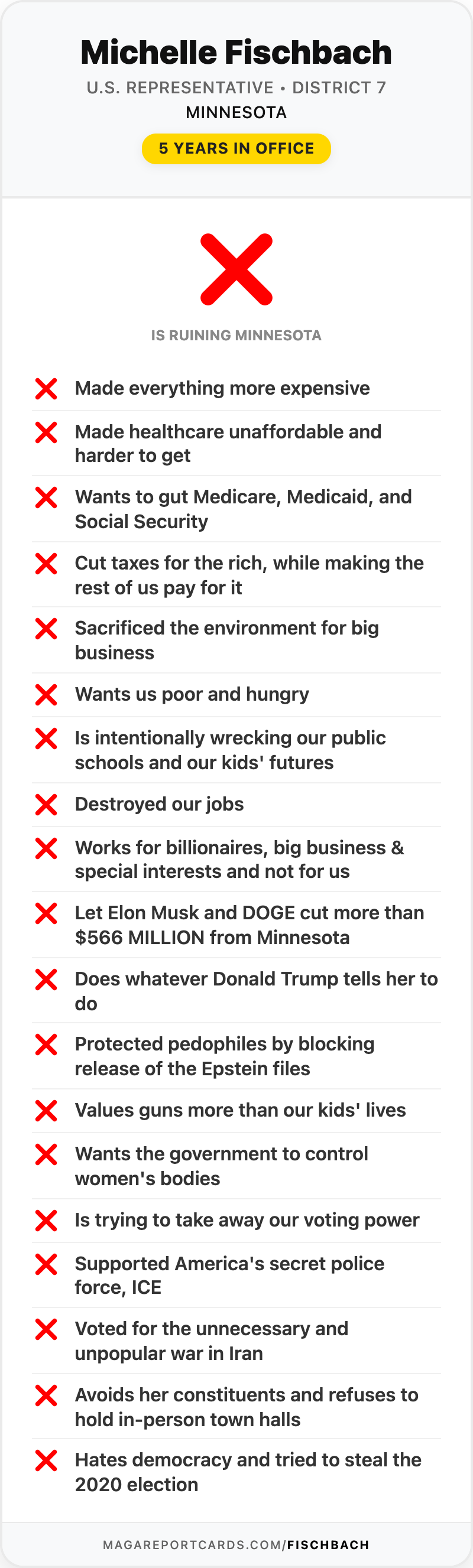
On Tuesday, August 4, 2026, Michelle Fischbach stood on a stage at Minnesota Farmfest in Morgan and defended President Trump's tariffs to a room full of farmers.
A member of the front-row audience started booing.
She kept going. There have been "20 agreements" on trade under this administration, she told them, and "usually ag is a winner" in them.
Why that landed badly in a room full of farmers
Six months ago, the Supreme Court ruled that Trump's tariffs were illegal — that the 1977 emergency law he used to tax nearly everything coming into the country never gave a president that power.
The government collected roughly $166 billion under those tariffs and has to give it back. As we wrote last week, that money is going to Apple, Ford, Nike, Amazon and General Motors — the importers who legally paid the tariffs. Not to the farmers who lost export markets. Not to anyone who paid more at the register.
Fischbach's opponent, DFL-endorsed candidate Erik Osberg, put the question to her directly:
"If these tariffs have been so helpful, why did the Supreme Court have to create a $160 billion refund that is going to the importers? We need Congress to act as the Constitution said in Article 1, Section 8."
That's the part that should stick.
Article I, Section 8 is her job description
The Constitution gives Congress — not the president — the power to regulate commerce with foreign nations and to lay duties. Tariffs are a congressional power. The Supreme Court just said so in the most expensive way possible.
Fischbach sits on the House Ways and Means trade subcommittee. That is the specific committee, in the specific chamber, that holds that specific power.
She has spent that seat defending an executive tariff program the courts struck down, rather than exercising the authority the Constitution assigns to her. When she was asked what Congress's role should be, her answer was to describe what the administration had already done.
The farm payments question
Early in the forum, the moderator asked about the recurring need for ad hoc farm payments — the emergency checks Washington keeps writing to keep farms afloat.
Fischbach said Congress needs to "provide more stability and more clarity," and that farmers want strong markets, not payments.
Osberg agreed on the diagnosis and disagreed on the cause: bridge payments are "throwing billions of dollars at a problem" that needs a long-term fix, he said, adding, "It'd be nice and stable if Congress would stand up against the unconstitutional tariffs and take that back."
That's the loop farmers are stuck in. Tariffs close export markets. Closed markets crater prices. Washington writes emergency checks to cover the hole it made. Fischbach wants credit for wanting stability while defending the thing destabilizing it.
USMCA and the "very well" answer
On the U.S.-Mexico-Canada Agreement — which the Trump administration has decided not to extend — Fischbach pointed to her access to the chief U.S. agricultural negotiator and said talks with Mexico were going "very well."
"We have the base of it, and we are taking a look at what's going on in the USMCA, what we can improve on, and there's obviously things we can improve on."
Osberg's answer was the one the room could measure against their own experience:
"One of the improvements we could make is looking at ourselves in the mirror and saying, 'Are we a reliable trade partner right now?'"
He then quoted a young farmer on a committee he convenes: "I wouldn't run my farm the way we're running this country right now."
"She is out here"
The forum also covered USDA's plan to move Washington-based staff into regional hubs. Osberg described the effect on the ground — local food producers who have waited three years just for permission to accept food stamps — and called it "chaos and uncertainty and dysfunction."
Fischbach's rebuttal was that Agriculture Secretary Brooke Rollins had been at Farmfest a few hours earlier.
"(Rollins) is out here. She is listening to people. She is talking to the people that are actually farming, the people with boots on the ground."
A cabinet secretary attending a farm show is not a response to a producer who's been waiting three years for a permit. It's evidence that someone showed up.
What Minnesota farmers are actually carrying
Tariffs hiked Midwest household costs and slashed jobs, according to a report published in July. A Minnesota Senate subcommittee on federal impacts keeps Twin Cities Business's June 2025 account of how the tariffs hit Minnesota businesses in its committee files.
Fischbach closed the forum on her record: estate tax relief, crop insurance improvements, year-round E15.
Osberg closed with a question.
"Are farmers better off today than they were two years ago?"
The booing from the front row was one person's answer. The $166 billion in refunds going to Apple and Amazon instead of Minnesota grain farmers is a bigger one.
Source
West Central Tribune, "Fischbach, Osberg clash over tariffs, USDA shakeup in Farmfest candidate forum," by Noah Fish, August 5, 2026. The booing was also covered by Courier Minnesota.