Amelia Johnson is 12. She was born with a rare genetic anomaly, has been through many surgeries, and needs a brain shunt and a feeding tube. Two years ago her mother, Angela, learned that Florida had a voucher program built for children with disabilities, and in 2024 Amelia was awarded about $10,500 to spend on a private school.
Her mother could not find one that would take her.
She called an upscale Christian school nearby. No nurse trained to care for medically fragile children. She called several more. Some said yes — until she explained the feeding tube, the pencil grip, the help with toileting. Then every one of them said no. She could not find a single private school with nurses for her daughter's medical needs, teachers trained to educate nonverbal children, or even a bus ride home.
Angela Johnson returned the money to the state, along with a very stern email.
That story, reported by ProPublica and republished this week by the Arkansas Times, is the story of what "school choice" actually means for children with disabilities. Private schools generally are not required to educate them. And they often don't. About 8% of the $1.7 billion Florida distributed last year through its voucher program for disabled children was returned because those children ended up in public school instead — against 1% in the program open to all students. In Louisiana, 30% of disability voucher money was returned, against 6% overall.
The reason that matters in Arkansas is that disabled children are how this whole thing got started here.
Arkansas is named in that investigation
ProPublica's piece traces a deliberate political strategy. Voucher advocates went after programs for children with disabilities first, because those were the hardest for any lawmaker to vote against. One advocate, Howie Beigelman, put it plainly on a panel at a 2011 school choice conference: "Special needs is a very easy way to get into this business." He recently told ProPublica that this was his own opinion and that he had "never seen anything 'intentional'" about such programs. Clint Bolick, then president of the Alliance for School Choice and now a justice on the Arizona Supreme Court, wrote an essay called "Toe-Hold Strategies" arguing that "choice begets choice: Once the Rubicon is crossed and legislators vote to adopt a school choice program — no matter how small or targeted — it becomes easier to support a new one, or expand the old one, the next time around."
Arkansas appears in that story by name. The legislature created the Succeed Scholarship for children with disabilities in 2015, and it launched the following year. It was the first voucher program in Arkansas history. Not one legislator voted against it.
Our own university wrote the strategy down in 2017
In January 2017, months after the Succeed Scholarship started paying out, the University of Arkansas's Office for Education Policy published a brief on the new program. It weighed the potential savings to the state first. Then it said this:
Special education private school choice programs are often seen as a "foot in the door" for school choice laws. Once some success has been shown to the public, more laws can be passed to expand these programs.
The same brief predicted, nine years ago, the exact failure ProPublica just documented across the country. It warned that the voucher might not cover tuition at a school that would actually meet a child's needs, and that this was "particularly true for students with the most severe disabilities, who cost substantially more to educate." It warned that participating private schools could still screen applicants through "testing, interviews, and review of records," so that students with academic, social, emotional and behavioral disabilities "may be at a real disadvantage and be de facto discriminated against, limiting their true school choices."
And it flagged the trade that almost no parent understands going in: families using the voucher must give up their child's rights under the federal Individuals with Disabilities Education Act — the law that guarantees a free, appropriate public education. Take the money, lose the legal recourse.
Arkansas was told. In writing. By its own flagship university.
What the disability voucher actually did here
By 2021, Arkansas had its own version of Amelia Johnson's story, several times over.
The Succeed Scholarship had grown from 23 students in its first year to 479, at a cost of $3.3 million a year. More than half of the recipients were clustered in three central Arkansas schools, and more than a quarter were in Little Rock alone — in a state where many rural areas have no private schools at all. Just 17% of recipients were known to be eligible for free and reduced-price lunch, against 60% of Arkansas public school students. And 78% were white, against 61% of students with disabilities statewide.
The state was barely watching. An Arkansas Department of Education attorney said the difference between how the department oversees public and private schools was "night and day": "We have an affirmative obligation to monitor and ensure compliance with the public schools. It's not the complaint-initiated thing we do with private schools." Investigations happened only after a complaint, and at that point had never once included an in-person visit to a school.
At the Hannah School near Little Rock, a private dyslexia program that enrolled more than 60 Succeed recipients, parents alleged the school employed teachers without bachelor's degrees and skipped required testing and progress reports. A co-founder said in a video on the school's own website that "we were not in compliance with the policies set forth by the Department of Education." One mother, an attorney, never received her son's records or the therapy records she asked for; a re-evaluation found he had made almost no progress and was behind grade level. Back in public school, he caught up.
Tom Masseau, who runs Disability Rights Arkansas, described families "accepting this scholarship thinking they're going to get the moon, the sun, the stars, everything. And in fact, they're getting very scarce services." Five years before ProPublica went looking, he was already describing the same sorting. Anecdotally, he said, schools were more apt to take in children whose disabilities were primarily learning disabilities, while "students with severe disabilities — those in wheelchairs, those with dexterity [problems] or whatever it might be — are less likely to be admitted into these voucher programs because schools are not equipped to handle and provide the services they need to succeed."
Asked what a parent should do when no private school near them will serve their child, the Republican who sponsored the bill had an answer: "The smart thing they should do, if that's a priority for them, is move to a place where those needs can be met."
That is the choice, at the end of the road. Move.
Then Sanders walked through the door
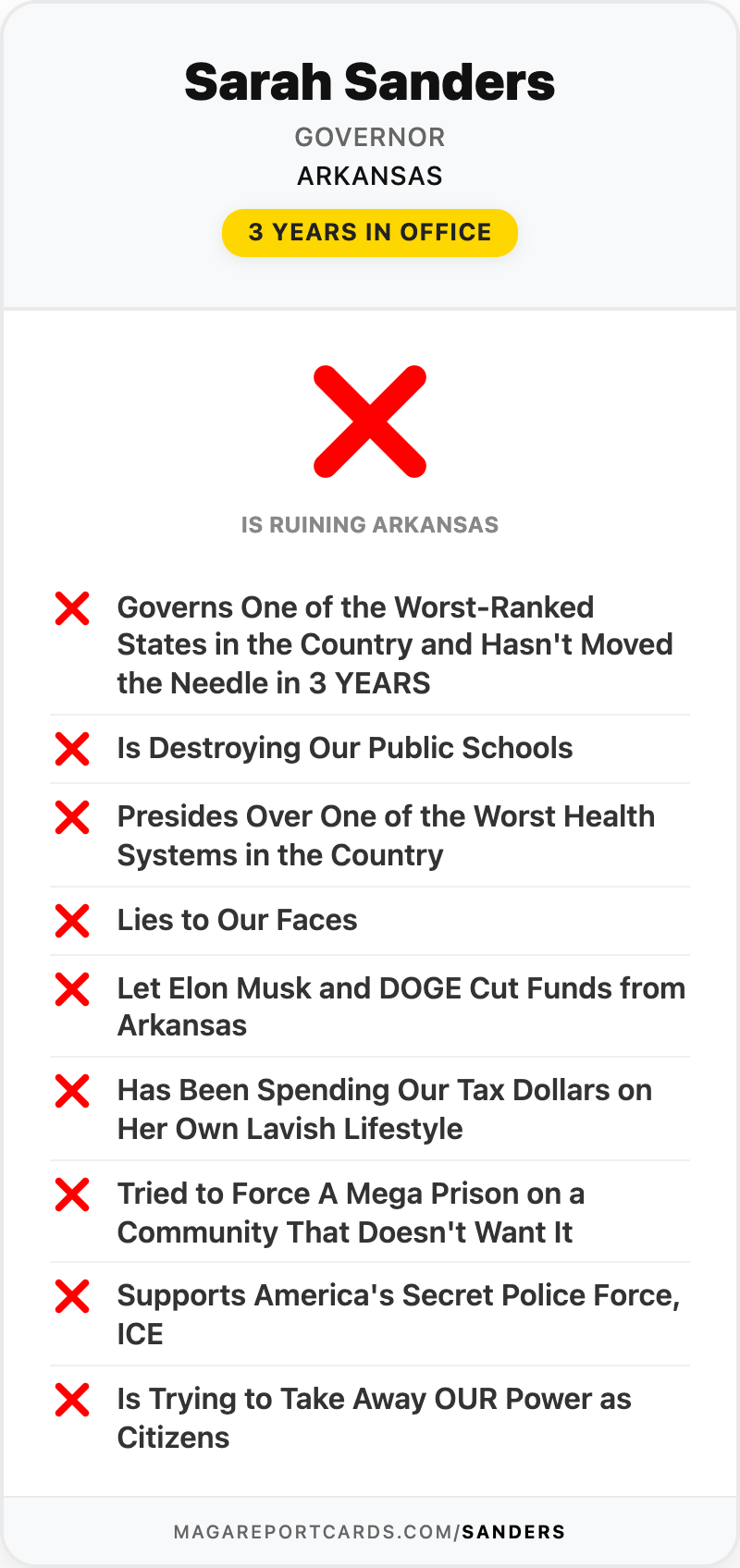
Sarah Sanders took office in January 2023. The marquee bill of her first session was the LEARNS Act, and its centerpiece was the Educational Freedom Account — a voucher for everybody.
Year one was supposed to be for the kids who needed it most: children with disabilities, foster kids, first-time kindergarteners, homeless students, children of active-duty military, and children coming out of an "F"-rated public school or a district in need of Level 5 intensive support. Roughly 4,800 students enrolled that first semester. According to the Education Department's own report to the legislature, 44% of them had a disability and fewer than 5% had previously been enrolled in a public school.
Read those two numbers together. The disability category — the one built in 2015 for children who could not get what they needed in public school — became the fastest lane into a voucher for families whose children were already in private school.
On AR Watch, an advocacy group that obtained the Education Department's application emails through public records requests, reported how that happened: the department told parents they could prove a qualifying disability with district test results, an IEP, a 504 plan — or a doctor's note. The first three are the documents a public school generates after weeks of evaluation. The fourth is a note. Families whose children had never been in a public school had no access to the first three.
Then the program opened to everyone anyway. More than 44,000 Arkansas students hold an Educational Freedom Account this school year, and total state funding for 2025-26 is $309.4 million. Next year's bill is expected to run more than $367 million, and a legislative panel has already approved a study of a third program on top of the two we have.
The Succeed Scholarship no longer exists as its own program. It was absorbed into the Educational Freedom Account under LEARNS. Its former recipients get a slightly larger check — $7,627 this year against $6,864 for most participants — and that is all that is left of it.
The door held open by disabled children was walked through, and then the door was taken off its hinges.
What Arkansas bought with the oversight it skipped
The warning in that 2017 brief was about accountability, and Arkansas never fixed it. It just made the unaccountable thing far bigger: from 479 students and $3.3 million a year to more than 44,000 students and $309.4 million.
A private school that took Arkansas voucher money had students physically attack a 13-year-old classmate and made children scrub floors as punishment; its founder pleaded guilty to criminal charges, and the state kept funding the school. The state also invented a category called a microschool, decided it is not a private school and does not get routine visits, and signed up 142 of them — one of which took money from 56 students and collapsed three weeks before classes started.
Meanwhile, the disabled Arkansans who are not in this program at all are waiting. More than 2,400 people sit on the waitlist for the CES waiver, the Medicaid program that pays for in-home care for people with developmental disabilities. A Republican governor cleared that list once, in 2021, for more than $37 million. A Little Rock lawmaker puts the cost of clearing it again at $35 to $50 million. Sanders has not called the special session that would do it, and the next regular session is in January 2027. She did call a special session this spring — to cut income taxes.
What the record shows
Arkansas created its first voucher in 2015 for children with disabilities, and in January 2017 the University of Arkansas's own education policy office wrote that such programs are "often seen as a 'foot in the door'" for school choice laws, that private schools would screen out the children with the most severe disabilities, and that families taking the money would surrender their federal disability rights. Every one of those warnings proved accurate. Sarah Sanders' LEARNS Act then expanded the program to every child in the state, absorbed the disability scholarship into it, and grew the bill to $309.4 million this school year — while 44% of the first voucher class had a disability and fewer than 5% of that class had previously been enrolled in a public school. More than 2,400 disabled Arkansans are still on a waitlist for in-home care she has not called a session to clear.
Source
Arkansas Times / ProPublica, Vouchers promise students with disabilities a path to private school. Parents say that's not the reality., September 14, 2026. Photo: Zaydee Sanchez/ProPublica.