Here is a number worth sitting with.
Through June 29 of this year, Republicans in Congress had held 39 in-person town halls — 17% of all the town halls they held at all. Democrats held 451 town halls in the same six months, two-thirds of them in person.
That count comes from LegiStorm, which has been tracking town halls for years. Those 39 are the fewest in-person town halls the company has ever recorded for Republicans in the first half of any year.
It did not used to be this way. In the first half of 2024, Republicans held more town halls than Democrats — 309 to 214 — and 229 of theirs, nearly three quarters, were in person. Then came 2025: Republicans held 378 town halls but only 122 in person, while Democrats jumped to 924. This year Republicans are down to 234 town halls, 39 of them in person.
Something changed between those two years. We know exactly what it was, because it was said out loud in a room full of members of Congress.
The order
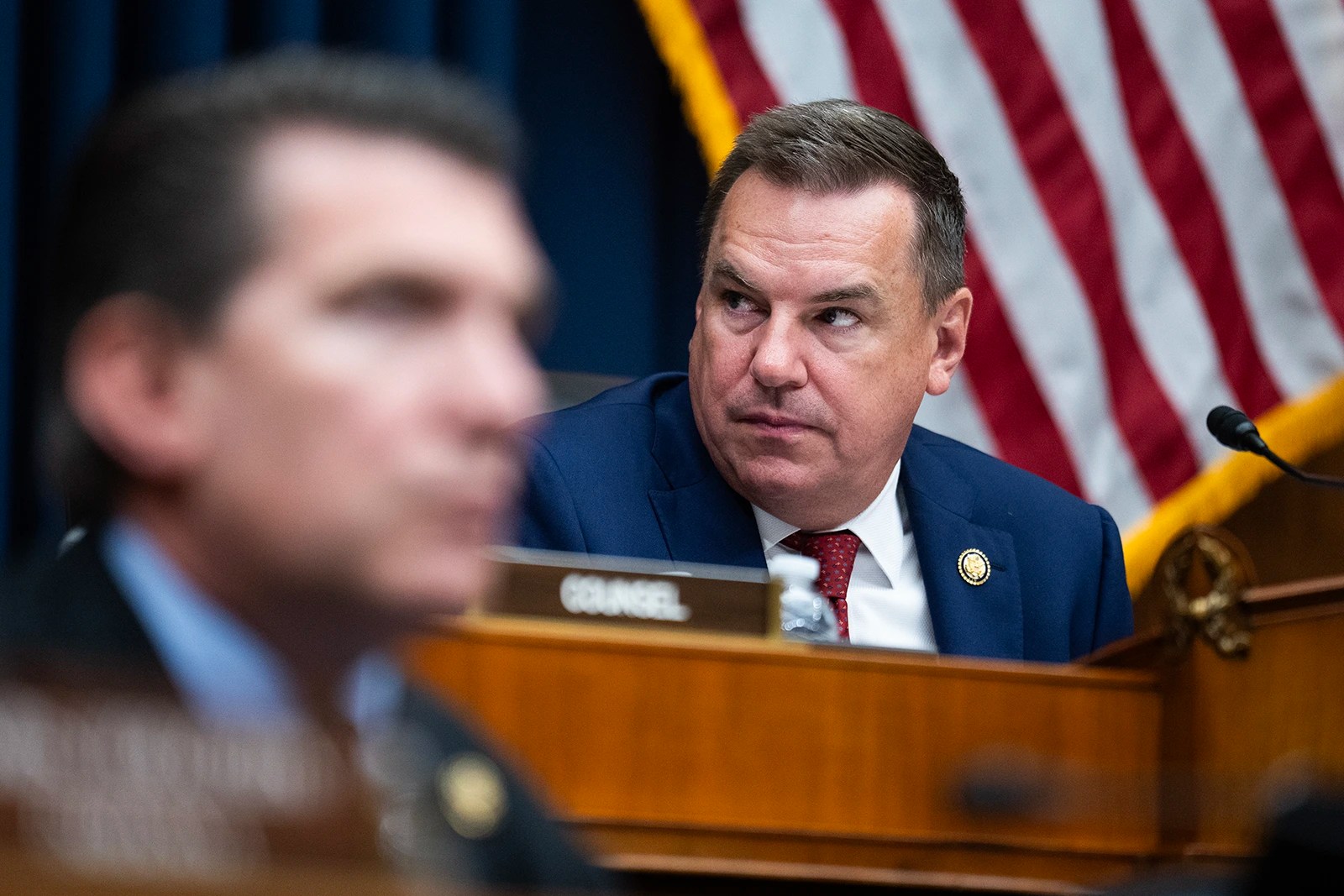
On Tuesday, March 4, 2025, House Republicans went into a closed-door conference meeting. Richard Hudson — the North Carolina congressman who chairs the National Republican Congressional Committee, the group that raises the money and runs the campaigns for every House Republican on the ballot — stood up and told them to stop holding in-person town halls.
NOTUS reported it from the meeting: Hudson told members to switch to tele-town halls or Facebook Lives instead. His stated reason was that they could still hear from constituents that way, without "disruption from activists."
The unstated reason was in the same story. Going online would also avoid "the recent images of Republicans running off stage, getting drowned out by boos and being challenged on unpopular cuts to programs like Medicare and Medicaid." At the time, Congress was writing the budget bill that would cut $2 trillion in spending, much of it out of Medicaid.
Speaker Mike Johnson backed him at his weekly press conference: "There are other avenues to do it than just going in to try to give the other side sound bites."
We wrote about that meeting, and about the tele-town hall Hudson went on to hold himself — 50 minutes, eleven screened callers, and a constituent who asked about Medicaid and got told the cuts were "just rumors". Seventy-two days after he said that, he voted for the cuts.
Now the receipts are in. Since March 2025, Republicans have held 231 in-person town halls. Democrats have held 1,042. The advice worked. Republicans stopped showing up, and they have not started again.
"It's a good way to get shot"
MS NOW's Mychael Schnell asked House Republicans why, and several answered on condition that their names not be used. That detail alone tells you something: these are elected officials who wouldn't put their name on their reason for not meeting voters.
"They're a setup. It's just a setup to get us — get you off something off guard. And for me, personally, it's a good way to get shot. There's a lot of crazies out there right now."
The same lawmaker added: "I just don't feel like there is any gain to be had."
Another said the reasons were political, logistical and about safety: "It's the disruptive factor. It's the screaming factor. But it's also, truthfully, a security factor."
Nobody should wave away the safety part. Political violence in this country is real and members of both parties have been targeted. But Democrats have held 1,042 in-person town halls since Hudson gave that advice, under exactly the same threat environment. Whatever is different here, it isn't the danger. It's the questions.
And listen to the order those reasons come in. Disruptive. Screaming. Then security.
Jeff Van Drew blames the voters
Jeff Van Drew, the New Jersey Republican who switched parties in 2019, gave MS NOW the version with no hedging in it. He endorsed the virtual events fully, and he blamed the people who show up at the real ones.
"The Democrats have bastardized this and ruined town halls."
He called the traditional format "completely nonfunctional and noninformational," and said town halls that are "completely weaponized and abusive and demeaning and crude and rude" don't work for anybody.
This is Van Drew's long-running position, not a new one. He told the Press of Atlantic City last year that in-person events just bring out "the same 50 or 100 people who just don't like you."
On March 13, 2025, about 600 people lined the road outside his Northfield office to ask him to protect Medicaid and Social Security. They brought their concerns in writing to hand in at the door. The doors were locked and the building was closed.
Six hundred is not fifty. And the "crude and rude" framing is how this always gets sold — Mike Bost said his constituents' protests were staged, with paid protesters, and offered nicer-looking signs as evidence. Brian Fitzpatrick went on national television to call in-person town halls a "three-ring circus". Dan Meuser, asked to name a recent town hall, couldn't come up with one — and says he won't turn up at his constituents' weekly protests because he doesn't want to be a "piñata."
Angry voters are not a scheduling problem. They're the feedback.
What replaced it
The replacement is the telephone town hall, and it's worth being clear about what that is. Your congressman's office picks who gets to speak. It picks the order. It cuts the line whenever it wants, and nobody in the room can see anybody else's face — because there is no room.
Rob Bresnahan, the Pennsylvania Republican, is a clean example. In March 2025 he held his first telephone town hall, an hour long, taken from his office in Washington. More than 9,000 constituents dialed in. His office put out another release later celebrating that 15,000-plus people joined a telephone town hall about the government shutdown.
The big participation numbers are always the pitch. They're also the point — 15,000 people on a phone line is 15,000 people who each got, at best, one question and no follow-up.
We've watched how these go. Mike Carey promised to post the call-in number for his telephone town hall, never did, and then put out a press release celebrating that 12,000 people joined. Brad Knott's first three town halls were all by telephone; when a constituent in rural Harnett County got through to ask how he could vote to cut Medicaid, he answered that lawmakers "stand ready" to fix it later.
That is the format Hudson recommended, and that is what it produces.
One Republican still does it
Not everyone took the advice. Mike Flood, who represents a safe Republican district in Nebraska, was lambasted at a forum in May 2025 — and kept holding them. He told MS NOW he promised in 2022 to hold three town halls a year and intends to keep the promise.
"Things only get better when you go to the town square and you have an exchange of ideas. For me, it works."
He also punctured the excuse his colleagues are using. The viral clips, he said, come from a tiny slice of the event: "The reality is, a lot of the times, the same people that might be animated against me, they're clapping with me when I'm talking about supporting Ukraine or where I'm at on certain issues."
One Republican stood in the room, took the shouting, and reports that it's fine. That is the whole case against every excuse in this story, delivered by a Republican.
Someone else is holding their town halls
The seats aren't staying empty. Democrats have been going into Republican districts and holding the events themselves.
In December 2025, Rep. Brendan Boyle of Pennsylvania traveled into Bresnahan's district — Pennsylvania's 8th — to take questions from voters who aren't his. He told MS NOW he may do it again.
"Republicans know their agenda is deeply unpopular, so they're hiding from their constituents. After voting to gut healthcare, raise costs and shower billionaires with tax breaks, they won't even defend their record back home."
The NRCC's response, from spokesman Mike Marinella, was that "House Republicans are meeting voters where they are, delivering results that matter to working families."
Meeting voters where they are. The voters are in Northeastern Pennsylvania, in Fayetteville, in South Jersey. The congressman is on a phone in Washington choosing which of them gets to talk.
The part that isn't about town halls
A town hall is not a favor. It's the one hour where the person casting votes in your name has to stand in a room, in front of neighbors who can see his face, and account for them — and where the follow-up question is not his to switch off.
That's why they stopped. Not because voters got ruder, but because the votes got harder to defend: Medicaid cuts, rising costs, the Epstein files, a war nobody voted on. Every one of those is a question with no good answer at a microphone, and every one of them is a question a screener can drop.
Hudson didn't invent members ducking their constituents. What he did was turn it into official party guidance, in his capacity as the man who funds their campaigns — and 231 to 1,042 is what that guidance bought.
Source
The Republican town hall is vanishing — and Democrats see an opening — Mychael Schnell, MS NOW, August 20, 2026, and Why Republicans are hiding from their own voters — Nick Hilden, AlterNet, August 20, 2026. Photo of Rep. Richard Hudson: Tom Williams/CQ-Roll Call, Inc. via Getty Images.