In November 2024, Nebraskans voted directly on two things their Legislature had refused to give them. Paid sick leave passed with nearly 75% of the vote. Medical cannabis passed with 71%.
In April 2026, Jim Pillen stood at a press conference and said this about the process that produced those results:
"I just don't think that's the way policy should be made. We have a Unicameral. We elect 49 representatives. We have three government system. The people speak by electing people."
On September 3, 2026, Pillen and Secretary of State Bob Evnen announced they will ask the Legislature to rewrite the rules for gathering petition signatures.
What happened, and what actually caught it
There is a real fraud case here, and it is serious. It is worth stating plainly before anything else.
A group called the Good Government Lincoln Project submitted more than 30,000 signatures for three Lincoln city charter petitions. In early August the Lancaster County Election Commission rejected more than 65% of them, overwhelmingly for suspected fraud. Warrants went out for out-of-state circulators. As of Pillen's press conference, four had been extradited back to Nebraska.
Statewide, petitioners filed about 767,000 signatures across 17 petitions this year. Election officials in Lancaster and Hall counties caught thousands of suspect signatures and referred them to law enforcement.
Note who found it. Not a new law. County election officials and the secretary of state's own elections staff, doing the job the current system already asks of them. Evnen said so himself:
"We caught the signature fraud. This is not an accident. This is the result of the hard work and dedication of our county election officials and the hard work and dedication of the people in the Elections Division of the Secretary of State's Office."
He also said, in the same appearance, that "no state runs better elections than Nebraska."
Both of those things are the strongest possible argument that the existing process works. Pillen's response is to change it anyway.
What he wants to change
The proposals target paid signature gathering. No more paying circulators per signature. Circulators would have to be U.S. citizens, would be barred if they have felony convictions, would have to complete training and consent to Nebraska's jurisdiction.
Some of that is unobjectionable on its face. But the pay-per-signature rule is not a fraud rule, it is an economics rule — it governs how expensive and how practical it is for ordinary Nebraskans to put anything on a ballot at all. Paying per signature was banned in Nebraska from 2008 until 2015, under a law a bipartisan group of senators passed over a governor's veto. Pillen's predecessor, Pete Ricketts, signed the 2015 bill that repealed that ban.
And Pillen's own words about ballot initiatives, from five months earlier, tell you what he thinks the process is worth in the first place.
He didn't respect the results he already had
This is the part that turns a policy fight into a credibility problem.
Nebraskans passed paid sick leave with roughly three-quarters of the vote. On June 4, 2025, Pillen signed LB 415, which narrowed the law before it ever took effect — exempting businesses with 10 or fewer employees, and stripping the benefit from temporary agricultural workers and workers under 16.
Nebraskans passed a minimum wage increase. In February 2026 the Legislature capped the annual increases at 1.75% and created a teenage wage that stays below $15 until 2065.
Nebraskans legalized medical cannabis with 71%. Pillen, Attorney General Mike Hilgers and U.S. Senator Pete Ricketts publicly campaigned against the bill that would have regulated it, and peeled off enough Republican senators to stop it.
State Senator George Dungan of Lincoln put it to KOLN this way:
"I find it surprising that the governor has suddenly decided defending the voice of the people is an important issue after so clearly ignoring the people of Nebraska on issues like medical cannabis, earned paid sick leave, and minimum wage."
The pattern in Lincoln
Senator Danielle Conrad told the station she is worried about a "double standard," and said of the governor and attorney general: "We shouldn't use these excuses to clamp down on the voice or the right of the people, which is exactly what the governor and the attorney general want."
Both Conrad and Dungan have asked for an independent investigator and prosecutor on the fraud cases, rather than leaving them with officials who have said out loud what they think of ballot initiatives.
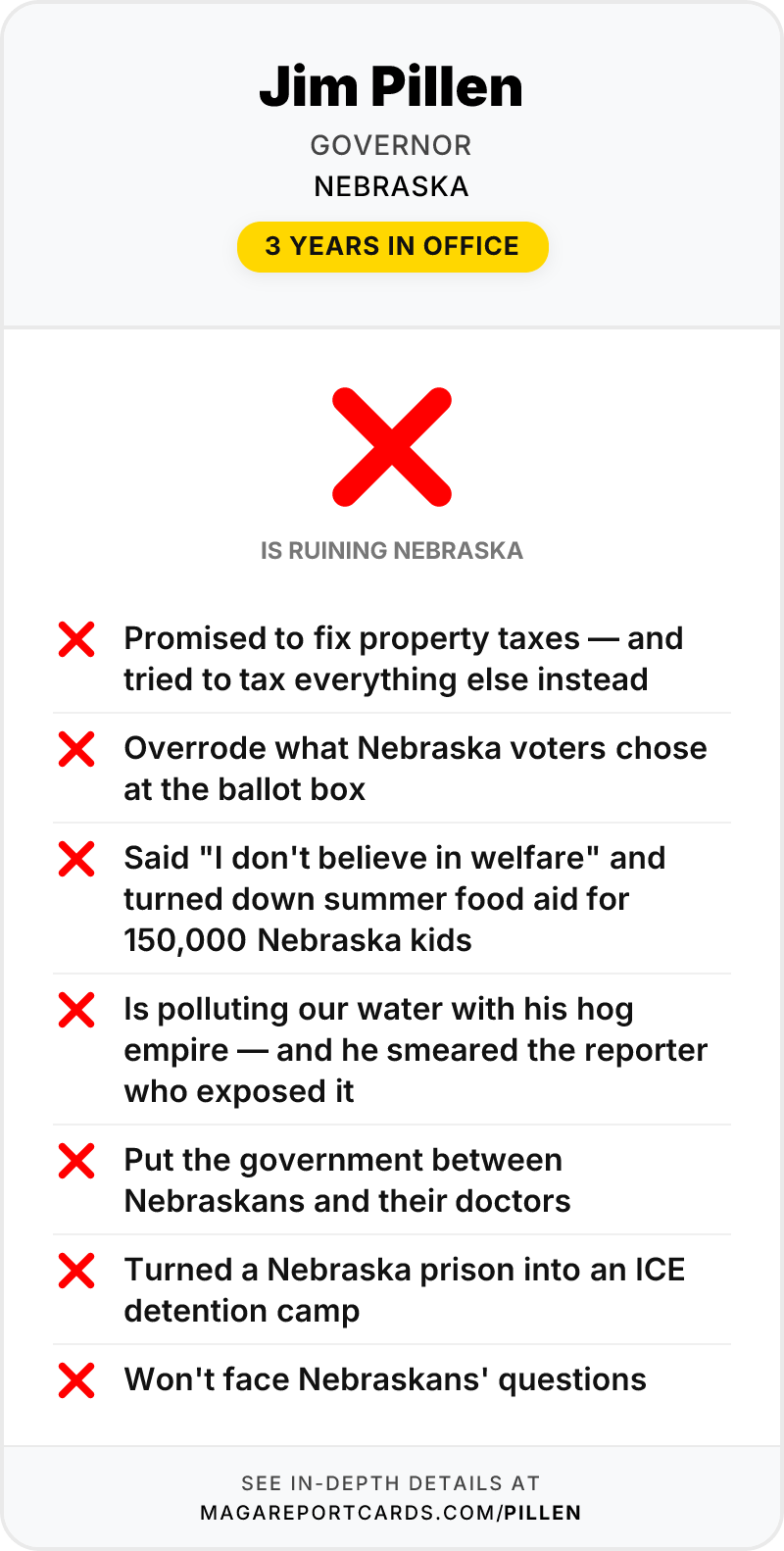
It fits what we've already documented about how Pillen handles Nebraskans who disagree with him. He called them "libtards" three times in one hour and then had his staff step in before he could answer reporters about it. When a reporter found nitrate contamination on his hog farms, his answer was that the author "is from communist China". When Nebraska was offered $18 million to feed hungry children over the summer, he said "I don't believe in welfare".
What the record shows
Nebraska voters used ballot initiatives to win paid sick leave with about 75% support and medical cannabis with 71%. Jim Pillen signed a law narrowing the sick leave measure before it took effect, helped kill the bill regulating medical cannabis, and watched the Legislature cap the voter-approved minimum wage. In April he said of ballot initiatives, "I just don't think that's the way policy should be made." In September, pointing to a fraud case his own county election officials caught and referred for prosecution, he asked the Legislature to make the petition process harder to use.
Sources
- Darsha Dodge, After criticizing ballot initiatives, Pillen seeks to reform Nebraska petition process, 10/11 NOW / KOLN (September 3, 2026).
- Pillen, Evnen, county election officials call for changes to Nebraska petition circulator laws, Nebraska Examiner (September 3, 2026).