In 2022, Nebraskans were asked a simple question: should the state's minimum wage go up to $15, and then keep pace with the cost of living?
They said yes. Not narrowly — 59% to 41%, with majority support in 38 of the state's 49 legislative districts.
Four years later, that raise has been cut back by the Legislature, signed into law by the governor, and is now being defended in court by the attorney general against two cities that tried to give their own workers what the voters asked for.
On Tuesday, Nebraska Attorney General Mike Hilgers announced he is suing the City of Omaha to block its new minimum wage ordinance. He has already sued Lincoln, and got an injunction — a judge blocked Lincoln's ordinance on July 17, one day before it was set to take effect.
His argument: "Our Constitution does not permit the City of Omaha to repeal any portion of a statewide law passed by the Legislature."
Which is a fine sentence, until you ask where that statewide law came from.
What voters actually passed, and what replaced it
Initiative 433 raised Nebraska's minimum wage from $9 to $15 between 2023 and 2026. After that, it would rise every year alongside the Consumer Price Index — the standard measure of what things cost.
That last part was the whole point. A wage that doesn't track prices is a wage that shrinks a little every year without anyone having to vote for a pay cut.
In February, the Legislature took that out. Legislative Bill 258 replaced the cost-of-living link with a flat 1.75% per year.
Here is why that number matters. The Nebraska Examiner ran the history: over the past 26 years, average inflation in the Midwest has been 2.4% — and it hit 8.7% in 2022 alone. Locking raises at 1.75% doesn't freeze the minimum wage. It sets it to fall behind, quietly, every single year.
Governor Jim Pillen signed it on February 10.
The part about 14-year-olds
LB 258 did something else. It created a "youth minimum wage" of $13.50 for workers aged 14 and 15.
That wage goes up 1.5% — not every year, but every five years, starting in 2030.
Do that math and you get the detail that gave the Examiner's story its headline. A 14-year-old bagging groceries in Nebraska will not be guaranteed today's $15 minimum wage until 2065. By then the regular minimum wage is projected to be $29.51, and the youth wage will have finally crawled to $15.20.
State Sen. Terrell McKinney of North Omaha — whose district backed the 2022 raise with 89.67% of the vote, the highest in the state, and who helped sponsor the original ballot measure — did not soften it:
"We don't care about our youth. We just want discounted labor."
State Sen. Megan Hunt of Omaha said the Legislature's first act of 2026 would be cutting workers' wages:
"Families are asking us, how are they going to keep up with prices? How are they going to keep up with the cost of living? And we're answering by cutting their paychecks."
"Opinion polls"
The most honest thing anyone said during the debate came from State Sen. Tony Sorrentino of the Elkhorn area, who has repeatedly called ballot measures "flawed" and described them as "opinion polls" that shouldn't be used to make laws.
"I would suggest we focus on the facts and not the opinion polls," he said.
He is describing a statewide election in which 59% of Nebraskans voted for it. That is not an opinion poll. That is the thing opinion polls are trying to predict.
And this wasn't a one-off. Ballotpedia notes LB 258 was the second voter-approved initiative the Legislature has rewritten since 2024 — the year before, lawmakers carved exemptions into a 2024 initiative requiring Nebraska businesses to offer earned paid sick leave. Voters keep passing worker protections. Lawmakers keep editing them down.
How it passed, and who paid for the favor
Altering a voter-approved law in Nebraska takes a two-thirds supermajority: 33 of 49 votes. LB 258 got exactly 33.
Two details are worth knowing about that vote:
- The bill's sponsor, State Sen. Jane Raybould, is a registered Democrat — and her family operates B&R Stores, the parent company of Super Saver, Russ's Market and other grocery chains. She said the bill was "a request from many of the business communities." She was one of them.
- One Republican voted no: State Sen. Dave Wordekemper of Fremont, a former firefighter.
An earlier attempt actually failed when a supporter missed the vote. The chamber's conservatives scrambled to revive the bill, and the speaker held it until this year, when it finally cleared with nothing to spare.
Cities tried to fix it. The state sued.
Omaha and Lincoln did the obvious thing. Both passed ordinances keeping the inflation link voters approved and setting a $15 floor for all workers, with a $13.50 training wage limited to 16- to 19-year-olds for their first 90 days.
Omaha's city attorney told the council it had the authority as a "home rule charter city," and made the practical case in writing: "Given the higher costs in Omaha, compared to the balance of Nebraska, the Legislature-enacted minimum wage increases may not be sufficient to deal with costs unique to Omaha."
Hilgers disagreed, and went to court. His office argues the ordinances will "inevitably" drive up the cost of goods statewide, and that wages are a "matter of statewide concern" where the Legislature has the final say.
Notice how that works in practice. When Nebraskans use the ballot box, they're told the Legislature has the final say. When Nebraskans use their city councils, they're told the Legislature has the final say. The one branch of government where working people actually won gets overruled, and then the overruling gets enforced by lawsuit.
Omaha's ordinance is set to take effect October 1 unless a judge blocks it first.
The bigger picture
Nebraska is not an outlier here so much as an example. We've written before about how the ten lowest-paying states in America are nearly all Republican-run, and how the "low cost of living" excuse doesn't survive contact with the data. In Wisconsin, a Republican congressman wrote a bill making it easier to pay disabled workers a median of $3.46 an hour.
The through-line is the same: when workers win a raise, someone goes looking for the exception that takes it back.
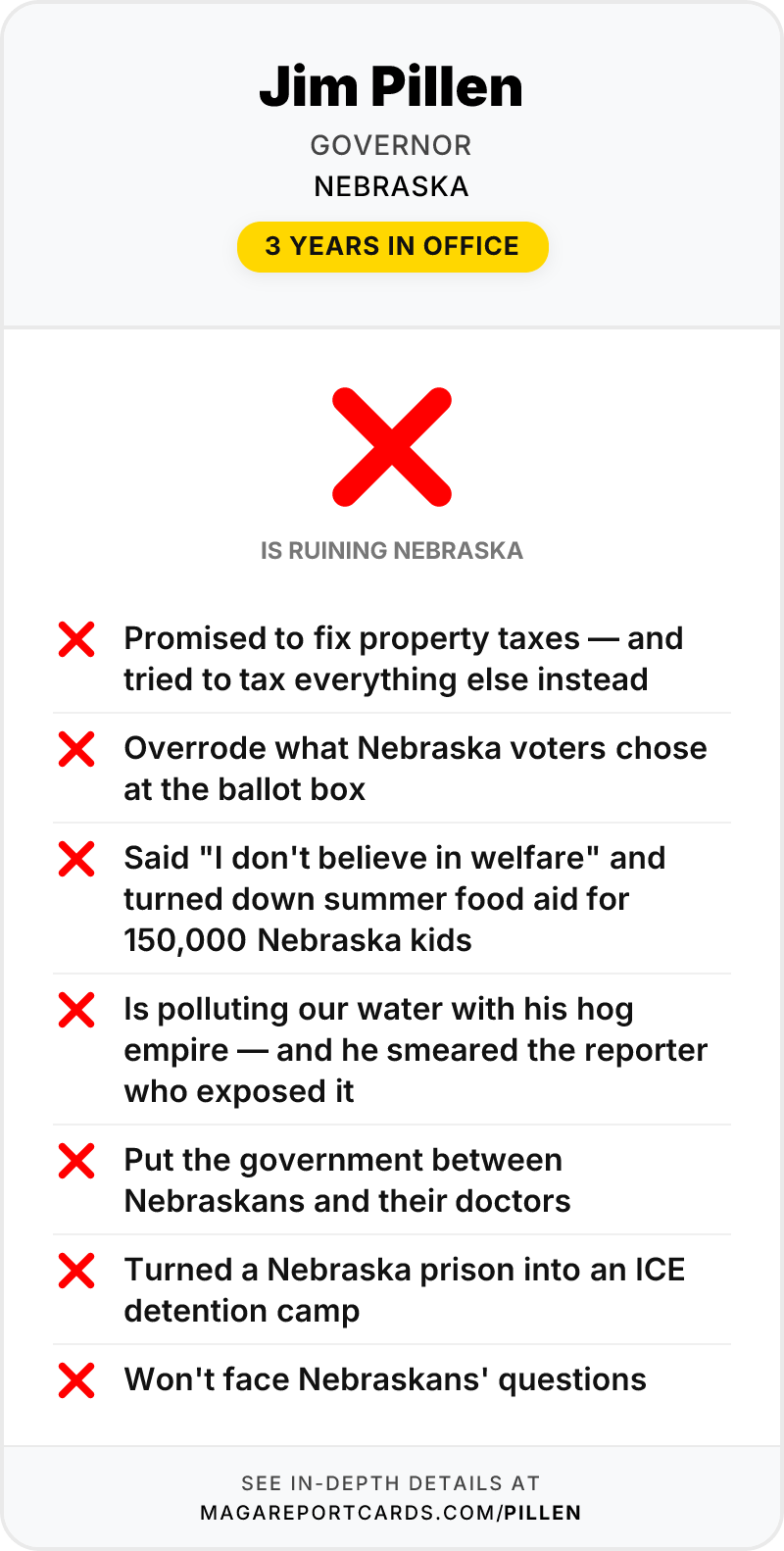
For Pillen specifically, this fits a pattern we've already documented. He's the governor who turned down $18 million in federal summer grocery money for low-income Nebraska kids because "I don't believe in welfare," reversing only after a petition and a sit-down with children who were living it, and whose agencies, under his budget squeeze, floated the idea of employees sleeping in their cars to cut travel costs.
Now he's signed a law that pays 14-year-olds less and guarantees every minimum-wage worker in the state a raise smaller than inflation — while his attorney general goes to court to stop two cities from doing better.
Nebraskans already voted on this. Twice, counting 2014. The answer keeps being yes.
Source
Nebraska AG sues City of Omaha over minimum wage ordinance — Zach Wendling, Nebraska Examiner, August 18, 2026. Photo by Zach Wendling/Nebraska Examiner. Background from the Examiner's February report on LB 258's passage.