On January 20, 2026, Jim Pillen held a telephone town hall and waved off the state's budget shortfall, telling Nebraskans that "the press tries to say that we're broke."
"Quite simply, we've got bushel baskets and bushel baskets of money. And when these people try to make it like we're broke, it's just crazy. It's unacceptable."
Six months later, in July, Pillen sent state agencies a memo. His State Budget Division would withhold at least 5% of their monthly allotments, and most state hiring was frozen.
On Friday, Nebraska Public Media obtained the agencies' written responses. This is what bushel baskets of money look like when the bill arrives.
What agencies said they would do
The Nebraska Board of Barber Examiners proposed doing fewer inspections to save on travel — and that when employees do have to travel, they sleep in their cars instead of getting hotel rooms.
The State Electrical Division will reissue used uniforms rather than buy new ones, so long as they're still clean.
The rest of the list:
- The Nebraska Commission for the Blind and Visually Impaired will discontinue a pilot Support Services Provider program for the DeafBlind community.
- The State Fire Marshal will cut a full-time deputy position and an accountant, and limit staff training.
- The Nebraska State College System will freeze 14 full-time positions and leave 12 more vacant.
- The State Historical Society will cut about $240,000 by eliminating positions — then raise museum admission from $5 to $7 for adults and from $3 to $4 for children, and double the History Nebraska magazine from $35 to $70.
- The Department of Revenue proposed closing its offices in North Platte and Norfolk.
- The Tourism Commission will eliminate positions.
- The Public Employee Retirement Services will install software to pre-answer calls so it needs fewer call-center staff, and cut back in-person seminars for members — even though the educational outreach is required by statute.
And a string of new fees on Nebraskans: insurance licensing fees up $2.2 million a year, contractor registration up from $25 to $40 (the Labor Department wants the Legislature to take it to $100 for a year), broker-dealer and adviser fees up more than $3 million over the next few years, and $325,000 in unspecified fee increases at the Department of Water, Energy, and Environment.
Pillen's office called all of it "hypothetical fiscal restraint considerations" requiring "substantial analysis." He asked for the plans. His agencies wrote them.
The one that hits hardest: seniors and disabled Nebraskans would start paying property tax
Buried in the Department of Revenue's response is the most consequential item.
Nebraska's homestead exemption relieves property taxes for seniors and people with disabilities, and the credits have been based on income — the lowest earners have received a 100% exemption. Revenue's proposal narrows eligibility so that everyone with a homestead exemption would pay at least 10% of their property taxes before credits apply.
That means the poorest elderly and disabled homeowners in Nebraska, who currently owe nothing, would start owing something.
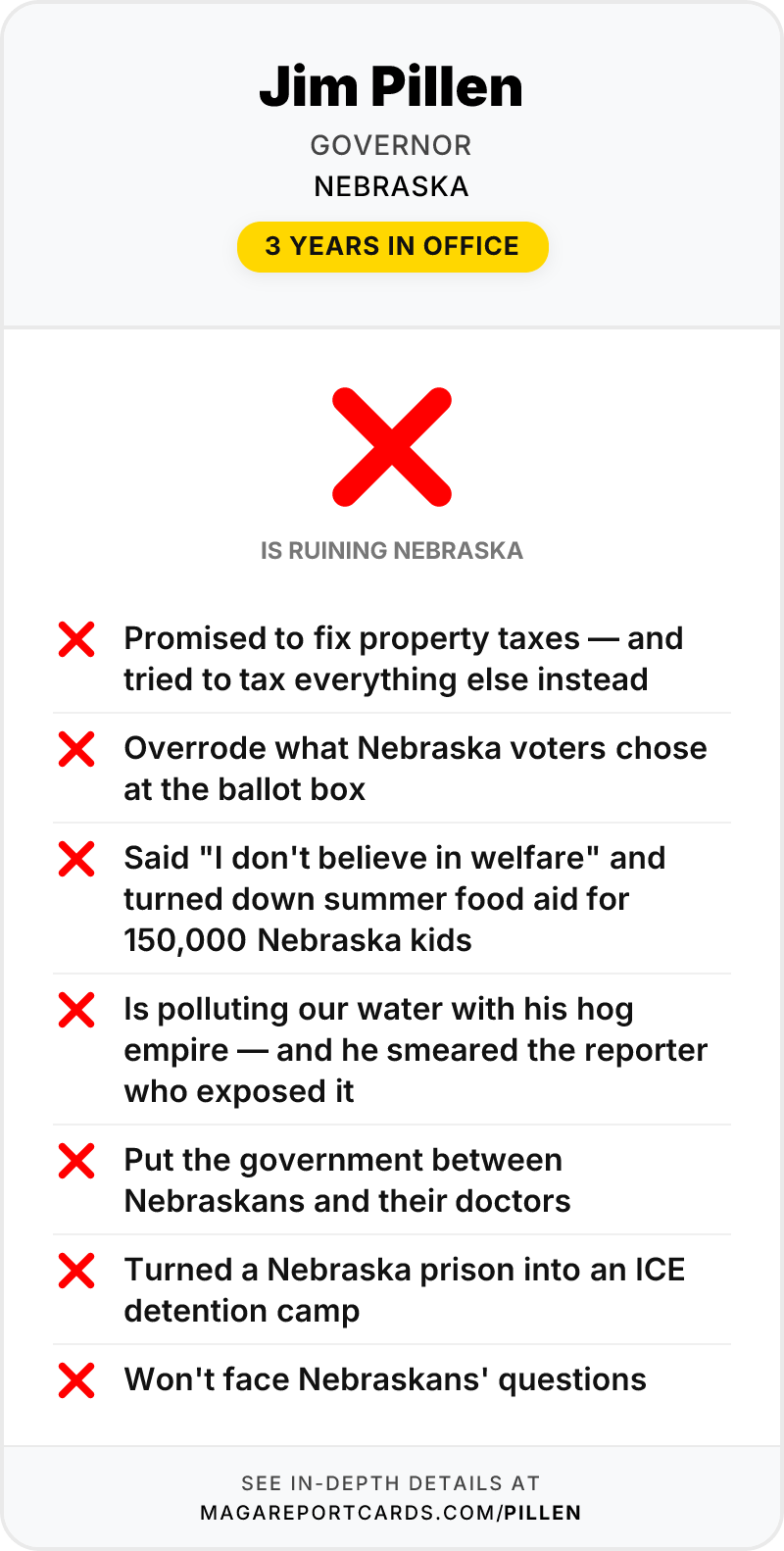
Remember what Pillen ran on. Property tax relief is his signature issue — it is the first item on his report card, and the story there is that he promised to fix property taxes and reached for sales taxes on nearly everything else instead.
Now the budget squeeze he ordered has produced a proposal to raise property taxes on disabled Nebraskans and low-income seniors — the narrowest, most sympathetic group the state protects.
Where the money actually went
Pillen keeps describing this as a spending problem. It started as a tax problem.
Nebraska walked into the 2023 legislative session with a record $1.9 billion surplus — nearly 17% of a year's budget. As the Center on Budget and Policy Priorities documented, that surplus came from one-time federal pandemic relief, not from recurring growth.
Lawmakers spent it anyway — permanently. LB 754 lowered both personal and corporate income tax rates to 3.99% by 2027. LB 243 expanded property tax credits and pulled funding away from public schools.
The promised boom did not arrive. Revenue slowed, costs rose, and to get through last year lawmakers flat-funded most agencies and raided $150 million from cash funds, including the rainy day fund. When a bill came up — LB 171 — that would have simply paused the next round of income tax cuts, the Legislature declined to consider it.
As CBPP put it: when one-time money is used to fund permanent tax cuts, the math doesn't hold, and the bill eventually comes due.
Nebraska is now $208 million in the hole this year and facing an additional $840 million deficit in the next two-year budget. The income tax rates keep stepping down on schedule.
A Republican auditor told him no
The sharpest response in the whole cache came from Mike Foley, Nebraska's auditor of public accounts — and a Republican who spent eight years as lieutenant governor under Pete Ricketts before voters returned him to the auditor's office.
Foley refused, over five pages. He listed what his office has caught — state employees using state vehicles for personal use, ineligible former employees claiming benefits, nonprofits misusing funds — and pointed out that a 5% cut would cost him at least three auditors.
"Such a 'penny-wise and pound-foolish' approach to budgeting would unquestionably jeopardize countless taxpayer dollars by dramatically increasing their risk of undetected (much less unprevented) loss or misappropriation."
Foley also described what happened when his office audited the WIC nutrition program: rather than answer the findings, he wrote, Department of Health and Human Services managers "enlisted Federal bureaucrats in an unsuccessful attempt to dissuade this office from publicizing some of the more startling details contained in the document."
Foley did not object to the policy itself — he told Pillen the call for fiscal restraint was prudent and timely. He objected to taking it out of the office that finds the waste.
Secretary of State Bob Evnen declined to propose reductions too. And four of the largest agencies in state government — Health and Human Services, the State Patrol, Administrative Services, and Motor Vehicles — didn't submit plans at all.
Meanwhile the Military Department warned that the Governor's Emergency Fund, which pays for disaster response, cannot absorb more cuts. It projects just $1 million left in fiscal year 2027-28, assuming no new disasters.
Nebraska is a state with floods and tornadoes. One million dollars is not a disaster fund.
The pattern
This is the same governor who, in January, told a phone line full of his own constituents that the press "tries to say that we're broke" — on the same call where he used an ableist slur three times and proposed cutting roughly $152 million from the agency that runs Medicaid, child welfare, and services for people with disabilities.
It is the same governor who turned down $18 million in federal money to feed low-income Nebraska kids over the summer because, as he put it, "I don't believe in welfare." He reversed only after a petition and after sitting down with children who were going hungry.
The through-line isn't fiscal discipline. Pillen is not asking wealthy Nebraskans to give back any part of a tax cut that is still phasing in. He is asking a state agency's inspectors to sleep in their cars, asking children to pay a dollar more to see the state museum, asking disabled homeowners to start paying property tax, and asking the state auditor to fire the people who find waste.
He is running for a second term in 2026. The bushel baskets are gone, and Nebraskans can see who is being handed the empty one.
Source
- Nebraska Public Media, "Following Pillen's budget memo, Nebraska leaders detail plans to cut staff, increase fees" by Jackie Ourada and Noelle Annonen (August 15, 2026).