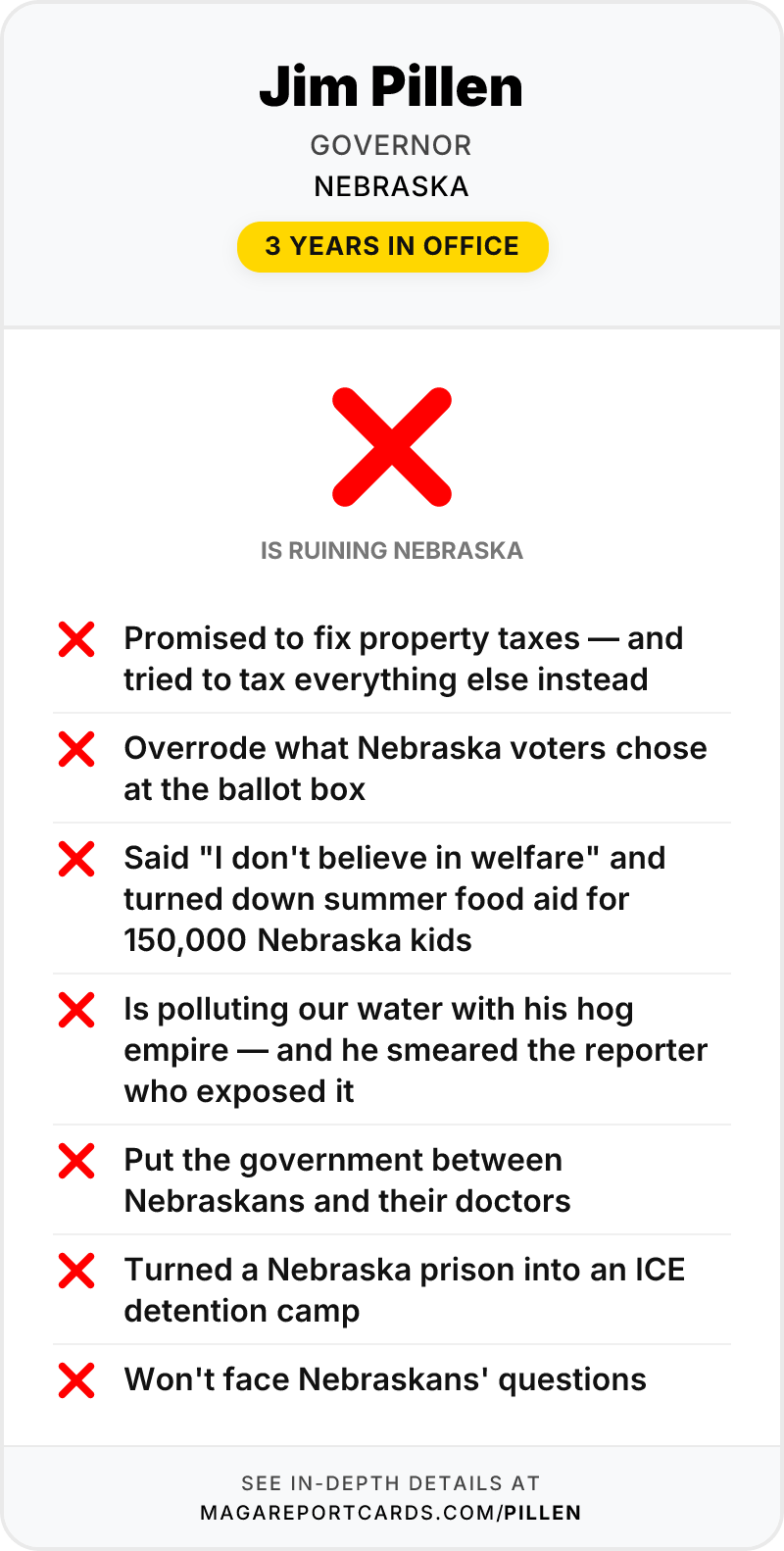
In December 2023, the federal government offered Nebraska $18 million to feed children from low-income families during the summer months, when school meals stop.
The program is called Summer EBT. It puts about $40 a month per child on a grocery card. Nebraska didn't have to build anything or pay for the benefits — the state only had to opt in and split administrative costs.
Jim Pillen said no.
Defending the decision at a news conference, the governor gave an answer that traveled well beyond Nebraska:
"I don't believe in welfare."
What he was turning down
The money would have gone to groceries for kids in families that qualify for free or reduced-price school meals — about 175,000 Nebraska children, by the U.S. Department of Agriculture's estimate, who might otherwise go hungry when school lets out.
At $40 a month, that is around $120 per child across a summer. That is not a lifestyle. It's about two weeks of breakfast.
By the day he reiterated his refusal, 28 other states had already signed up, according to the USDA. The children affected did not choose their parents' income, and none of them can opt into anything themselves.
What changed his mind
The refusal didn't hold.
Nebraska Appleseed circulated a petition and delivered 6,144 signatures from 230 communities. An Omaha man began a vigil outside the governor's residence.
And then Pillen met some of the kids. In February 2024 he reversed himself and accepted the $18 million. His own explanation for the change was that "you sit down with kids who are living it."
Take that sentence seriously, because it's an admission. The governor of Nebraska decided the state's position on child hunger, announced it, defended it publicly with "I don't believe in welfare" — and only discovered what it meant after he sat down with the children it applied to.
He had that available to him before he said no.
The program he tried to block worked
The first summer under the program Pillen initially refused, Nebraska delivered nearly $24 million in grocery benefits to 121,855 Nebraska families. State officials deemed it a success.
That is what was on the other side of "I don't believe in welfare": twenty-four million dollars of groceries, in the carts of a hundred and twenty thousand Nebraska families, in one summer.
Why it isn't ancient history
Pillen's position on this hasn't softened — it's expanded.
Nebraska is now the first state in the country to implement Medicaid work requirements, which he announced alongside the federal Medicare and Medicaid administrator in December. On that same call, he brushed off the state's $471.5 million budget shortfall — "the press tries to say that we're broke," he said, insisting his budget "fills it" — while defending a proposed budget that would cut roughly $152 million from the Department of Health and Human Services — the agency that runs Medicaid and child welfare.
The through-line is a governor who treats programs for low-income Nebraskans as a matter of belief rather than arithmetic. The $18 million wasn't refused because Nebraska couldn't afford it. Nebraska wasn't paying for the groceries. It was refused on principle, and the principle was stated out loud.
The bottom line
Jim Pillen was handed $18 million in federal money to keep Nebraska kids fed over the summer and turned it down, explaining that he doesn't believe in welfare. It took a 6,144-signature petition and a face-to-face meeting with hungry children to move him.
When the program finally ran, it fed nearly 122,000 Nebraska families.
Nebraskans deserve a governor who doesn't need to meet a hungry child to understand what hunger is. We deserve better.
Source
"Nebraska governor again rejects giving kids from low-income families $40 per month for food: 'I don't believe in welfare'" — Associated Press via Fortune, December 29, 2023. Reversal reported by WOWT, February 12, 2024; results by the Nebraska Examiner, October 17, 2024. Photo: Jim Pillen at SelectUSA (Wikimedia Commons).