There is a corner of federal law almost nobody knows about. It says that if you have a disability, your boss is allowed to pay you less than the minimum wage. Not a little less. A lot less.
It is called Section 14(c) of the Fair Labor Standards Act, and it has been on the books since 1938. As of May 2024, about 40,000 people worked under it. The Labor Department's own numbers say the median worker in that program earns $3.46 an hour.
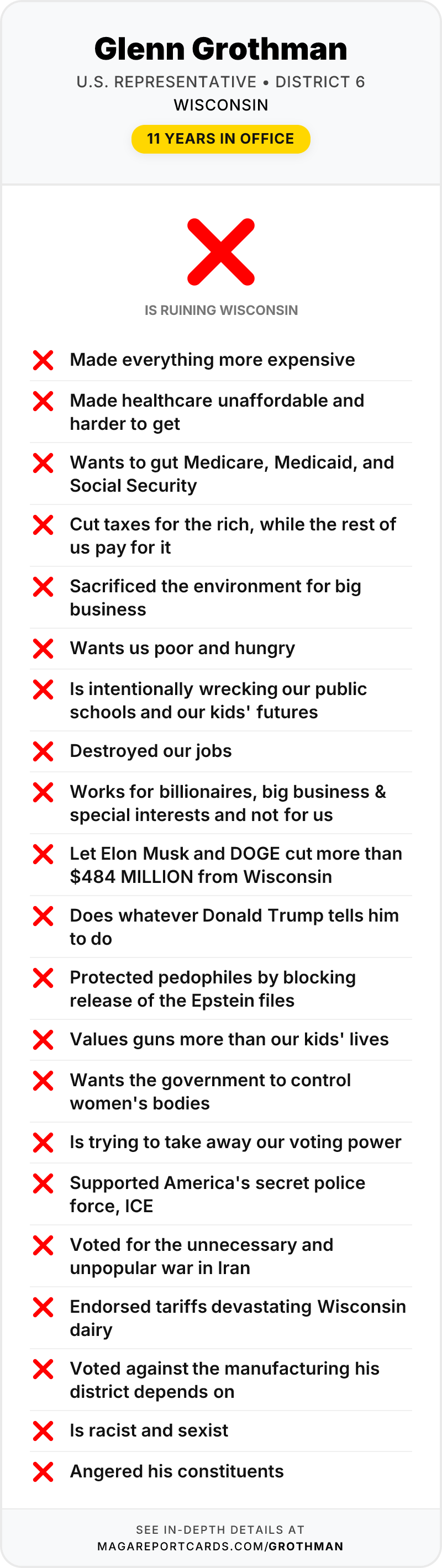
In May 2026, Glenn Grothman introduced a bill to make it easier to put more people into those jobs — and to put them there younger, with fewer questions asked first.
What the bill actually does
The bill is called the Restoration of Employment Choice for Adults with Disabilities Act, H.R. 8736. Grothman has introduced some version of it in the 118th Congress and the 117th too. This is not a one-off. It is a project.
The nonpartisan Congressional Research Service wrote the plain-English summary. In its words, the bill "relaxes requirements that allow entities with a special wage certificate to pay subminimum wages to individuals with disabilities." It singles out two changes:
- It "eliminates a requirement that an individual with a disability who is age 24 or younger receive pre-employment transition services and meet specified vocational rehabilitation criteria before beginning subminimum wage work."
- It weakens the career-counseling rule. Right now an employer has to make sure a subminimum-wage worker actually gets periodic counseling and referrals to other kinds of work. Under Grothman's bill, the employer is off the hook if it makes "a documented effort" to contact the state agency and the agency doesn't come through.
Read that first one again. The protection he is removing exists for exactly one reason: to stop a young person with a disability from being handed a below-minimum-wage job at 18 or 19 and staying there for the rest of their life without ever being told there was another option.
Those protections were bipartisan, and they are barely ten years old
The rules Grothman wants gone are not some leftover regulation. Congress passed them.
In 2014, the Workforce Innovation and Opportunity Act added Section 511 to the Rehabilitation Act, and it took effect in 2016. As the Labor Department laid out in 2024, WIOA "established new limitations on the payment of a subminimum wage." Certificate holders have to document that young workers got transition services before they started, and that every subminimum-wage worker gets counseling every six months for the first year and every year after that.
That is the paperwork Grothman calls a burden. It is also the only thing standing between a 19-year-old and a lifetime at $3.46 an hour.
The numbers he is not mentioning
The Labor Department published all of this. From its December 2024 analysis of the program:
- The mean average hourly earnings for workers on a 14(c) certificate is $4.08. The median is $3.46.
- Those workers get a mean of 11.45 hours a week. At the median wage, that is about $40 a week.
- As of May 1, 2024, 40,579 workers with disabilities were being paid subminimum wages, at 801 employers.
- About 91% of them have an intellectual or developmental disability listed as their primary disability.
- Only about 4% of certificate holders are private for-profit businesses. Roughly 93% are community rehabilitation programs — many of them funded with public money.
The federal minimum wage is $7.25 an hour. Half the people in this program are making less than half of that.
The Labor Department looked at all of it and tentatively concluded that "subminimum wages are no longer necessary to prevent the curtailment of employment opportunities for individuals with disabilities." It proposed phasing the certificates out over three years. More than 17,000 people filed comments.
Then, on July 7, 2025, the Trump administration's Labor Department withdrew the proposal entirely — "formally discontinuing the rulemaking process and removing the proposal from further consideration."
So the phase-out is dead. Subminimum wage is staying. And Grothman's bill would push it further, by lowering the age at which someone can be routed into it and cutting the counseling that might get them out.
"Freedom to choose"
Here is how Grothman describes what he is doing. He told Seehafer News that "adults with disabilities deserve the freedom to choose the workplace environment that works best for them without unnecessary government obstacles standing in the way."
The "unnecessary government obstacle" is a counseling session. The "freedom to choose" belongs to a person who, under this bill, would no longer be guaranteed the information needed to choose anything.
He has been making this argument for years. In February 2021, when Democrats tried to end Section 14(c) in the COVID relief bill, he and three other House Republicans warned President Biden in a letter that doing so would leave many people with intellectual and developmental disabilities "limited to day rehabilitation services or unpaid volunteer work," or with "no option other than being at home."
That was the argument in 1938 too. The Labor Department's review found it doesn't hold up anymore: the number of employers using these certificates fell from 2,820 in April 2015 to 801 by May 2024 — down almost 86% from 2001 — while the employment rate for people with disabilities generally climbed. Employers stopped using it and disabled people kept working.
He is on the committee that writes these rules
This matters more than a backbencher's message bill usually would. Grothman sits on the Education and Workforce Committee — per the House Clerk's official member roster — the committee with jurisdiction over federal labor law and the Rehabilitation Act, including the very section his bill amends. He is not shouting from the sidelines. He is inside the room where this gets decided.
And the country is moving the other way. In South Carolina in 2022, a bipartisan effort to end subminimum wage for people with disabilities passed the state Senate unanimously. The Labor Department counted 53 certificate holders sitting in states that are already phasing the practice out. States are closing this door. Grothman is trying to hold it open, and widen it for teenagers.
What this says about who he works for
Grothman has spent his career arguing that people at the bottom are not trying hard enough. He said giving public employees Martin Luther King Jr. Day off is "an insult to all the other taxpayers around the state." He told Wisconsin Public Radio last October that federal workers "are not working very hard at all." He backed repealing a Wisconsin law that made it easier for women to sue over pay discrimination, and when asked about the gender pay gap, said, in his words, "you could argue that money is more important for men."
This bill is the same instinct pointed at people with intellectual and developmental disabilities. Not "how do we get them a real wage." How do we make it easier to pay them $3.46 an hour, starting younger, with less explanation.
When the Labor Department last counted, there were about 40,000 people in this program. Ninety-one percent of them have an intellectual or developmental disability. They are somebody's kid, somebody's brother, somebody's neighbor. On average they work about eleven hours a week, and at the median wage that comes to about forty dollars.
Glenn Grothman looked at that and decided the problem was too much counseling.
Source
- H.R. 8736, Restoration of Employment Choice for Adults with Disabilities Act — Congress.gov
- Rep. Grothman Introduces New Adults with Disabilities Employment Bill — Seehafer News, May 15, 2026. Photo: Seehafer News.