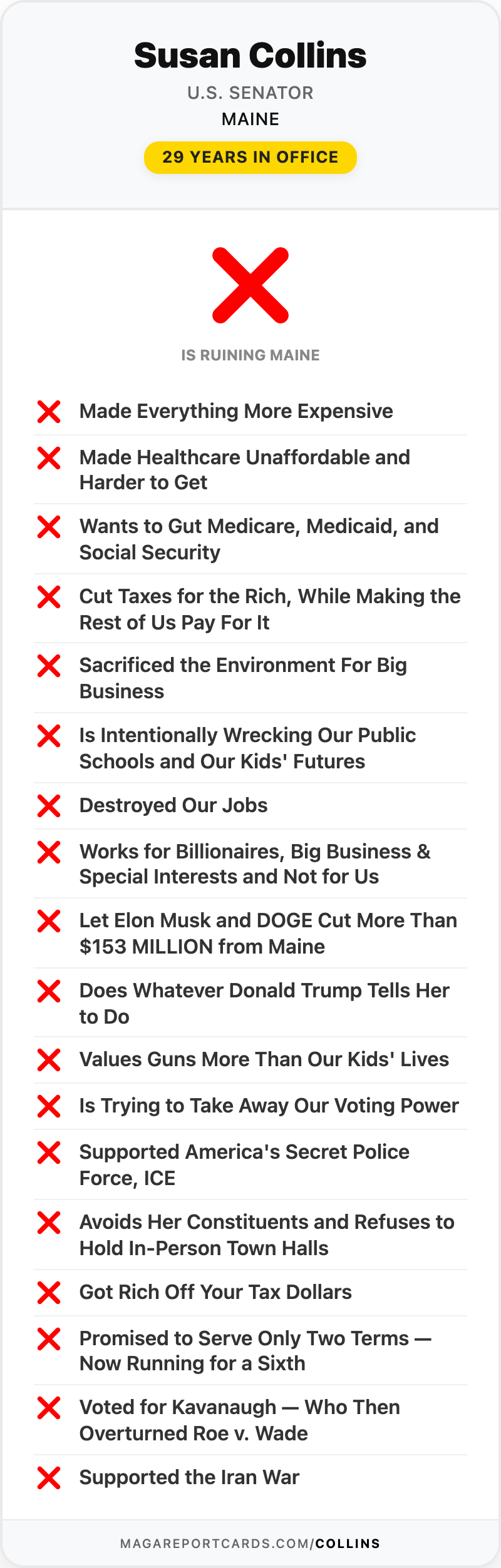
Susan Collins has built a reputation in Washington as a moderate. Long before she got to Washington, she had a job that tested that. She was the person Maine's Republican governor sent to cut benefits for workers who got hurt on the job.
A new report by Branko Marcetic in Jacobin digs up that record from the newspapers of the time. It shows Collins, then an unelected state official, leading a years-long push to cut workers' compensation — the insurance that pays a worker's medical bills and lost wages after an injury at work.
Who workers' comp is for
Workers' comp exists for the logger who loses a hand, the nurse who wrecks her back lifting a patient, the mill worker crushed by a machine. When it shrinks, those people pay.
In the late 1980s, Maine's system was expensive. Costs for a permanent injury ran nearly double the next-most-expensive state, and insurance companies were threatening to leave. Gov. John McKernan's answer was to cut. Collins was his point person.
Papers at the time called her "the administration's point person on workers' comp," the governor's "top advisor" on the issue and "the administration's negotiator," Jacobin reports. When Collins ran for governor in 1994, she campaigned on it, taking credit for having "reformed workers' compensation."
What the cuts did
The changes came in two rounds.
- 1987: Lawmakers handed the power to set rates to a single political appointee. Benefits were cut by more than 40 percent while premiums went up more than 50 percent, according to Jacobin, with some of the most badly injured workers taking the hardest hit.
- 1991: More cuts for some workers, plus a new rule that let one "independent medical examiner" effectively decide disputed claims. A 1993 Maine Law Review article explains that the state's workers' comp board had to adopt that examiner's medical findings unless there was clear and convincing evidence against them — and questions whether that was even constitutional.
Before the 1991 round, Collins advised the governor to veto a Democratic bill that would have made benefits more generous. Then she toured the state to sell his plan. The administration's own analysis found two-thirds of the savings in that plan came out of injured workers' pockets, Jacobin reports.
She asked business to lobby for it
Collins did not just carry the plan. She recruited help from the industries that stood to gain.
"We're counting on the business community to mount a lobbying effort to push [the cuts] through," she told a Portland-area chamber of commerce in October 1987, according to Jacobin. "It's absolutely critical that you start today."
Business spent nearly $50,000 lobbying for the 1987 changes. A few years later, insurance agents got a letter for the governor's campaign praising Collins and other appointees for their "knowledge of our industry."
And when nearly 40 industry groups wrote their own wish list in 1991, Collins admitted her package "parallels some of the themes advanced by" the employers.
The shutdown
In the summer of 1991, Gov. McKernan tied the workers' comp cuts to the state budget and refused to sign it without them. The government shut down. He furloughed 10,000 state employees for nearly three weeks, the Christian Science Monitor reported.
It was the first government shutdown in Maine's history. Democrats held firm, and the final deal dropped the limits on who could get benefits and for how long that Collins had fought for. It kept other cuts, and it kept the independent medical examiner.
It didn't work
The cuts were sold as a way to save jobs. There was little sign they did.
In 1991, a Maine Chamber of Commerce survey of 75 companies that had closed or laid off workers found just two that named workers' comp as the main reason, according to Jacobin. Insurers kept winning big rate hikes anyway. Less than half a year after the 1991 deal, nine insurance companies again filed to leave Maine.
Even the governor's own press secretary admitted in 1992 that "only about 40 percent" of the money in the system made it "into the hands of injured workers."
One long-proposed alternative was a state-run insurance fund that would add competition and wouldn't flee the market. Collins fought it, in part "because of our philosophical commitment to the private market," she wrote in 1990.
It took nearly 30 years for Maine to roll back the cuts she backed. The 2019 effort to fix the system was partly led by Troy Jackson — the Democrat now running against her.
The same pattern, 30 years later
As a senator, Collins has kept siding with employers over the people who work for them. In a single sitting, she voted against equal pay, paid sick days and the right to join a union.
Gerard Conley Jr., a Democratic state senator who negotiated with her back then, remembered her this way: "She struck me as being extremely bright. But I also felt she had absolutely no heart. She would get what she knew the governor needed at any cost — even if it included shutting down state government."
In summary
In the late 1980s and early 1990s, Susan Collins was the Maine governor's lead official on cutting workers' compensation. She pushed changes that cut benefits for injured workers, asked business groups to lobby lawmakers for them, and helped carry a fight that ended in a nearly three-week state government shutdown. The cuts didn't deliver the jobs they promised, and Maine spent almost 30 years undoing them.
Source
Jacobin: Susan Collins's Record: Making Injured Workers' Lives Harder