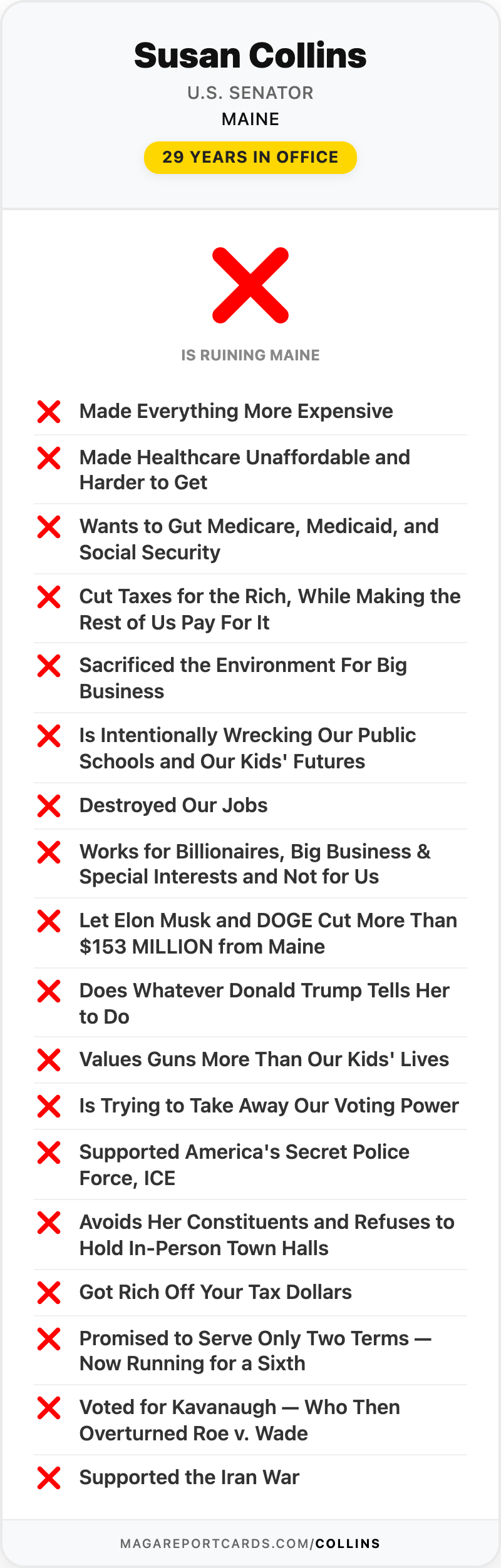
Susan Collins calls herself a moderate. At one committee markup in June 2023, she had three chances to prove it, on three of the plainest questions in American working life: should women be paid the same as men for the same work, should workers get paid days off when they are sick, and should workers be able to organize a union without being punished for it.
She voted no on all three.
What was on the table
On June 21, 2023, the Senate Health, Education, Labor and Pensions Committee — the committee that writes the country's labor law — took up three bills in one markup:
The Paycheck Fairness Act (S. 728). It would limit an employer's ability to defend a pay gap between men and women by calling it "a factor other than sex," stop companies from forcing workers to sign contracts that bar them from discussing their pay, strengthen protection against retaliation, and raise the penalties for breaking equal-pay law.
The Healthy Families Act (S. 1664). It would let workers at businesses with 15 or more employees earn up to seven paid sick days a year — one hour of sick time for every 30 hours worked. At smaller businesses, the days would be unpaid but job-protected.
The Protecting the Right to Organize Act (S. 567). It would make it harder for employers to punish workers for organizing, close the loophole that lets companies call employees "independent contractors" to strip their rights, and ban the forced-arbitration clauses that keep workplace disputes out of court.
All three passed the committee 11 to 10, along party lines. Collins is a Republican member of that committee. She was on the losing side of all three votes.
She did not just vote no. She tried to make the bills weaker first.
Voting against a bill is a position. Amending it to do less is a choice about what you would accept even if it passed.
On the equal-pay bill, Collins backed two amendments that would have gutted it. One would have let an employer escape liability for paying women less by having run a recent pay-equity audit and taken reasonable steps to correct what it found. The other went after the requirement that pay differences be tied to merit at all. Neither passed.
On the paid sick leave bill, American Journal News reports that she supported an amendment to carve seasonal workers out of it entirely.
Think about who that carve-out covers. Summer hospitality, the harvest, winter tourism — the seasonal jobs Maine's coastal and rural economies run on. Those are the workers least likely to already have paid leave from an employer, and Collins moved to make sure the bill would not reach them.
What it means to have no paid sick days
Seven days a year is not a generous benefit. It is the difference between staying home with the flu and serving food with it. For a parent, it is whether a sick child means a lost shift or a lost job.
A worker without paid sick leave who takes a day off loses the day's pay, and often risks discipline for it. That is the status quo Collins voted three times to preserve — no federal right to paid sick days, no strengthened equal-pay enforcement, and no new protection for workers trying to organize.
The pattern this fits
Collins has represented Maine in the Senate since 1997 — 29 years. She has built her brand on being the reasonable one. The record keeps landing somewhere else.
She is running this year with Elon Musk's America PAC targeting Maine as one of eight states, and the Senate Leadership Fund committing $42 million of its own. Her campaign also made a man named on the Oath Keepers' leaked membership rolls a town chair.
The labor votes are the quietest part of that record, because committee votes do not make the evening news. They are also the part that shows up in a paycheck.
What the record shows
On June 21, 2023, Susan Collins sat on the Senate committee that writes labor law and voted against all three bills before it: equal pay enforcement, seven paid sick days a year, and the right to organize a union. Each passed the committee 11 to 10 on a party-line vote with her in the minority. She additionally backed two amendments to weaken the equal-pay bill and one to exclude seasonal workers from paid sick leave altogether.
Source
"Susan Collins voted against pay equity, sick leave," by Jesse Valentine, American Journal News, September 8, 2026 — the source for the three amendments Collins backed. The June 21, 2023 markup, the three bill numbers and the 11-10 party-line tallies were confirmed against the committee summary published by CUPA-HR, the Senate HELP Committee's own executive-session record, and Congress.gov, which shows all three bills ordered reported on June 21, 2023. The sick-leave thresholds are from the text of S. 1664.