Elon Musk is planning to spend heavily to keep Susan Collins in the United States Senate.
The New York Times reported that Musk has authorized his super PAC to spend up to $120 million across at least eight states this fall — and Maine is one of the early targets. The Bangor Daily News confirmed that the money is expected to land on Collins' side of Maine's Senate race.
The vehicle is America PAC, the same group that, in the BDN's words, "dumped nearly $300 million supporting President Donald Trump in 2024."
Maine has about 1.4 million residents. One man is preparing to spend a nine-figure sum across a handful of states to decide who represents them.
He said he was done with this
The timing is worth noting, because Musk spent this summer telling people he was stepping back.
"I think I got a little too involved in politics, got carried away frankly," he told The Economist in late July, per Forbes. He'd said something similar to Bloomberg back in May 2025 about his political spending: "I'm going to do a lot less in the future."
Days after the Economist interview, the $120 million plan leaked. The early Senate targets are Alaska, Iowa, Maine, Michigan and Ohio, with conversations underway about North Carolina and Texas. The money is going largely into a turnout operation — door-knockers, digital ads, direct mail — rather than TV.
That is a specific kind of spending. TV ads argue for a candidate. A ground operation goes and gets the votes. Musk isn't buying a message in Maine. He's buying the machinery.
What makes this strange
Here's the part that doesn't fit the obvious story.
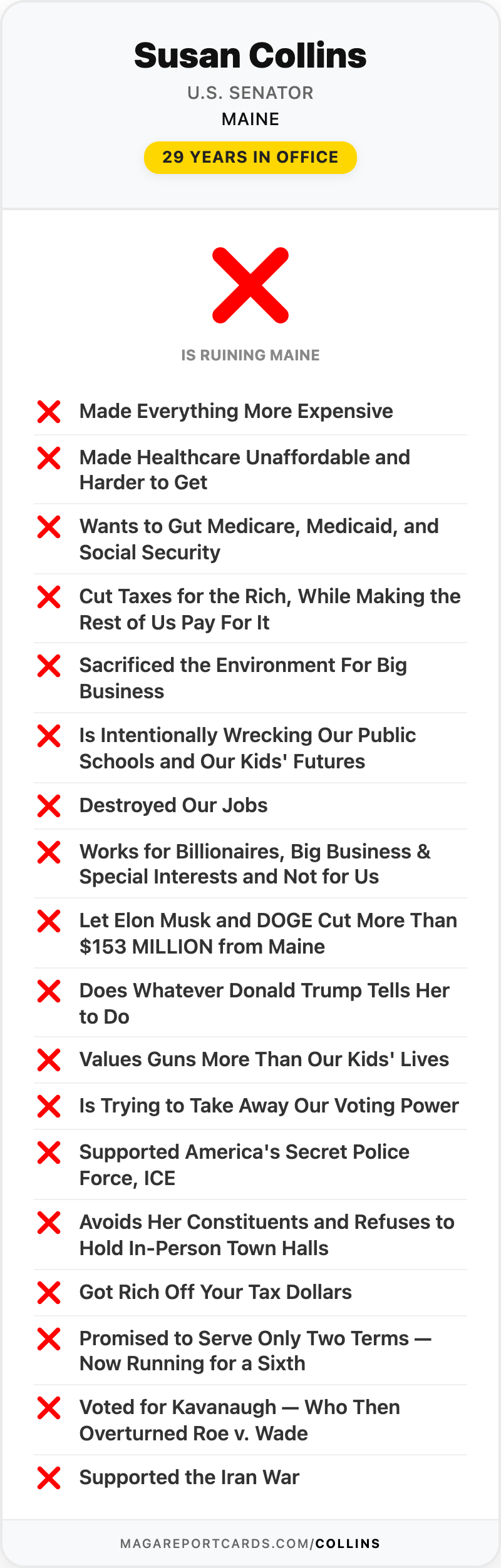
Collins is not a Musk ally. She chairs the Senate Appropriations Committee — the most powerful spending panel in the federal government — and she was, as ABC News reported at the time, the most vocally skeptical Republican on the bill that wrote Musk's DOGE cuts into law — a bill that clawed back roughly $9 billion Congress had already approved for public broadcasting and USAID. Her stated objection was to the public broadcasting piece: "There is a lot of what the Corporation for Public Broadcasting does that I support, such as the 70 percent of the money that goes to the emergency fund to local stations."
When that bill came to the Senate floor at 2:18 in the morning on July 17, 2025, the official roll call shows it passed 51-48. Exactly two Republicans voted no. Collins was one of them. Lisa Murkowski was the other.
So the man whose signature project she voted against now wants to spend millions keeping her in office.
That tells you what this money is actually for. It is not a reward for a vote. It is not an argument about Maine. Musk is not buying Susan Collins — he is buying the Senate, and Maine is one of the seats it runs through. Whether Collins personally agrees with him on any given bill is beside the point, which is exactly why nobody in Maine gets a say in it.
Update, August 14: Musk isn't even the biggest check
Since this was published, the scale of the outside money behind Collins has gotten clearer — and Musk turns out to be a junior partner in it.
The Senate Leadership Fund, the super PAC aligned with Senate Republican leadership, has committed $42 million to defending Collins. The Bangor Daily News reported the figure in January; it is the group's largest-ever investment in Maine, and nearly $37 million of it is earmarked for broadcast, cable, digital and radio advertising across a state of 1.4 million people.
Its nonprofit sister organization, One Nation, has raised its own Maine spending to $30 million from $25 million. One Nation is the same dark-money group that runs at least six websites designed to look like local newspapers — one of which exists to flatter Collins, with readers never told who pays for it.
On August 12, SLF went on the air with a 30-second spot attacking Democratic nominee Troy Jackson over his son's lobbying work and calling him "another dirty politician."
One number worth keeping straight: the $42 million is a commitment, not money out the door. We pulled the Senate Leadership Fund's independent-expenditure filings from the FEC to see what has actually landed in Maine. Through August 4, 2026 — de-duplicating the 24-hour notices that get refiled on the periodic reports — SLF has reported spending $776,326 in the race:
| Target | Amount |
|---|---|
| Against Troy Jackson | $292,500 |
| Against Graham Platner (before he left the race) | $250,000 |
| Supporting Susan Collins | $233,826 |
So the ad deluge has barely started. About 98% of the $42 million is still to come, and nearly all of it is booked for the fall.
Jackson's response to the whole arrangement, in a video posted the day after the ad launched:
"The billionaires in the country know whose side they're on, and it's not ours... They're here to prop up Susan Collins because they want her to continue to be a rubber stamp and get their income tax cuts."
The pattern this fits into
Musk is not new. He is one of several.
Collins' reelection is already, in the BDN's phrasing, backed by "a cluster of well-heeled groups" — and the pattern of who funds her, and what happens afterward, is long and documented.
Her top donors are the Wall Street private equity firms whose tax treatment she is in a position to protect: KKR, Blackstone, Apollo Global Management, Oaktree, Goldman Sachs. Blackstone's CEO Steve Schwarzman gave $2 million to her PAC the day before she helped advance Trump's budget bill, Rolling Stone reported. ProPublica documented the broader arrangement in a piece whose headline says the whole thing: "Susan Collins Backed Down From a Fight With Private Equity — Now They're Underwriting Her Reelection."
Her Democratic opponent, Troy Jackson, made the point about Musk bluntly on social media:
"He doesn't care about us. He really doesn't care about Susan. He cares about him."
The independence brand and the bill
Collins' entire political identity is that she is the independent one — the Republican who breaks with her party when Maine needs her to.
That vote is real, and it counts. But it also fits a shape Mainers have seen before: a highly visible no vote on the last step, after the earlier steps that made the outcome possible. We laid this out in detail when her campaign ran an ad claiming she "stood up for Maine" on Medicaid — she voted no at the end, after casting the procedural vote that sent Trump's Medicaid-cutting budget bill to the floor in the first place. A fellow Republican thanked her for it.
A no vote you can put in an ad is worth a great deal. It is also, from a donor's perspective, cheap — as long as the bill passes anyway.
That is the arrangement Musk's $120 million is joining. Collins gets to keep the independent label. Her funders get the majority. And when the bills that matter to them come up, the votes are already there.
What Mainers should ask
There's a straightforward question here, and it doesn't require anyone to guess at motives.
Collins has spent thirty years telling Maine that she works for Maine. She promised in 1996 to serve only two terms — "twelve years is long enough," she said on camera — and she is now running for a sixth.
The question for her is simple: does she want this money?
She can say no. Super PACs are legally independent of campaigns, so she can't coordinate with America PAC — but nothing stops a candidate from standing up and publicly asking an outside group to stay out of her race.
If she won't say that, Maine voters can draw their own conclusion about who this campaign is being run for.
Sources
- "Elon Musk plans boost for Susan Collins' reelection campaign" — Bangor Daily News / Maine Public, August 4, 2026
- "Musk Investing Up To $120 Million To Help GOP In Midterms, Report Says" — Sara Dorn, Forbes, July 30, 2026
- "Senate to vote to formalize DOGE cuts to public broadcasting, USAID" — ABC News, July 2025
- Senate Roll Call Vote 119-1-411, On Passage of H.R. 4 — U.S. Senate, July 17, 2025
- "Troy Jackson Slams 'Failed Trillionaire Elon Musk' as Billionaires Dump Millions Into Maine US Senate Race" — Common Dreams, August 13, 2026
- "Conservative groups launch ad deluge in Maine Senate race" — Semafor, August 12, 2026
- Senate Leadership Fund (C00571703) independent expenditures, 2026 cycle — FEC Schedule E, retrieved August 14, 2026
Photo: Associated Press, via Bangor Daily News.