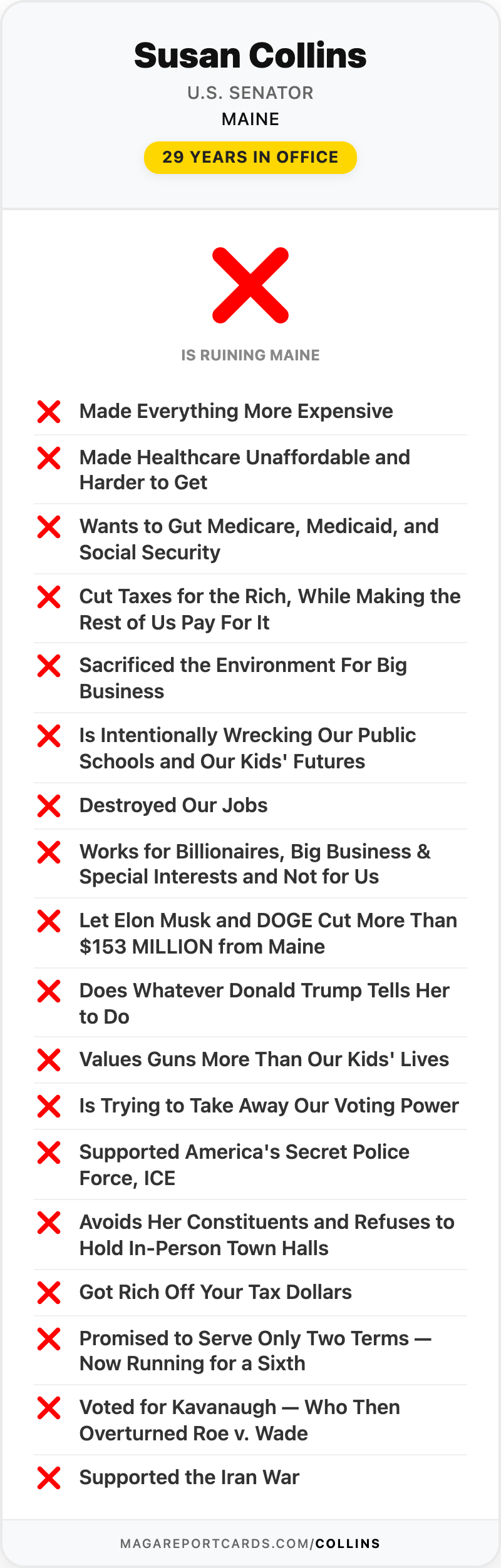
Susan Collins is running a new campaign ad. It tells Mainers that "when Medicaid was on the line, Susan Collins stood up for Maine." It's a nice line for a tough reelection fight. There's just one problem: it leaves out the vote that helped the Medicaid cuts pass in the first place.
Collins wants credit for the "no" vote she cast at the very end — after the outcome was already locked in. What her ad doesn't mention is the vote she cast at the beginning — the one that put the bill on the floor.
The vote her ad leaves out
Trump's budget bill — the "One Big Beautiful Bill Act" — cut roughly $1 trillion from Medicaid and health care. Before the Senate could pass it, senators had to agree to take it up. That's called the motion to proceed. If it fails, the bill goes nowhere.
On June 28, 2025, the Senate voted 51–49 on that motion. It was that close. Two Republicans — Rand Paul and Thom Tillis — voted no. If Collins and one more Republican had joined them, the bill could have been stopped right there. Her vote alone would only have forced Vice President J.D. Vance to break a tie.
She didn't. Susan Collins voted yes and helped send the bill to the floor.
Her fellow Republicans knew exactly how much that vote was worth. North Dakota Senator John Hoeven called Collins a "team player" who "helped us get on the bill at a time when we needed that help." That's not a Democrat attacking her. That's a Republican thanking her.
The "no" vote came too late to matter
Days later, on final passage, Collins voted no. That's the vote her ad is built around.
But by then it changed nothing. The bill passed the Senate 51–50, with Vice President J.D. Vance breaking the tie. Collins' "no" was the 50th vote against — one short of stopping it. Lisa Murkowski's yes, as the Boston Globe put it, was the "pivotal support"; Collins' vote "was not decisive."
This is a pattern with Collins, and it's one we've written about before. As TIME reported, her protest votes are "as strategic as they are symbolic." She votes no when the outcome is already decided — when a no vote lets her look moderate back home without actually stopping anything.
And the timing of that motion-to-proceed vote is its own story: Collins cast it the day after a private equity billionaire gave $2 million to a super PAC supporting her reelection. Then she voted against the final version. Same move: help it along quietly, oppose it loudly at the end.
Why this matters for Maine
This isn't a technicality. About 396,000 Mainers are enrolled in Medicaid — between 23% and 34% of the people in each of the state's congressional districts — and half of them live in rural areas. Rural hospitals across the state depend on those dollars to keep their doors open.
Collins says she fought for rural-hospital protections. She did negotiate for carve-outs — TIME calls it unsuccessful; she wanted $100 billion for rural hospitals and got a $50 billion fund — and she voted to advance the bill while those talks were still going. Wanting a better version of a bill that guts Medicaid, and then helping it move forward, is not the same as stopping it.
Here's the honest version of what happened:
- Collins voted yes on the motion to proceed, the vote that put the bill on the floor.
- She voted no on final passage — after it was clear the bill would pass anyway.
- The Medicaid cuts became law.
An ad that tells Mainers she "stood up for Maine" on Medicaid asks them to remember only the second of those three facts.
The bottom line
A campaign ad is supposed to tell voters what a politician did. This one tells them what she wants credit for while hiding what she actually did. When her party needed votes to get Trump's budget bill onto the Senate floor, Susan Collins supplied one — and a Republican colleague publicly thanked her for it.
Mainers who lose their health coverage because of this bill won't get to vote "no" once the outcome is already decided. Collins did. She's now running ads hoping they don't notice the difference.
Source
This post is based on reporting by American Journal News, the official U.S. Senate roll-call record for the June 28, 2025 motion to proceed, and the Boston Globe.