Coal miners in eastern Kentucky spent their working lives breathing in the dust that pays for our lights and our steel. A lot of them are dying from it. The disease is called black lung, and once you have it, it never gets better.
The federal government sends those miners a disability check every month. Right now it comes to about $794. That check has not kept up with the cost of living in decades — a miner as of 2023 got about 30% less, after inflation, than a miner got in 1969, according to an analysis by two Appalachian nonprofits. If the payment had simply kept pace, it would be well over $1,000 a month.
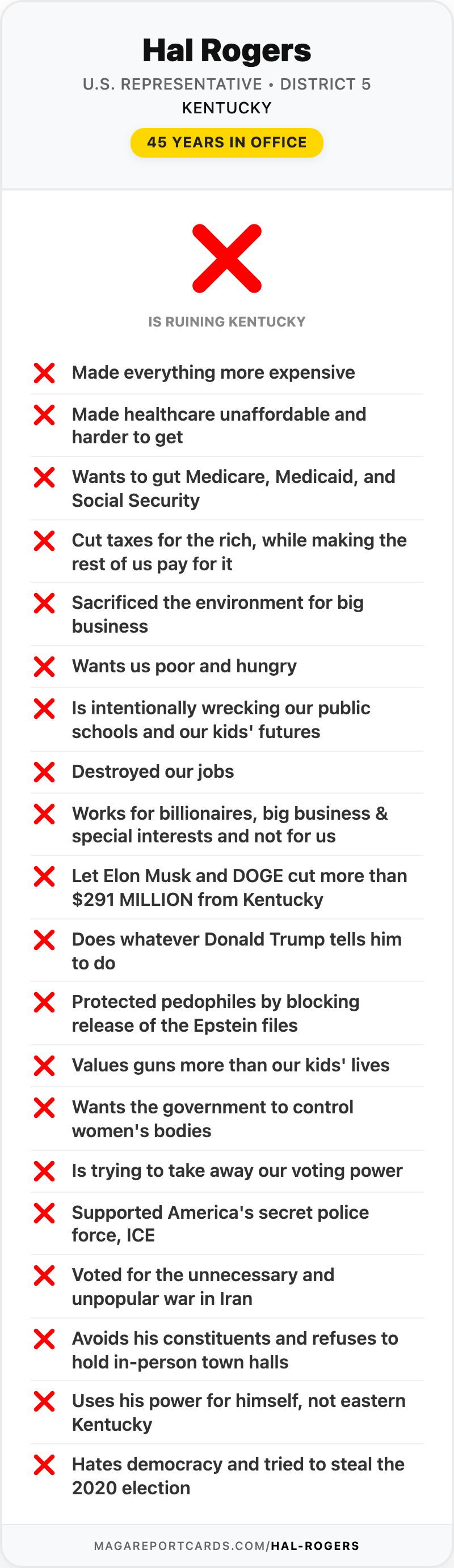
Kentucky has more black lung recipients than any state in the country — more than 4,700 as of 2025. The heart of the state's coal country, the mountains of eastern Kentucky, has been represented for the last 45 years by Hal Rogers.
Local leaders in coal country — Republicans and Democrats both — want those checks raised. Rogers won't sign on to do it.
Local Republicans are begging Washington to act
This isn't a partisan fight back home. All over Appalachia, county and city governments have passed resolutions asking Congress to boost black lung benefits.
One of them is David Johnston, the Republican Judge-Executive of Ohio County, Kentucky. His uncle died of black lung. His father suffered from it. "The government should have had workplace safety in place to protect them, and they didn't," he told the Kentucky Lantern. "These folks got sick."
Todd DePriest, the Republican mayor of Jenkins, called the money it would take a "drop in the bucket." "They mined the coal that made the steel that won the war," he said.
There is even a bill ready to go. The Support Our Miners Act, introduced at the end of June, would raise the monthly benefit and tie it to inflation so it never falls behind again. It's aimed at helping more than 25,000 miners and their families across the country.
Here's the problem. Not a single Kentucky Republican in Congress has signed on. The only Kentuckian backing it is Democratic Rep. Morgan McGarvey of Louisville. Rogers is not on the bill. When the Kentucky Lantern emailed the offices of Rogers' fellow Kentucky Republicans — both senators and four House members — not one of them responded.
What Rogers said instead
Rogers did send a statement. He didn't say he'd back the bill. He said he had voted for an $18 million increase to the Black Lung Disability Trust Fund in the most recent budget, and that his caseworkers help miners get benefits. Mostly, he blamed Democrats.
He accused them of a "targeted War on Coal" and said they weren't "being transparent about their movement to destroy the trust fund." He said the Black Lung Disability Trust Fund — the government fund that pays miners when their old coal company has gone bankrupt — "needs significant reform."
That sounds responsible until you learn who actually weakened that fund. Because the story of the trust fund is the exact opposite of what Rogers is telling his own constituents.
The fund is broke because Republicans let coal companies stop paying
The Black Lung Disability Trust Fund is supposed to be paid for not by taxpayers but by a small excise tax on every ton of coal that comes out of the ground. The coal companies are supposed to fund the care for the miners they made sick. That's the deal.
At the end of 2018, Republicans broke that deal. Congress let the coal tax rate collapse — it dropped by more than half, from $1.10 a ton down to 50 cents, on underground coal. It didn't happen by accident. The coal lobby — the National Mining Association, Peabody Energy, and others — lobbied lawmakers against extending it, and when the Republican chairman of the House tax-writing committee, Kevin Brady, tried to add a one-year extension, he got pushback from fellow Republicans and dropped it. Coal companies paid less. The fund that pays sick miners got starved.
So who fixed it? Democrats did. The Inflation Reduction Act of 2022 made the higher coal tax permanent. It would "ensure that coal companies fund their obligations, not the American taxpayer," as the watchdog group Taxpayers for Common Sense put it.
And Hal Rogers voted against it. On the final House vote, Rogers voted Nay on the Inflation Reduction Act, along with every other House Republican who voted.
Read that again. Rogers now says the trust fund "needs significant reform." But when there was a vote to make coal companies pay into that exact fund — the fix that keeps it solvent — Rogers voted no. He is using a problem his own party created as the excuse for why he can't help.
The cost is tiny. He just won't spend it on miners.
Republicans point to the fund's finances. But the numbers make that excuse look thin.
An older version of this legislation, the Black Lung Benefits Improvement Act, was scored by the nonpartisan Congressional Budget Office in 2022. Giving miners a modest raise and tying it to inflation would cost a little over $5 million a year. That is a rounding error in a federal budget.
For comparison, watchdogs have spent years documenting how Rogers moves money. The Lexington Herald-Leader nicknamed him the "Prince of Pork" for steering hundreds of millions in earmarks to his district — including, watchdogs allege, $30 million to companies that had donated to his political committees. ABC News reported that a tiny airport got $17 million in federal dollars and had so little traffic that its last commercial airline pulled out.
So the money is there when Rogers wants it there. A $5 million-a-year raise for dying coal miners is not a budget problem. It's a choice.
Forty-five years, and this is what miners get
Rogers has represented Kentucky's 5th District since 1981. He chaired the Appropriations Committee — the committee that decides where federal money goes — from 2011 through 2016. There is almost no one in Congress with more power to help sick miners, and few places in America with more sick miners than his own district.
Advocates put it plainly. Rebecca Shelton of the Appalachian Citizens' Law Center said the cost is so small that "it really doesn't feel like a valid reason to not support this bill." She added: "I cannot imagine anyone in Eastern Kentucky, you know, saying that it's a bad idea to support miners with this disability."
Local Republicans agree. The mayors and judges back home agree. The only people who won't get behind it are the Kentucky Republicans in Washington — the ones with the actual votes.
Eastern Kentucky's miners kept the country running. After 45 years, their congressman still won't fight to keep their checks from shrinking. He'd rather blame the other party for a fund his own party bled dry.
Source
Liam Niemeyer, "Local leaders support boosting black lung benefits. That consensus hasn't emerged in Congress." — Kentucky Lantern, July 13, 2026.