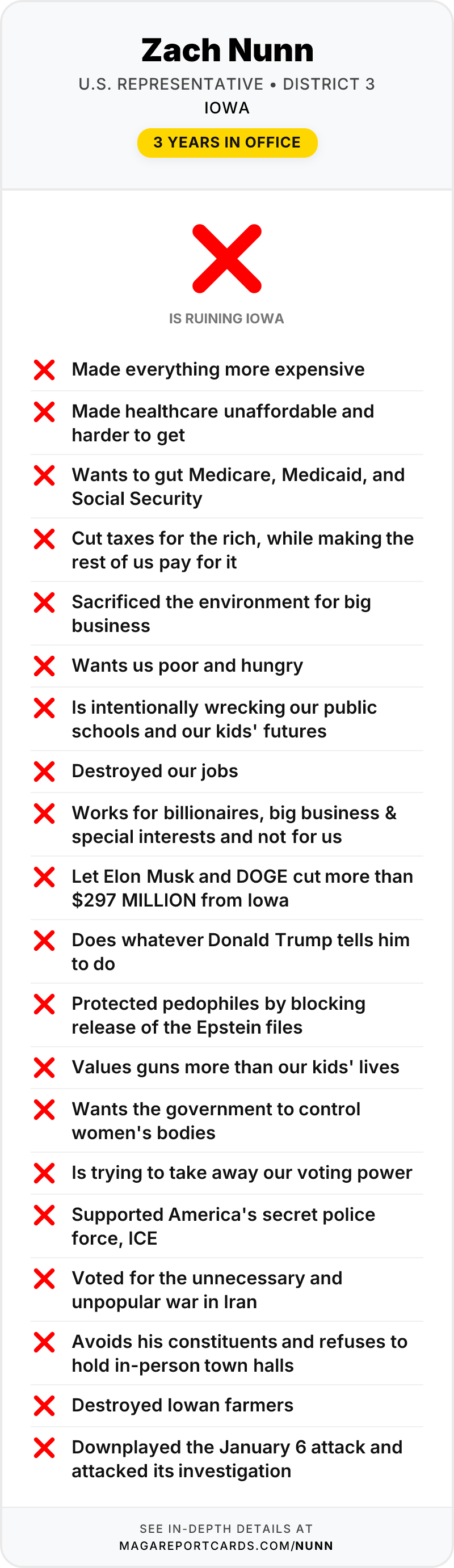
On July 10, 2026, Zach Nunn sat down with cancer patients, survivors, and advocates at the Adel Public Library. The event was a "Cancer Votes Coffee Chat," hosted by the American Cancer Society Cancer Action Network. Nunn used it to take credit.
He told the room that this Republican-led Congress has been the most effective in "generational history" on cancer research funding. He said he "personally fought for $128 million" for targeted cancer research. He called the year's funding "a good first start" and said, "I take that as a badge of honor."
Then he described the Medicaid cuts he voted for as a way to protect health coverage. In the room was a young woman who had lost hers in January.
The patient in the room
Clara Cirks of Dallas Center was diagnosed with stage four lung cancer in February 2025, at age 30. The cancer had spread to her breast, liver, lymph nodes, bones, pelvis, ovaries, and brain. She moved back to Iowa from Colorado to get treatment. For her first year, Iowa Medicaid covered most of her care.
Then, in January 2026, it stopped.
"I was notified that I got kicked off of Iowa Medicaid because they said I made too much on disability, so I had to purchase a healthcare plan on Iowa Marketplace, that didn't kick in until February 1," Cirks said. That left her uninsured for the month of January — a month in which she made two trips to the emergency room and saw two specialists, her oncologist, and another cancer physician. She's been on payment plans ever since, calling it "a very large financial burden for myself with a disability income."
That's the real-world stakes of health coverage for a cancer patient: lose it for one month, and you're paying off ER bills on a disability check. Cirks told her story to Nunn directly.
What Nunn actually voted for
Here's the part Nunn's "badge of honor" framing skips over.
Nunn voted for the 2025 "One Big Beautiful Bill" — the law that cut roughly $1 trillion from federal health programs. He voted yes on final passage on July 3, 2025, a vote that's in the official House record. At the Adel event, Nunn defended the law: he said it was an important step toward preserving public healthcare coverage options for people in the most need, the Iowa Capital Dispatch reported.
Preserving coverage is a strange way to describe a law that Democrats on the Joint Economic Committee estimate will cost about 16,300 people in Nunn's own district their Medicaid — about 26,300 losing coverage in all once the committee's Affordable Care Act estimate is added.
This is the same Nunn who, two months before that vote, announced a resolution to block any budget bill that cut Medicaid for children, seniors, pregnant women, or people with disabilities — people exactly like Clara Cirks. He announced the promise, then voted for the cuts.
Wanting credit for both sides
What Nunn is doing at events like this is trying to have it both ways. He wants credit for cancer research dollars and for the law that squeezes the Medicaid those cancer patients rely on.
He told the room he's "been a strong champion" for keeping Medicare, Medicaid, and Social Security alive "well past 2030." He said he "broke with Republican leadership" to support extending the Affordable Care Act tax credits that keep Marketplace premiums down. And he pointed to the law's Rural Health Transformation Program — $50 billion nationally, with $209 million coming to Iowa in 2025 — as proof it will ensure easier access to care.
But that rural fund is money handed out to soften a wound Nunn helped inflict. His Democratic opponent, state Senator Sarah Trone Garriott, and other critics say the program won't be enough to offset what providers lose from the Medicaid cuts. The evidence is already in his district: MercyOne closed its Ottumwa clinic in early 2026, and a River Hills clinic in Centerville — women's health, pediatrics, behavioral health — is closing July 31, citing "reimbursement challenges." Nunn had earlier called rural hospital closures a "myth."
Why Iowa can't afford the spin
Iowa has the second-highest rate of new cancer cases in the country, and is one of only three states where that rate is still rising. When cancer is that common, health coverage isn't an abstraction — it's the difference between starting immunotherapy on time and racking up ER bills you can't pay.
Nunn's answer is to call for "sustainable" healthcare and warn against a "government takeover." That's a fine slogan. But the people at that roundtable weren't asking for a slogan. They were asking him to protect the coverage that keeps cancer patients alive. He voted to cut it, then showed up to collect a "badge of honor."
Clara Cirks doesn't get a badge. She got a month with no insurance and a stack of payment plans.
Source
This post is based on reporting by Robin Opsahl for the Iowa Capital Dispatch, plus the official House roll-call record and the Joint Economic Committee Democrats' district-level estimates.