There is a television commercial running in Terre Haute right now in which Mark Messmer marches around his hometown of Jasper playing a trumpet.
"Some say Mark Messmer is tooting his own horn," the voiceover says, "but all he's doing is spreading the news of conservative results for Southern Indiana."
The ad goes on to tout his votes to "secure" the southern border, to keep "Hoosiers safe from illegal fentanyl and dangerous cartels," and his support for Trump's "One Big Beautiful Bill." A sheriff walks out of a police station and waves at him.
You paid for it.
The Evansville Courier & Press pulled the records. The disclaimer at the end of the spot reads "Paid for by official funds authorized by the House of Representatives." The WTWO purchase order in the FCC's public inspection file lists the product description in plain language: "IN-08 Franking."
What franking money is supposed to be
Franking is the taxpayer-funded allowance members of Congress use to communicate with constituents — traditionally mailers explaining a new law, a change to Medicare, where the mobile office hours will be.
The House Communications Standards Manual is not vague about the limits. Official communications "should not be used for political or personal business," and it specifically warns against "campaign content or electioneering." A violation, the manual says, results in "disciplinary action."
Messmer's ad threads a needle. It never asks anyone to vote for him. It never mentions his opponent, Evansville city councilor Mary Allen.
Nick LaRowe, an associate professor of political science at the University of Southern Indiana, explained why that technicality doesn't mean much:
"Distinguishing between taxpayer-funded communications with your constituents (permitted) and persuading them to vote for you (not permitted) can be hard to distinguish in practice and thus enforce. If you are telling constituents how hard you work and all the good things you have supported, the obvious implication is they should vote for you, even if you don't say that."
The calendar tells on him
Here is the detail that makes the "it's just constituent outreach" defense collapse.
Federal law bars members of Congress from sending franked communications within 60 days of a general election. The rule exists precisely because everyone understands what these ads turn into as an election approaches.
Messmer's ad is scheduled to run 84 times between August and early September — during local newscasts, The Today Show, Saturday Today, The Kelly Clarkson Show, and Wheel of Fortune.
Its last scheduled day on air is September 2. That is 62 days before Election Day.
He isn't stopping because the message is finished. He's stopping two days before the law would make him stop.
He is not short of money
Allen called it a "clear misuse of taxpayer dollars," and made the obvious point:
"Public funds designed for constituent outreach should be used to communicate important information or official government business, not campaigning. What makes it even more egregious is that he has hundreds of thousands of dollars in his campaign account. If he wants to run ads boasting about his record 80-something days out from the election, he should use his campaign funds, not hard-earned tax dollars."
The FEC filings back that up. Messmer's latest report showed $681,902 in total contributions as of June 30. The Messmer Victory Fund, a PAC tied to him, has raised another $763,580.
That's roughly $1.4 million raised into his political operation — and he reached for the public's wallet instead.
LaRowe's read on why is the least flattering explanation available, and the most likely:
"I don't claim to have any insight into the decision making of the Messmer campaign. But if you could run a digital communication that is legal and functions like a campaign ad while saving money … well, why not do it?"
The parts that don't add up
Four details in this story are worth sitting with.
His own constituents can't see it. The ad only airs on WTWO, the Terre Haute NBC affiliate. Evansville-area residents — the population center of the 8th District — never see it. The Courier & Press had to get a copy from Allen's spokeswoman, and the Allen campaign only got one because someone recorded it off their television. A "constituent communication" that most constituents can't watch and that his own office didn't circulate is a strange kind of public service.
The sheriff didn't know. Gibson County Sheriff Bruce Vanoven appears in the ad walking out of the Jasper police station and waving as Messmer passes. Asked about it, he told the Courier & Press: "Mark contacted me and asked me if I was available. I have not seen the video and I have no knowledge how it was funded."
Nobody will answer. The Courier & Press contacted a Messmer staffer and emailed the congressman's personal address on Monday, asking why the office paid for the spot with public funds. Both went unanswered.
How much did it cost? Unknown. The price was redacted in the FCC records.
This is the pattern, not a slip
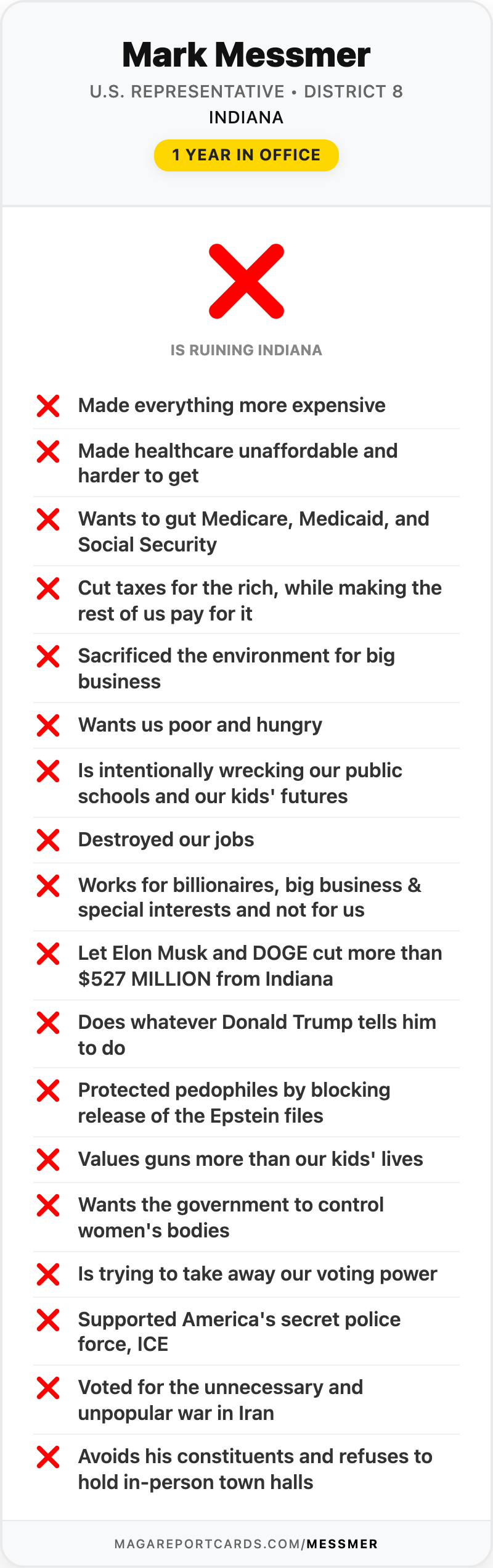
Messmer's problem isn't that he communicates with the 8th District too aggressively. It's that this is the only way he communicates with it at all.
He has never held an in-person town hall anywhere in the 21 counties he represents. In June 2026, about 70 people gathered at the Central Library in Evansville for a town hall he never answered an invitation to and never showed up for. In 2025, protesters at a "People's Town Hall" put his face on a fake milk carton. In March of that year, his office asked Boonville library workers to call the police on a crowd of mostly older constituents who had come to a mobile office hours event. The library staff refused.
So: he won't take unscripted questions in a room. He won't answer a reporter's email. But he will spend public money on 84 airings of a spot in which he plays the trumpet and lists his accomplishments, timed to end 62 days out.
He is not alone in this. Georgia's Mike Collins spent more than $400,000 in taxpayer office money on TV ads nearly identical to his own campaign spots — one of them built around Trump praising him by name. Minnesota's Michelle Fischbach sent more taxpayer-funded mass communications than anyone else in her state's delegation — 55 in one year, 50 more in a single quarter — while never holding an in-person town hall in her district.
The pattern is always the same. The mailers and the ads go out. The town halls don't happen. And the bill goes to you.
Source
Jon Webb, "Records: Rep. Mark Messmer used taxpayer funds for commercial", Evansville Courier & Press, August 12, 2026.