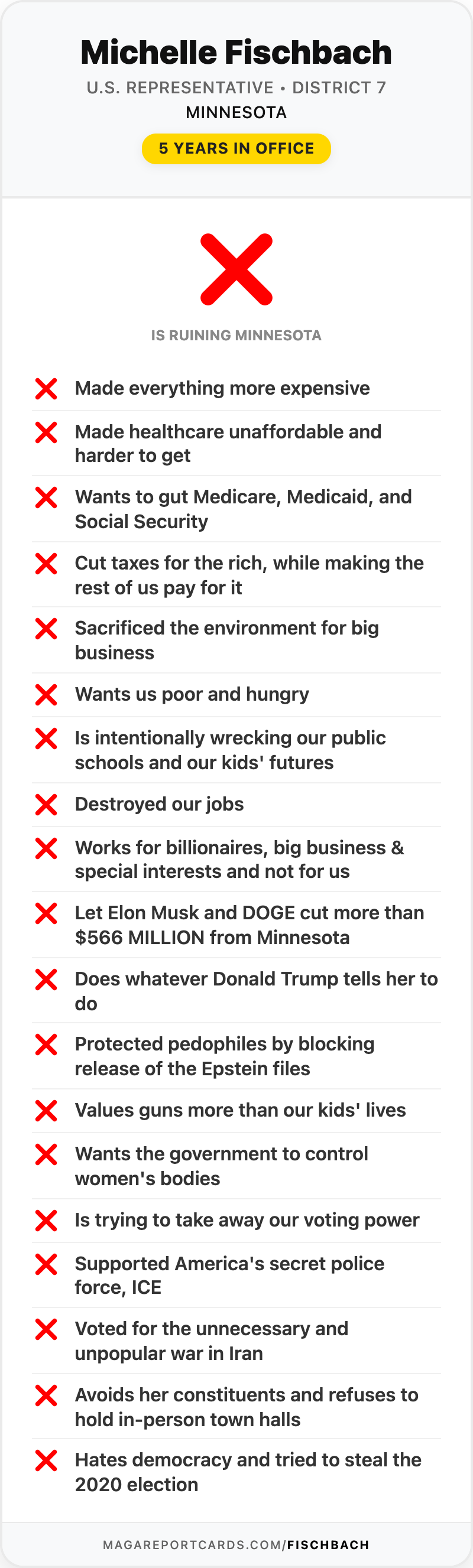
Michelle Fischbach has represented Minnesota's 7th District since 2021. Four years in, as of April 2025, she had not held a single in-person town hall in a district that runs from the Canadian border almost to Iowa.
She does communicate with her constituents, though. She just does it one way, on her terms, and sends you the bill.
MinnPost went through the records the Clerk of the House keeps on "franking" — the taxpayer-funded privilege that lets members of Congress send mail, texts, emails, robocalls, radio ads and digital ads to constituents. What it found: Fischbach sent more of them than any other member of Minnesota's congressional delegation.
She produced 55 franked communications last year. In the first quarter of 2026 alone she sent 50 more, at a cost of about $51,000 in public money.
For comparison, in that same first quarter Rep. Betty McCollum sent four. Rep. Pete Stauber sent seven. Rep. Brad Finstad sent nine.
What your $51,000 bought
Not answers to your questions. Here's what MinnPost found in her franked output:
- A radio ad promoting legislation she introduced on fraud. Taxpayers paid for a commercial about a bill with her name on it.
- Text messages to constituents about her support for the SAVE America Act, the bill stalled in the Senate that would require documentary proof of citizenship to register to vote and photo ID to cast a ballot.
- Surveys. One asked constituents whether they "support revoking welfare benefits to immigrants who send taxpayer-funded benefits dollars to foreign countries?" Another, sent on Mother's Day, asked, "Do you support increasing access and support services to expectant mothers and their families?"
Read that first survey question again. It isn't a question. It's a campaign message with a checkbox on the end, and it went out on the public's dime.
Franking rules are supposed to draw a line between informing constituents and campaigning. As MinnPost put it, these taxpayer-funded messages sometimes "blur the line between being totally informative and touting a lawmaker's accomplishments in a way that boosts their chances of reelection." The money comes out of each member's roughly $1.9 million office budget — the same account that pays the caseworkers who help a constituent untangle a Social Security problem.
And the research says the blurring isn't accidental. A study in Legislative Studies Quarterly, cited in the same piece, found that members who won their last election by small margins send significantly more franked communications than members in safe seats.
The other direction is closed
Here is the part that makes the $51,000 sting.
As of April 2025, Fischbach had not conducted a single in-person town hall in her district. Her office's answer was a telephone town hall — a call she controls. The League of Women Voters, still asking her for an in-person event in November 2025, said those calls "often occur with little or no advance notice and typically come from an unrecognized number."
When constituents organized their own meetings, sign rallies and postcard campaigns to get her attention, Fischbach went on the radio and called those activities "garbage", suggesting they were fueled by outside activists.
It got bad enough that in April 2025, Rep. Angie Craig — who represents a completely different part of Minnesota — drove to Willmar and held a town hall for Fischbach's constituents. More than 100 people came. Craig told them: "Michelle Fischbach won't show up and bring your concerns back to Washington."
In August 2025, after a private event in Willmar for her campaign volunteers, Fischbach declined to answer questions from the press or from the dozen-plus people standing outside with signs.
So the ledger for Minnesota's 7th District looks like this. Messages from Fischbach to her constituents, paid for by those constituents: 105 in fifteen months. In-person town halls where those constituents could stand up and ask: zero.
This is a pattern, not a quirk
We've now written this story about three different Republicans in six weeks, which is how you know it's a strategy rather than an accident.
Georgia's Mike Collins spent more than $400,000 in taxpayer office money on TV ads that look nearly identical to his campaign ads, right down to the same clip of Trump praising him. Utah's Blake Moore's office, facing the federal rule that bars mass communications in the 60 days before an election, sent taxpayer-funded mailers touting his record in batches of 499 — one under the 500-piece threshold that defines a "mass" mailing.
Pennsylvania's Brian Fitzpatrick went further and said the quiet part on national television, calling the in-person town halls his party's campaign arm was steering members away from "a circus, a three-ring circus".
The through-line is control. A town hall is a room where a stranger can stand up and ask about the Medicaid vote. A franked text is a message you can't reply to.
What she'd have to answer for
There's a reason the room is scarier than the mailer.
Fischbach didn't just vote for Trump's budget bill — her office said she "played a pivotal role in the development and passage" of it from her seats on Ways and Means and Rules. An estimated 14,092 people in her district are projected to lose Medicaid coverage because of it, and 17,992 in all once the lapsing Affordable Care Act tax credits are counted alongside it. Another 30,242 households in the 7th District rely on SNAP to buy groceries.
On tariffs, she defended them from a Farmfest stage this month and got booed from the front row — in a district that grows about $9 billion in agricultural products a year.
None of that showed up in a survey question.
Fifty-one thousand dollars of public money bought western Minnesota a radio ad about a Fischbach bill, a push about the SAVE America Act, and two loaded questionnaires. What it did not buy was one evening, in one room, with a microphone that works both ways.
Source
How the Minnesota delegation uses the congressional frank — MinnPost D.C. Memo, July 2026.