Here's a thing about political money that's easy to miss: the most revealing spending is usually not in the close races.
In a close race, a donor is trying to win. In a race nobody can lose, a donor is buying something else.
On June 2, 2026, an AI-industry super PAC called Leading the Future told the Washington Reporter it would spend $850,000 backing Kevin Hern in his Oklahoma Senate race.
The Reporter's own description of the race: Hern "is on a glide path to the Senate." He had Trump's endorsement. He won the Republican primary on June 16 in a state where the Republican nominee wins. The general election is November 3. He did not need $850,000.
The ad is set to run anyway — from before the primary through the general election, on cable, broadcast, streaming and digital.
What Leading the Future is for
This isn't a group with a vague interest in technology. It has one clear purpose, and it says so.
Leading the Future is an AI-industry super PAC that raised $125 million in 2025 and started 2026 with $70 million on hand, CNBC reported. By April 2026 the group announced that it and its affiliated committees had raised more than $140 million between them. Its goal, as CNBC described it, is backing candidates who support national AI regulations rather than state-by-state rules.
Its funders, per CNBC: the venture capital firm Andreessen Horowitz, OpenAI co-founder and president Greg Brockman, Palantir co-founder Joe Lonsdale, SV Angel founder Ron Conway, and the AI company Perplexity.
Its two strategists put the mission this way: "Leadership in AI innovation will define economic growth, national security, and America's role in the global economy, and lawmakers can't afford to be distracted by demagoguery that would cause us to fall behind."
"Demagoguery" is doing a lot of work in that sentence. Translated: the state legislators and city councils writing rules about water use, electricity costs and disclosure are the problem, and Congress should override them.
Zac Moffatt, the group's co-strategist, told the Washington Reporter the PAC is "helping build a broad coalition of pro-innovation lawmakers and candidates who understand what's at stake in the global race for AI." He added: "We need a national AI framework that keeps the U.S. globally competitive, unlocks economic growth, and includes commonsense protections for families and their communities."
A national framework. That's the product being bought. And the customer, in this case, is a man who is expected to spend the next six years casting Senate votes on exactly that question.
Meanwhile, in Oklahoma
While an AI super PAC was buying ad time for Hern, Oklahomans were doing the opposite of what it wants.
By June 2026, a wave of data-center moratoriums had spread across the state — as Radio Oklahoma News reported, from "small Route 66 towns to Oklahoma's largest cities":
- Oklahoma City enacted an emergency moratorium through December 31, 2026, with the council later voting 7-2 to exempt facilities using 75 megawatts or less while keeping restrictions on bigger ones.
- Edmond adopted a moratorium through December 31. Mayor Darrell Davis said officials were trying to distinguish ordinary technology facilities from large-scale AI operations that consume far more.
- Broken Arrow froze new data center permits and rezoning requests for six months.
- Luther approved a six-month moratorium after a public meeting so heavily attended it required armed security and metal detectors.
The concerns residents raised were not abstract. AI data centers use millions of gallons of water for cooling, in a state that has to plan for drought. A single hyperscale facility can demand more than 100 megawatts — about what a small city uses. And residents kept asking who pays for the transmission lines and substations: the company, or everybody's electric bill?
There's also the transparency problem. Local officials in some Oklahoma towns signed non-disclosure agreements with developers before residents knew what was being negotiated.
The state responded too. On May 11, 2026, Gov. Kevin Stitt signed House Bill 2992, the "Data Center Consumer Ratepayer Protection Act of 2026," requiring customers adding 75 megawatts or more of demand to sign long-term agreements covering their own infrastructure costs instead of spreading them across everyone's rates. "When you plug into Oklahoma's world-class energy grid, you come to the table as a partner," Stitt said.
That is precisely the kind of state-level rule Leading the Future's money exists to make irrelevant.
Oklahoma City, Edmond, Broken Arrow, Luther and the Oklahoma Legislature all decided they wanted a say. A super PAC funded from Silicon Valley is spending $850,000 to help elect the man who will vote on whether they get to keep it.
He'll be in the room where that gets decided
Hern is not a bystander on this. He sits on the Ways and Means Committee — the panel that writes tax law, including the credits and treatments that determine how profitable a data center build-out is. He was Republican Study Committee chairman in the 118th Congress. In November he is expected to move to the Senate.
And Congress has already tried the preemption once. The version of Trump's budget bill that passed the House carried a ten-year ban on states enforcing their own AI rules — we wrote about that when Pennsylvania's delegation voted for it. Hern voted for that bill.
So the question Leading the Future is spending money on is not hypothetical, and Hern's answer is not unknown.
This is not his first eight-figure friend
The AI money also isn't the only outside money in this race. According to FEC records of outside spending in Hern's Senate campaign, Defending Our Values PAC spent $808,341 supporting him — a super PAC whose money came almost entirely from a single group, Public First Action, Inc. Fellowship PAC spent another $300,000; it took $10,000,000 from one Wall Street firm, Cantor Fitzgerald.
And the pattern holds inside his own campaign account. Only 1% of Hern's money came from small grassroots donors, ranking him #434 out of 440 House members in grassroots funding, according to FEC filings compiled by Who Bought My Rep. That is not a man funded by people chipping in twenty dollars.
We've seen this shape before. In Tennessee, Marsha Blackburn promised to hold Big Tech accountable right after Big Tech gave her $100,000. In Florida, Byron Donalds promised data centers wouldn't raise electric bills while the developers gave him $894,000. In Ohio, Jon Husted said he'd protect your electric bill while the companies raising it funded his campaign.
The industry has figured out that the cheapest way to win a fight over local rules is to buy the people who can cancel local rules.
The part that should bother Oklahomans most
Hern has not been especially available to Oklahomans who might want to ask him about any of this.
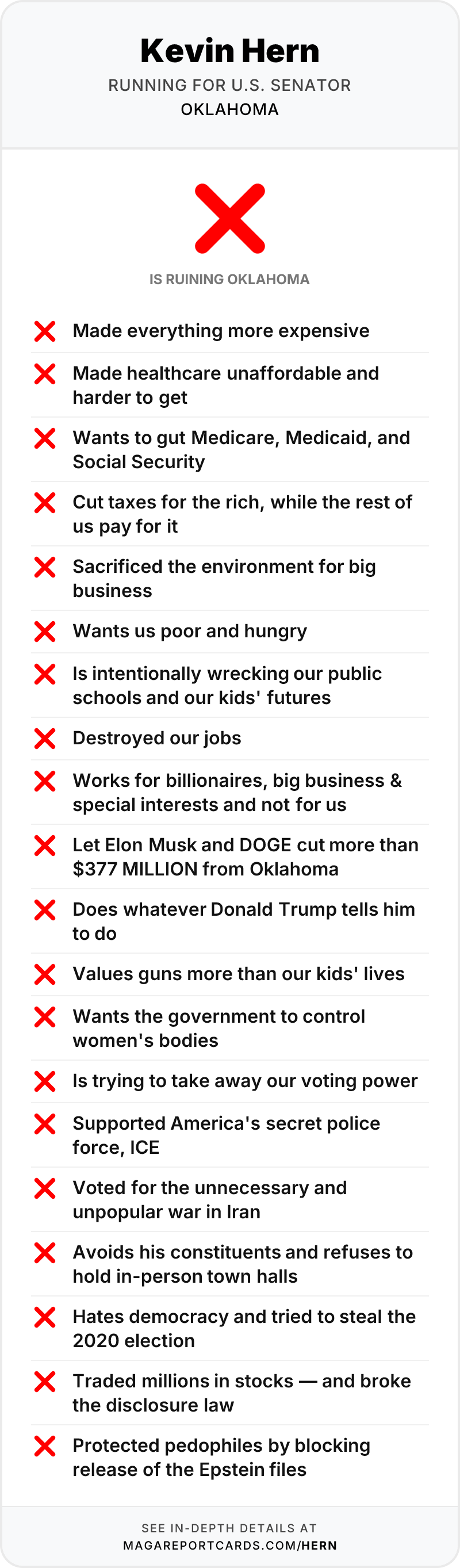
The last time he is known to have taken open questions from a room of constituents was February 2025, at a Chamber of Commerce meeting in Glenpool where people pressed him about Elon Musk and mass federal firings. Weeks later, a scheduled public lunch in Tulsa was canceled after more than 100 activists signed up to attend. That same day, a Tulsa station asked all five of Oklahoma's U.S. House members whether they'd keep holding town halls; two said yes, and Hern "did not respond to our several attempts to reach" him. In April 2025, constituents held a town hall for him anyway and asked their questions to an empty chair.
So there is a group that gets Kevin Hern's attention on AI policy, and a group that doesn't.
One of them is funded by Andreessen Horowitz, OpenAI's president and Palantir's co-founder, and is spending $850,000 on television.
The other one showed up at a town meeting in Luther that needed metal detectors, because they're worried about their water.
Source
Matthew Foldi, "EXCLUSIVE: Pro-AI super PAC spending big for Sen. Lindsey Graham and Rep. Kevin Hern," Washington Reporter, June 2, 2026.