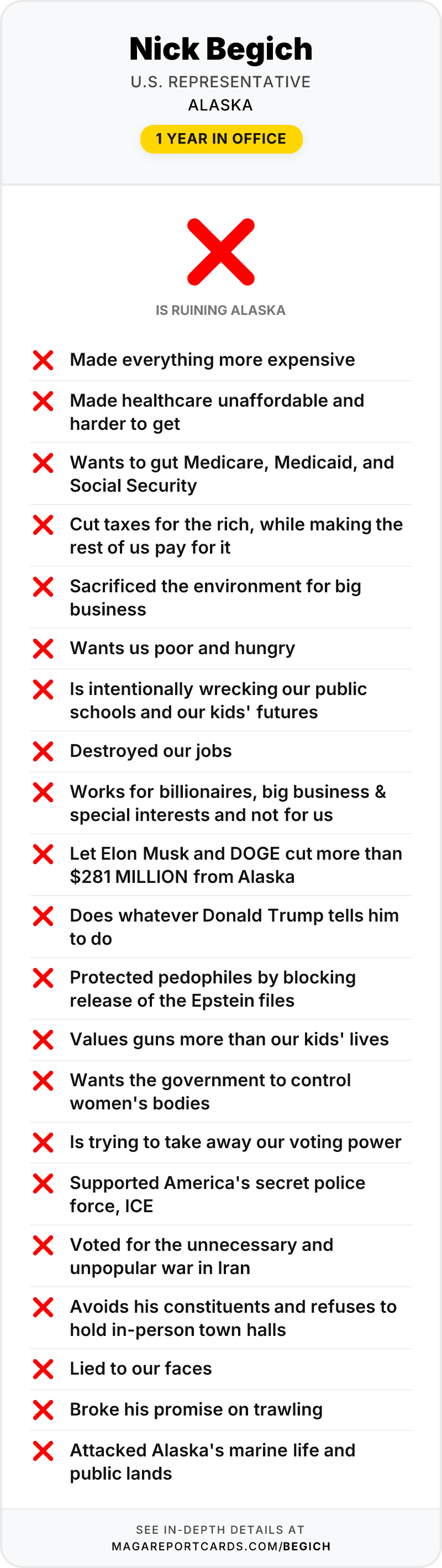
In 2013, a curious businessman in Alaska spent $100 on Bitcoin.
"I was just curious about how it worked," Nick Begich told Alaska Public Media. "And so I bought a little bit, and I bought a little bit more, and I think I put maybe $5,100 into Bitcoin."
That $100 is now worth about $760,000. Begich confirmed the math himself. His congressional financial disclosure reports one cryptocurrency line — "BTC, XRP, BCH, XLM, LTC, EOS, BSV" — worth between $500,001 and $1 million. Begich told Ruskin that band is his Bitcoin: "So it's between half a million and $1 million."
Two months into his first term in Congress, he introduced a bill ordering the United States government to start buying Bitcoin — 200,000 coins a year, every year, for five years.
What the bill actually says
Begich's BITCOIN Act of 2025, H.R. 2032, was filed on March 11, 2025. Section 5 is not vague:
"The Secretary shall establish a Bitcoin Purchase Program which shall — purchase 200,000 Bitcoins per year over a 5-year period, for a total acquisition of 1,000,000 Bitcoins."
One million Bitcoin is about 5% of every coin that will ever exist. At the price when Alaska Public Media's Liz Ruskin asked him about it in August 2025, that came to more than $20 billion a year.
And once the government bought them, it could not sell them. The bill locks every coin in the reserve for at least 20 years: no Bitcoin "may be sold, swapped, auctioned, encumbered, or otherwise disposed of" during that window.
Put plainly, the bill would make the U.S. Treasury the single largest buyer in the Bitcoin market — a buyer that is legally forbidden from ever taking profits, for two decades. There is only one direction that pushes a price with a fixed supply.
Begich, meanwhile, owns Bitcoin.
The ethics group's warning
Noah Bookbinder runs Citizens for Responsibility and Ethics in Washington. Ruskin asked him about it.
"This raises all sorts of red flags," Bookbinder said.
Even assuming Begich's motives are pure, Bookbinder said, the bill would increase the value of the exact cryptocurrency Begich owns. It is legal. It is not a good look.
"We want our members of Congress to be making decisions that are in the best interest of the country, not in their personal financial interest," he said.
Begich's answer was that plenty of Americans own Bitcoin, and that he owns other things too:
"I'm a homeowner who would benefit from lower interest rates, but I advocate for lower interest rates."
That comparison does not hold up. Interest rates move the cost of a mortgage, a car loan and a credit card for essentially every household in the country. A federal mandate to buy roughly 5% of the world's supply of one specific asset — an asset with no dividends and no earnings, whose price moves purely on demand — is a much narrower favor, aimed at a much smaller group.
Begich is in that group. By his own account, he got in early and cheap.
Three days after he filed it, a Bitcoin billionaire maxed out
Federal Election Commission records show what happened next.
Begich filed the BITCOIN Act on March 11, 2025.
- On March 14, 2025 — three days later — Cameron Winklevoss gave his campaign $3,500, and $7,000 for the year: the legal maximum for both the primary and the general.
- On March 18, 2025 — one week after the bill — his twin brother Tyler Winklevoss did the same. Another $7,000.
Both twins listed their employer as Winklevoss Capital Management. They are the founders of the crypto exchange Gemini and two of the best-known Bitcoin investors in the world.
The pattern continued. Coinbase CEO Brian Armstrong maxed out at $7,000 on April 28, 2026. Coinbase's chief policy officer, Faryar Shirzad, gave $3,500 a month later.
None of that is illegal. All of it is the industry that stands to gain from a mandatory federal Bitcoin buying program, writing checks to the man who wrote it.
We have seen this shape before. Nebraska's Mike Flood wrote his state's crypto banking law, then watched the nation's first crypto bank land in his hometown with its founder among his biggest donors. Georgia's Mike Collins bought Ether nine days before he voted on a bill that sent its price up.
Version two: he took out the part he couldn't defend
In that August 2025 interview, Begich told Ruskin that a future version of the bill might drop the purchase requirement.
On May 21, 2026, he introduced it. The American Reserve Modernization Act, H.R. 8957, replaces the Bitcoin Purchase Program with something quieter: a study on whether the government could buy Bitcoin in a "budget neutral manner."
What survived is the part that matters to a Bitcoin holder. Section 5 still locks every federal coin up for 20 years. Section 7 orders every federal agency to hand over its Bitcoin, and bars any agency from selling a coin in the meantime except for national security or on a court order.
The federal government's Bitcoin comes mostly from seizures — the bill's own definition of "qualifying Bitcoin" is coins "finally forfeited as part of criminal or civil asset forfeiture proceedings" or taken to satisfy a penalty. Until now, the government could turn around and sell them. Begich's bill ends that. For 20 years, by law.
A permanent buyer who never sells is the best possible news for everyone who already owns the asset.
What Alaska got instead
Begich has been in Congress for a year and a half. In that time he voted for a budget bill that cut Medicaid and food assistance in a state that ranks 36th of 50 on the measures we track, and told Alaskans the bill was "great" for the state anyway. In January 2026 he voted against a three-year extension of the health insurance subsidies that hold down premiums for Alaskans who buy their own coverage, even as 17 Republicans broke with leadership to save them.
He has not held an in-person town hall where Alaskans could ask him about any of it. His campaign's own rally with the Speaker of the House this month required a photo ID and barred the press.
Neither Bitcoin bill has gotten a hearing.
That's the scorecard: no hearing for the crypto bill, no hearing for the constituents, and a personal Bitcoin position that gets more valuable every time Washington moves his way.
Source
Liz Ruskin, "Rep. Nick Begich did well with Bitcoin. He wants the government to own some, too," Alaska Public Media, August 26, 2025. Photo: Liz Ruskin / Alaska Public Media.