On Friday, August 7, 2026, the Speaker of the U.S. House of Representatives flew to Alaska to campaign for Nick Begich.
The event was held in an airplane hangar in Palmer. It was called the "Grassroots Rally in the Valley."
Here is what the flyer for that grassroots rally said, according to the Anchorage Daily News:
- Do not share the address.
- RSVP in advance.
- Bring a photo ID.
- No press. No media.
About 100 people got in, by the estimate of one protester outside. Dozens of others stood on Cope-Industrial Way.
"Grassroots" with a guest list
Alaska's News Source asked to cover the event. They were told no. Begich campaign spokesperson Paul Smith told the station it was "closed press" and did not explain why.
State Sen. George Rauscher, a Republican from Sutton who RSVP'd and got in, told the ADN he figured the tight controls were about security for the Speaker.
Maybe. But a security perimeter does not require that the address itself be kept secret from the public, and it does not require that reporters be turned away at the door. Those are two different decisions, and the second one was Begich's campaign to make.
Outside, people held signs reading "Why a private grassroots rally?" and "Release the Trumpstein files."
Pete Bauer, a retired Air Force colonel and the Democrat challenging Rauscher for his state Senate seat, protested outside. He put it plainly:
"Obviously, Mike Johnson and Nick Begich have time to talk to the people of Alaska, but they choose to only talk to those they want to speak with behind closed doors and who are their higher donors."
Bauer also said a man he didn't know got in his face and made a "pistol" gesture with his hands, pointed at Bauer's head. "I didn't see a weapon on him, but he rapidly drew his hands within inches of my face to gesture as if he wanted to shoot me," Bauer said. "I didn't back down, and he left."
The Speaker who told them to hide is the one who came to help
There is a detail here that makes the whole thing worse.
In March 2025, Mike Johnson stood at a news conference and told Republicans in Congress to stop holding in-person town halls. Angry crowds were showing up. Johnson's explanation, reported by the Associated Press, was that the people in those crowds weren't real:
"They're professional protesters. So why would we give them a forum to do that right now?"
Instead of town halls, Johnson told his members to use "smaller community gatherings" and telephone town halls — formats where the office picks who talks.
Seventeen months later, the man who issued that instruction flew 3,000 miles to headline a closed, ID-checked, no-press event for a member who followed it.
On the radio that evening, Johnson told Alaskans why Begich has to win: "These crazy communists who are trying to take over the Democrat Party have a target on Nick's back."
Begich, on the same show, called the visit "historic." "When you've got the attention of leadership, you have the ability to influence policy that impacts so many people here in Alaska," he said.
That is the pitch: Begich has the attention of leadership. What he does not have, and has not had since he took office, is a room where any Alaskan can walk in and ask him a question.
The tele-town hall that Alaskans called propaganda
Begich did hold a constituent forum. His first one came in February 2025, six weeks after he was sworn in. It was virtual.
More than 3,000 people took part — the phone system failed for many of them, who watched the Facebook livestream instead and left more than 2,000 comments. Seven questions got asked in 50 minutes. Begich's own state director ran the queue and picked which ones went through.
The first person selected was PeggyAnn McConnochie — a longtime local Republican party official who had campaigned for Begich, the Juneau Empire's Jasz Garrett reported.
Juneau resident Angela Imholt typed into the livestream what a lot of people were thinking:
"This is no town hall. This is propaganda."
Another Juneau resident, Larri Spengler, registered to ask a question by phone and never got a call. She posted: "How about answering some of the real, actual, pressing questions that real, worried Alaskans are posting here?"
Alaska Public Media watched the same event and described the moderator softening questions before passing them to Begich — asking him how to contact his office and what "America First" means — while questions about federal job losses and frozen funding filled the comments unanswered. One caller who did get through to ask about Trump's executive actions had his line drop mid-question.
That format — office controls the invite, the queue, the questions — is the exact one Speaker Johnson recommended. Begich is not the only Republican who took the advice. Ohio's Mike Carey ran a tele-town hall his office never posted the call-in number for, then put out a press release celebrating that 12,000 people joined, because his office had dialed them.
The pattern outside the hangar
The closed rally isn't a one-off. It fits a record his constituents have been documenting for a year and a half.
In May 2026, Alaska Public Media's Liz Ruskin asked Begich's office where he stood on a nearly $1.8 billion federal fund the Trump administration set up to pay people it says were "victimized" by the Justice Department — a fund Sen. Lisa Murkowski called a slush fund. His office did not respond to interview requests or to written questions. He also skipped a May 22 meet-and-greet in Kodiak, billed as a session with him and Sen. Dan Sullivan, where constituents had come with questions for both. His campaign said notice of the event went out before his travel schedule was final, and the organizer confirmed that.
Bill Hill, the independent challenging Begich, says he hears the same complaint everywhere he goes: calls and emails to Begich's office go unanswered.
"Nick Begich calling up the party boss to hold closed events — from my perspective, it sounds like he's nervous," Hill said.
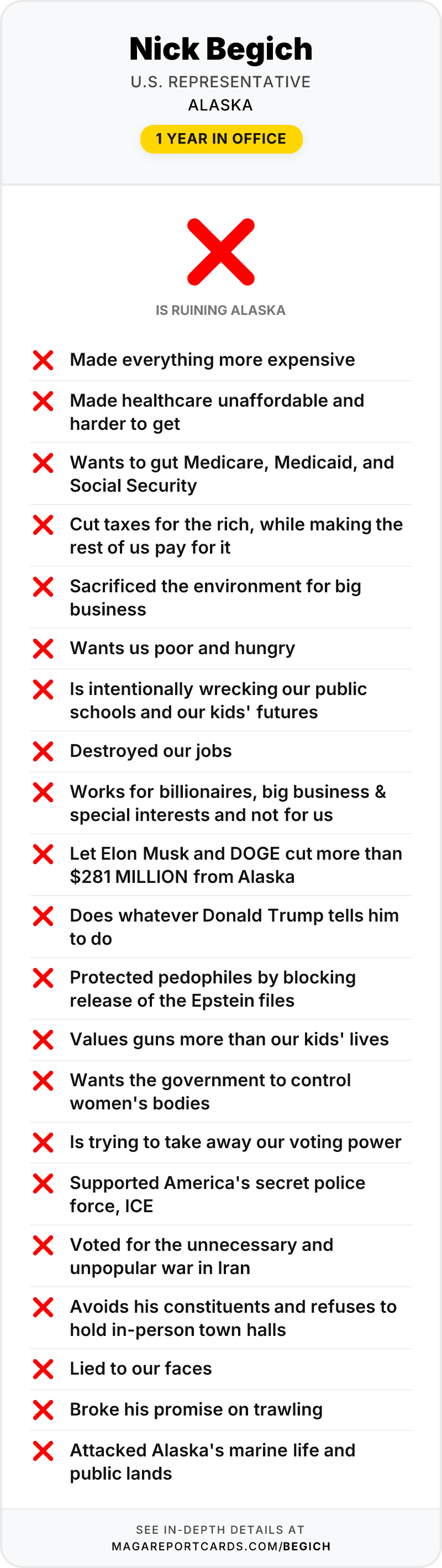
The ADN's own summary of Begich's first term is blunt: he "has been a reliable supporter of Trump's," and has "often been criticized by some constituents for his lack of public engagement, including through town hall meetings."
Why this matters more than a bad optics story
Access is not a courtesy. It is the only tool most people have.
In the year and a half Begich has been in office, he has voted for a budget bill that cuts Medicaid and food assistance in a state that ranks 36th of 50 on the measures we track. He voted against extending the health insurance subsidies that hold down premiums for Alaskans who buy their own coverage — while 17 Republicans broke with leadership to vote for them. He told Alaskans the bill was "great" for the state despite the Medicaid and SNAP cuts inside it.
Those are the votes people want to ask him about. That is exactly why they don't get to.
A congressman who is proud of his record holds a room. A congressman who is not tells you to bring a photo ID, keeps the address off the flyer, and locks the reporters outside.
Early voting in Alaska has already begun. The primary is August 18; under Alaska's top-four system the general election follows on November 3.
Source
Alex DeMarban, "U.S. House Speaker Johnson appears at tightly controlled Palmer event to support Nick Begich's reelection," Anchorage Daily News, August 8, 2026. Photo: House Speaker Mike Johnson with Nick Begich III at a ceremonial swearing-in at the Capitol, Jan. 3, 2025 (AP Photo/Jacquelyn Martin).