There is a simple test for whether a politician is working for us or for himself. Look at what he buys, and look at when he buys it.
Mike Collins — the Georgia congressman who wants to be our next U.S. senator — has a habit that keeps failing that test. He is one of the busiest cryptocurrency traders in Congress. And more than once, he has bought a coin just before Congress did something that made that coin worth a lot more.
The second time, he didn't have to wait and see what Congress would do. He was one of the people who did it.
The trade, and then the vote
On July 8, 2025, Collins bought Ether. At the time it was trading around $2,616.
Nine days later, on July 17, 2025, the House voted on the GENIUS Act — a bill setting up federal rules for stablecoins that the crypto industry had spent years and enormous sums pushing for. It passed 308 to 122, and Collins voted yes. Trump signed it into law the next day.
Ether climbed to roughly $3,673 — a gain of about 40% on a coin he had bought a week and a half earlier.
That same week, Collins voted yes on two more bills the crypto industry wanted: the CLARITY Act, which rewrites how digital assets are regulated, and the Anti-CBDC Surveillance State Act, which passed by a single vote, 219 to 210.
Three votes. One very good week for his portfolio.
It had happened once already
This wasn't the first time the timing lined up.
On April 30, 2025, Collins bought Ether at about $1,794. The very next day, May 1, the GENIUS Act was introduced in the Senate. Ether went on to hit $2,584.
Buy the day before a major crypto bill drops. Buy nine days before you vote for it. Do that twice, and "coincidence" starts doing a lot of heavy lifting.
Collins has never claimed to have inside information. But that is exactly the problem with a member of Congress trading the assets his own votes move. The public has no way to tell the difference between a lucky guess and a tip — and Collins is asking us to take it on faith.
He is not a casual investor
Collins is not somebody who bought a little Bitcoin and forgot about it.
Back in December 2024, CoinDesk found that Collins had the most extensive crypto trading record of anyone trading directly on Capitol Hill — 19 trades in a matter of weeks, spanning Ethereum, Velodrome Finance, and The Graph. The crypto advocacy group Stand With Crypto had already given him an "A" rating.
His disclosed crypto transactions since taking office in 2023 run up to roughly $745,000, and his estimated net worth has climbed by about $2.5 million.
When people first noticed his trades on social media, Collins did not offer an explanation. He posted a picture of Pepe the Frog.
The meme coin
The strangest chapter is a token called Ski Mask Dog — a meme coin with a picture of a dog in a ski mask on it, launched in May 2024. It has no product, no company, and no purpose beyond people buying it hoping someone else buys it next.
Then it collapsed. The coin peaked at about 27 cents on December 5, 2024. By mid-2026 it was worth roughly half a cent — a drop of nearly 98%. The whole thing shrank from a $277 million market value to about $5.6 million.
Asked to explain, Collins told Forbes: "I liked the coins, so I bought them." He added that "Washington and Wall Street have stigmatized emerging technology in the crypto ecosystem."
That is the entire defense. He liked them.
What he says when a voter asks
Collins knows insider trading in Congress is a problem. He has said so out loud.
Confronted by a voter in April about his own trades, Collins said:
"I don't know how you would manipulate crypto. It'd be like trying to manipulate the dollar, the peso or something. But the stock trading, I don't know how to do it … All I want to know is when people stop doing it. They're getting insider information."
Read that again. He is annoyed that other members of Congress are trading on inside information and wants them to stop — while telling us that the thing he trades is somehow beyond manipulation.
It isn't. Crypto markets are smaller, thinner, and far less regulated than the stock market, which makes them easier to move, not harder. A single well-timed federal announcement can swing a coin's price by 40% in nine days. We know, because it happened to a coin Collins had just bought.
This is a pattern, not a one-off
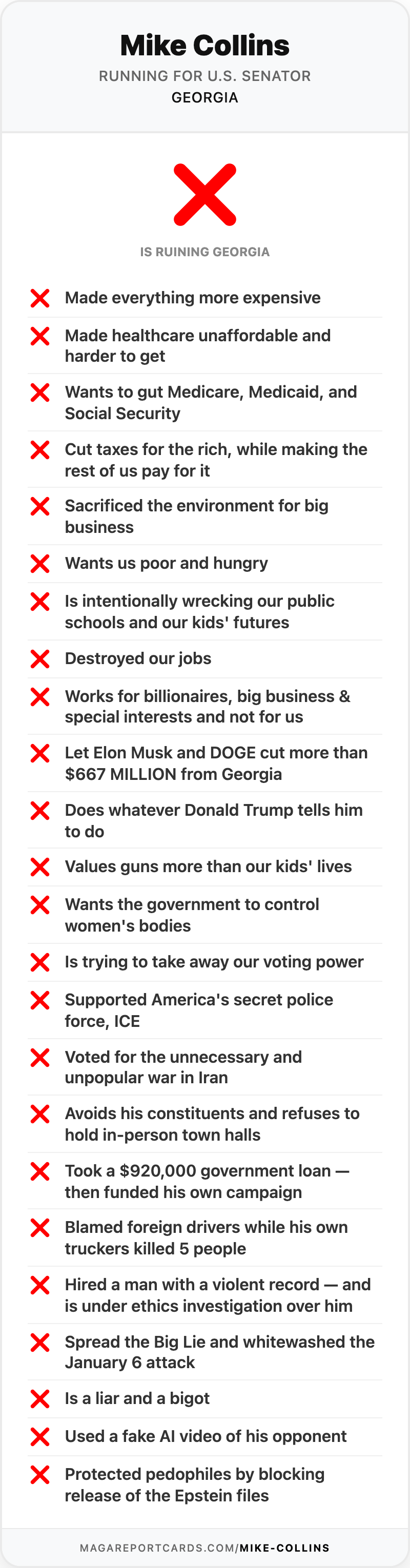
Collins already has an ethics problem that has nothing to do with crypto.
A congressional watchdog report released in January 2026 found "substantial reason to believe that Rep. Collins used congressional resources for unofficial or otherwise unauthorized purposes" and that roughly $5,000 in taxpayer money went to an intern — his then-chief of staff's girlfriend — for work she did not perform. Collins and his staff refused to cooperate, and investigators recommended they be subpoenaed. That investigation is still open.
So the picture we're being asked to promote to the U.S. Senate is a congressman who:
- Trades the assets his own votes affect, repeatedly and with excellent timing
- Put up to $165,000 into a joke coin that lost nearly all its value, and can only say he "liked" it
- Wants other members to stop trading on inside information
- Is under active investigation for how he spent public money
What Georgia actually needs from a senator
Here's what makes this more than a story about one man's brokerage account.
Every hour Collins spends timing his Ether buys is an hour he isn't spending on the things Georgians are actually struggling with. Groceries and rent are still eating people's paychecks. Rural hospitals are still closing. And when the House voted on February 11, 2026 to end the tariffs driving up prices on food, housing, and farm supplies, Collins voted to keep them in place — a vote that cost his own constituents money at the checkout line.
His portfolio went up. Our grocery bills went up too. Only one of those was an accident.
A Senate seat is not a trading desk. Georgia gets two of them, for six years at a time. We should not hand one to a man whose clearest record of achievement is his return on investment.
Source
Reporting by American Journal News. Photo: AP.