On June 16, 2026, Barry Moore won the Republican runoff for Alabama's open U.S. Senate seat, beating former Navy SEAL Jared Hudson with about 56 percent of the vote. In a state this red, that runoff was the real election. Whoever won it was almost certainly going to the Senate.
So it's worth asking who paid for it.
The biggest single spender in that race wasn't an Alabama business, an Alabama union, or an Alabama family. It was Defend American Jobs, part of the cryptocurrency industry's national Fairshake super PAC network. It put more than $12 million behind Barry Moore — $7.4 million in advertising before the May primary, and another $4.8 million before the runoff.
By the runoff, that was the crypto industry's largest single investment anywhere in the country so far this election cycle.
The super PAC outspent his own campaign three to one
Here's the part that should stop you.
Through June 30, 2026, Moore's own campaign committee reported raising about $3.8 million for the entire race — every donation, every fundraiser, every check.
One industry's super PAC spent more than three times that on him by itself.
That is not a supporting role. When an outside group outspends the candidate's own campaign by that much, it isn't helping Barry Moore talk to Alabama voters. It is doing the talking. Super PACs face no limit on what they can raise or spend, as long as they don't formally coordinate with the campaign — which is why a handful of very wealthy interests can simply decide who the nominee is going to be.
Fairshake, the network Defend American Jobs belongs to, is funded primarily by Coinbase, the venture capital firm a16z, and Ripple. Not one of them is an Alabama company.
And they were not shy about what they got. After the runoff, a Fairshake spokesman said it plainly:
"Our biggest spend of the cycle yielded yet another pro-innovation champion in the Senate."
A champion. Not a representative. A champion — for them.
What $12 million buys: a perfect voting record
The crypto industry didn't gamble on Moore. It bought a sure thing. As a member of Congress, Moore has voted yes on every noteworthy piece of crypto legislation.
Look at a single day — July 17, 2025, when House leadership ran the industry's whole wish list across the floor at once. Moore voted yes on all three:
- The CLARITY Act, which rewrites how crypto is regulated — Roll Call 199, passed 294–134. Moore: Yea.
- The GENIUS Act, the stablecoin bill the industry had wanted for years — Roll Call 200, passed 308–122. Moore: Yea.
- The Anti-CBDC Surveillance State Act — Roll Call 201, which squeaked through 219–210. Moore: Yea.
Three votes, three industry wins, one day. Within a year, the industry spent $12 million to move him from the House to the Senate, where a single member has far more power to block or pass a bill.
This isn't the first time we've watched this
Alabama isn't alone. In Georgia, Senate nominee Mike Collins became the most prolific crypto trader in Congress — buying Ether shortly before Congress acted on legislation that sent its price up, and casting one of those votes himself. He has also endorsed a ban on congressional stock trading while doing it.
The pattern is the same in both states. An industry with a specific list of things it wants from Washington finds a candidate who will deliver every item on the list, then spends whatever it takes to put him in a seat where he can.
The only thing that changes is the state on the ballot.
What Alabama gets out of this
Nothing.
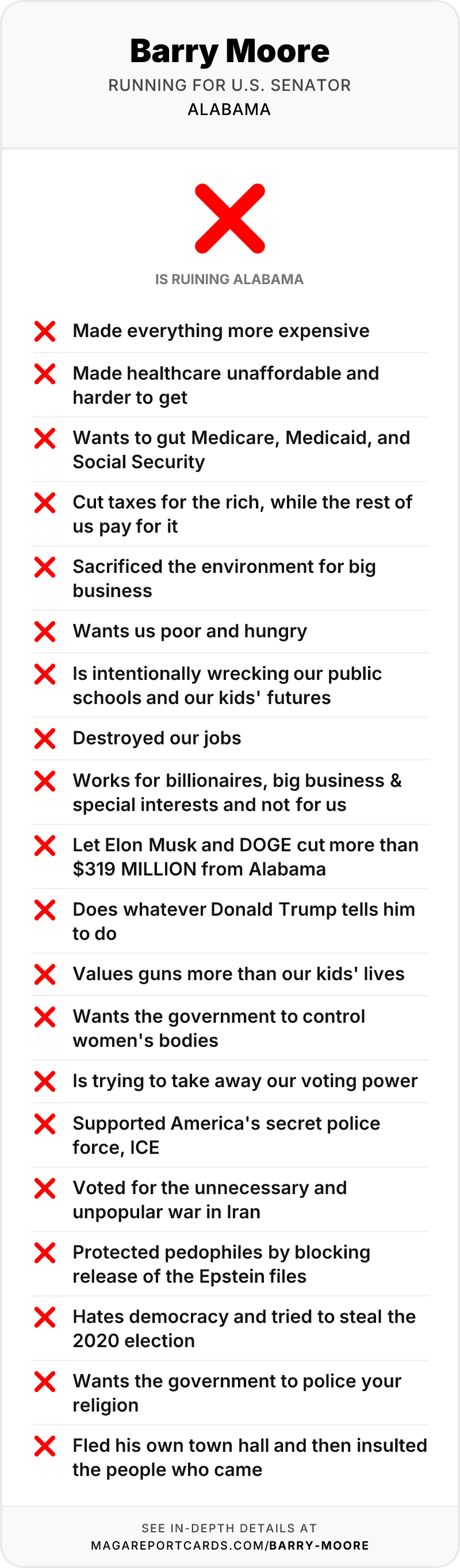
Alabama has the fifth-highest rate of gun violence in the country. About 740,300 Alabamians rely on SNAP to eat every month. KFF estimated that the House version of Trump's budget bill would leave about 53,000 more Alabamians uninsured — about 170,000 with the enhanced ACA tax credits expiring on top of it. When Alabamians packed a town hall in Daphne in August 2025 to ask Moore about exactly those Medicaid cuts and their rural hospitals, he told them the cuts would affect only undocumented immigrants — and the room accused him of lying, then watched him leave through a back door.
None of those problems have a $12 million super PAC behind them.
That's the whole story of modern campaign money. It isn't that Barry Moore was bribed — it's that he never had to be. The industries with money find the politicians who already agree with them, and then make sure those are the only politicians we get to choose between. By the time Alabama voters showed up on June 16, the field had already been shaped by people who don't live here.
A U.S. Senate seat belongs to the people of Alabama. Barry Moore's was underwritten by an industry that doesn't answer to any of us. We deserve better.
Source
Crypto PAC's $12 million Senate candidate, Barry Moore, wins Alabama GOP primary — CoinDesk, June 17, 2026. Photo: Alex Wong/Getty Images, via CoinDesk.