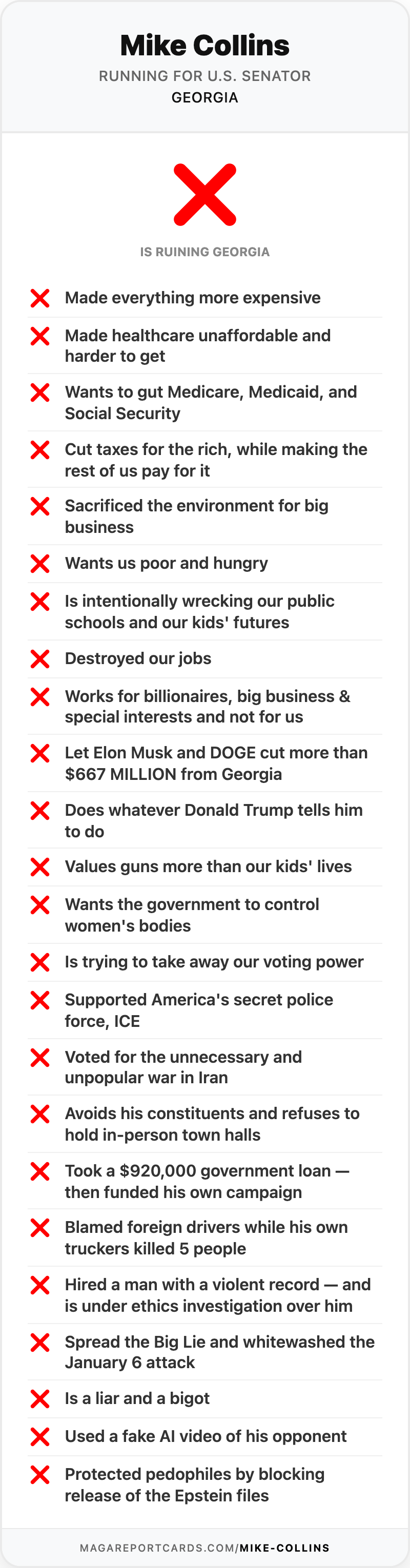
There's a good idea that most Americans agree on: members of Congress shouldn't be allowed to trade stocks while they're writing the laws that move those markets. It's an obvious conflict of interest. Mike Collins, the Republican running for U.S. Senate in Georgia, says he agrees too — he's endorsed a ban on congressional stock trading.
There's just one problem. While he was saying Congress shouldn't be gambling in the markets, Collins was quietly doing exactly that — with cryptocurrency.
One of the busiest crypto traders in Congress
Collins isn't a casual investor. In late 2024, CoinDesk called him Congress's "most prolific crypto trader," with 19 digital-asset trades on his disclosure forms by then. Since taking office in January 2023, he has reported as much as $745,000 in crypto activity.
Some of it is eye-catching. In December 2024, Collins bought a meme coin called Ski Mask Dog (SKI), a dog-themed token of the kind CoinDesk calls "typically volatile," and when that purchase was noticed on X he answered with a picture of Pepe the Frog. In August 2025 he bought more. He's disclosed positions in a string of other coins too, from Ethereum to obscure altcoins most voters have never heard of.
This is the same behavior a stock-trading ban is meant to stop: a lawmaker making personal bets in a market that the government he serves in is actively deciding how to regulate. And many of the proposed bans Collins says he supports — including the ones that would cover crypto — would apply to exactly the trades he's been making.
His excuse falls apart
When a voter confronted Collins about the contradiction at an April meet-and-greet, here's how he explained it:
"I don't know how you would manipulate crypto. It'd be like trying to manipulate the dollar, the peso or something. But the stock trading, I don't know how to do it … All I want to know is when people stop doing it."
That answer doesn't survive a second of scrutiny. Crypto markets can absolutely be manipulated — pump-and-dump schemes and insider-style trading in digital tokens are real, and prosecutors bring cases over them all the time (usually as wire fraud or commodities fraud). A congressman who's made dozens of crypto trades saying he doesn't understand how crypto could be gamed is either not being honest or not paying attention. Either way, it's not a reason to give himself a pass.
It's worth remembering that Congress has punished this kind of thing before. In 2022 the House Ethics Committee found that Republican Rep. Madison Cawthorn had engaged in the "repeated and knowing promotion of a cryptocurrency in which he held a financial interest," and directed him to pay $14,237.49 to charity — the discount he got buying it — plus $1,000 in late fees.
A pattern, not a one-off
For Collins, cashing in while in office isn't new. In 2020, his trucking company took a $920,000 federal PPP loan meant to save workers' jobs during the pandemic. The government forgave the loan entirely — and ahead of his 2022 primary, he lent his own congressional campaign $465,000. His opponent in that race, Vernon Jones, put it plainly: "It appears as though Mike Collins has used the PPP loans to further his political career."
Even his own primary opponent saw the pattern. Republican Derek Dooley's campaign said Collins "treats Congress like his own crypto casino." When the guy running against you in your own party is making the corruption argument, it's not a partisan attack — it's a warning.
The bottom line
Mike Collins wants Georgians to believe he's a reformer who thinks Congress shouldn't be trading in the markets. But he says one thing and does another: he backs the ban in public while running one of the most active crypto-trading accounts in the entire Congress, and then waves it all away with an excuse that doesn't hold up.
Georgia already has a senator's seat on the line. Voters deserve someone who follows the rules he wants to impose on everyone else — not one who writes himself an exception. We deserve better.
Source
This post is based on reporting by American Journal News: Mike Collins backed stock trading ban while betting big on crypto (republished by National Memo), with additional reporting from CoinDesk and TheStreet.