In December 2003, a 78-year-old retired schoolteacher in Los Angeles told the country something South Carolina had whispered about for decades: Senator Strom Thurmond — the state's most powerful politician for half a century, and the man who ran for president in 1948 on a segregationist ticket — was her father. Her mother had been a 16-year-old Black maid working in the Thurmond family home.
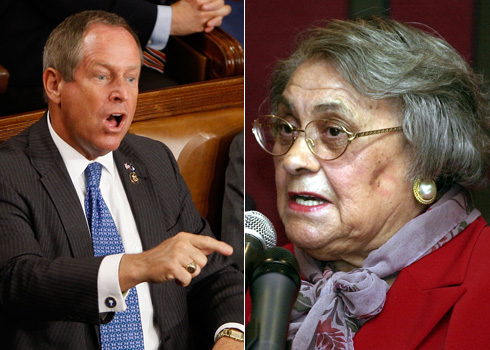
Joe Wilson, a former Thurmond page, went to The State newspaper and said he didn't believe her.
He was wrong. And the way he was wrong is worth sitting with.
What she actually said
Essie Mae Washington-Williams was born in 1925. Thurmond was 22 at the time; her mother, Carrie Butler, was 16 and worked as a maid in his family's house. Thurmond never publicly acknowledged her, but he supported her financially for decades.
She stayed silent until she was 78. She came forward only after Thurmond died in June 2003 at age 100.
Wilson's answer: "It's a smear"
Wilson didn't wait. He told The State newspaper he didn't believe her, called the revelation "unseemly," and argued that even if she were telling the truth, she should have kept it to herself:
"It's a smear on the image that [Thurmond] has as a person of high integrity who has been so loyal to the people of South Carolina."
He went further, putting it in the same category as the stories about Thomas Jefferson and an enslaved woman, and said it was unfair to debate rumors about Thurmond when he could no longer defend himself.
"Sometimes these things just go on. These are heroes of mine. I really hope these would be heroes to future generations of Americans. (The stories) are … a way to diminish their contributions to our country's existence."
Read that again. A woman said, at 78, that she was somebody's daughter. Wilson's objection was that saying it out loud might diminish the man who never claimed her.
Within days, the Thurmond family confirmed it
On December 15, 2003, the family's lawyer put out a statement: "As J. Strom Thurmond has passed away and cannot speak for himself, the Thurmond family acknowledges Ms. Essie Mae Washington-Williams' claim to her heritage."
So Wilson's certainty lasted a matter of days before the people who would know best contradicted him in public.
"Six days and several furious letters to the editor later," Talking Points Memo reported, Wilson apologized. Sort of. His apology was this:
"I have the utmost respect for Essie Mae Washington-Williams and wish her and the Thurmond family all the best."
And he still maintained she should not have gone public.
That's not an apology for being wrong. It's an apology for being caught being wrong, attached to a restatement of the original insult. The South Carolina legislature added her name to the Thurmond monument at the Statehouse the next year, changing the inscription from four children to five. Wilson's position was that the whole thing never should have been said.
Why "heritage" was the word he reached for
In April 2000, three and a half years before Washington-Williams came forward, Wilson was a state senator voting to keep the Confederate battle flag flying over the South Carolina Statehouse — one of only seven who did, against 36 who voted to take it down.
What matters here isn't just the vote. It's the reason he gave for it. In a speech to the General Assembly in 2000, Reuters found, Wilson explained why the flag mattered to him:
"Very, very personal. And it's personal because it's my family. For me, it began very early in that I was named for a Confederate general, General David Addison Weisiger."
That is the same instinct, a few years early. A symbol of the Confederacy was personal family honor. A Black woman's account of her own parentage was a smear on somebody else's honor. Both times, the thing being protected was a white man's reputation.
What he left out of that speech
In the same speech, Wilson volunteered that Weisiger "was not a plantation owner; he was a bank cashier."
What he did not mention is that Weisiger enslaved seven people in southeast Virginia in 1860, ranging in age from 5 to 45.
Reuters' 2023 investigation into lawmakers descended from slaveholders found more. Wilson has at least five slaveholders among his forebears, going back to the 1700s. His great-great-grandfather, Stephen H. Boineau, enslaved 16 people in 1860 — the youngest an 8-month-old girl, the oldest a 50-year-old man. Boineau also worked as an overseer on South Carolina plantations, the man paid to enforce discipline on people held in bondage.
Wilson has spoken for most of his adult life about how much family history means to him. Reuters contacted him five times with the documents. He never responded.
The apology that isn't an apology
Less than six years later, on September 9, 2009, Wilson shouted "You lie!" at President Obama during a joint session of Congress — the moment most of the country still knows him for. What happened next should look familiar by now.
He apologized once, by phone, to the White House. Then he refused to do it on the House floor: "I've apologized one time. The apology was accepted by the president, the vice president. … I am not apologizing again."
On September 15, the House passed a resolution disapproving of his conduct, 240–179. Wilson voted no — against a resolution about his own behavior.
That's the shape of it, in 2003 and again in 2009: say the thing, get contradicted, offer the narrowest walk-back that pressure will accept, and never concede the underlying point. Missouri's Jason Smith ran the same play years later when he yelled "Go back to Puerto Rico!" across the House floor and wouldn't own up to it in the room.
Why this still matters
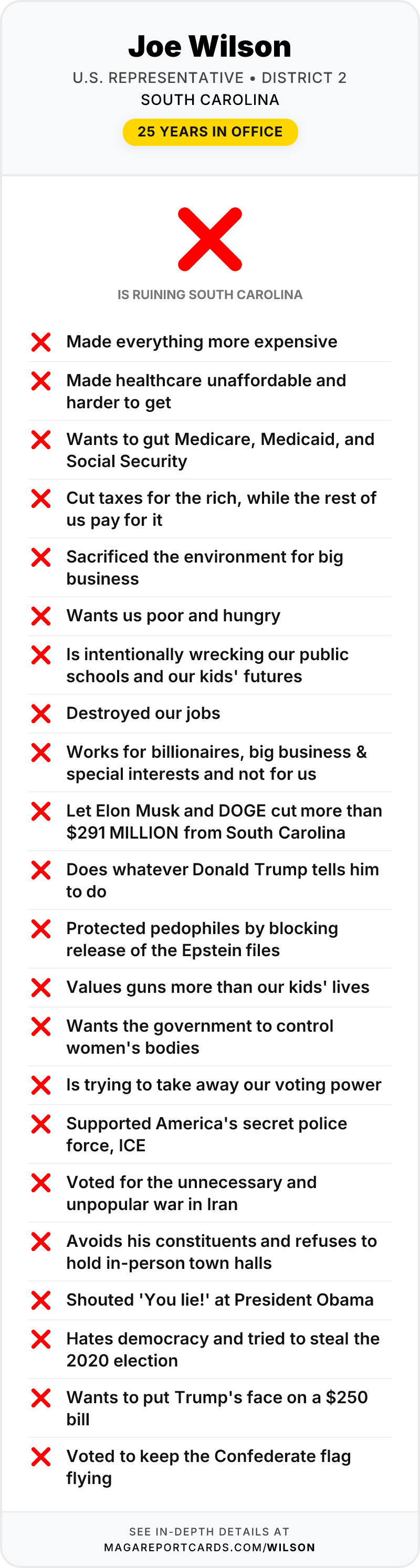
Joe Wilson has represented South Carolina's 2nd District since 2001 — 25 years. He is still in Congress. He is still asking the same voters to send him back, most recently while pushing to put Donald Trump's face on a $250 bill.
Essie Mae Washington-Williams died in 2013 at 87. She carried a powerful man's secret for him nearly her whole life, and when she finally set it down, a South Carolina congressman's first instinct was to tell her she'd damaged his hero.
We should be able to expect better than that from the people who represent us. When a constituent tells the truth, the job is to listen — not to calculate whose reputation it costs.
We deserve better.
Source
This post is based on reporting by Justin Elliott for Talking Points Memo, which surfaced Wilson's December 2003 comments to The State, plus Reuters' "Slavery's Descendants" investigation, CBS News on the Thurmond family's acknowledgment, Fox News on Wilson's refusal to apologize on the House floor, and House roll call records from the Office of the Clerk. Photo: Talking Points Memo.