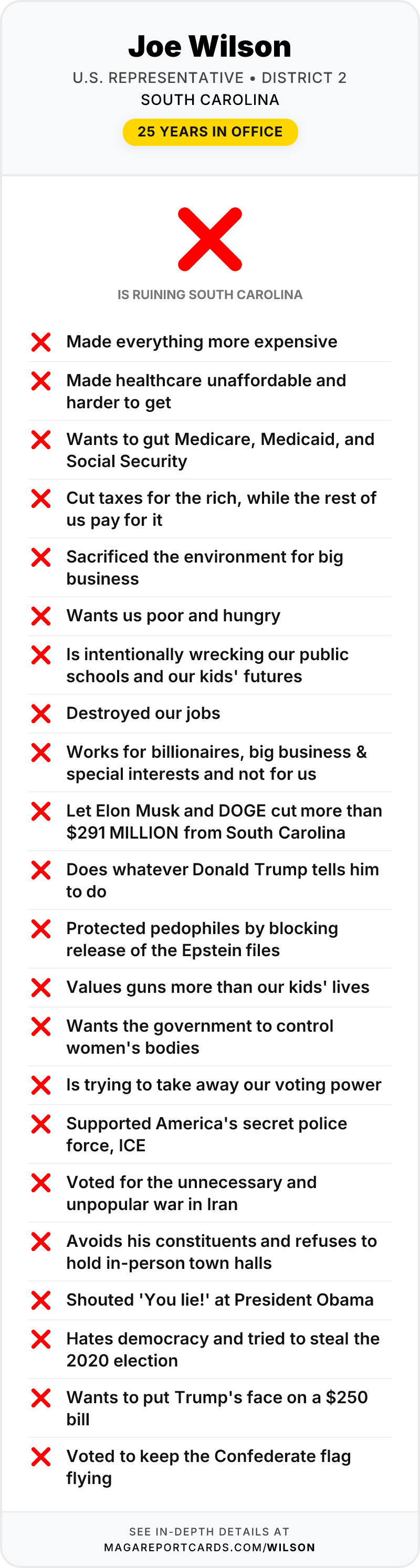
In February 2025, a month into Trump's second term, a 23-year veteran of Congress from South Carolina announced what he was going to spend his lawmaking power on.
Not groceries. Not health coverage. Not the tariffs.
A new $250 bill with Donald Trump's face on it.
Joe Wilson posted a mock-up on X and explained why the country needed one. (The image on his own press release carries the caption "AI concept artwork of what the bill may look like designed by Grok AI on X" — the currency of the United States, drafted by Elon Musk's chatbot.) His explanation:
"Bidenflation has destroyed the economy forcing American families to carry more cash. President Trump is working tirelessly to fight inflation and help American families. This achievement is deserving of currency recognition... The most valuable bill for the most valuable President!"
Read that again. His argument was that prices were so high that families needed a bigger denomination to carry them around in. And his solution to that problem was to put a picture on it.
He had to rewrite the law to do it
No living American has appeared on U.S. paper money since the 1860s, because federal law forbids it. As Treasury Secretary Scott Bessent summarized the rule, "no living person can be on U.S. currency." The statute says only the portrait of a dead person may appear on our money and securities.
Wilson's bill, H.R. 1761, doesn't work around that rule. It carves a hole in it. Section 4 tacks one clause onto the end of the law: "except if the individual is or has been the President of the United States." Section 3 then orders the Treasury Secretary to print the $250 notes with Trump's portrait within one year of the bill becoming law. Section 2 is a "sense of Congress" declaring that the notes should be printed "to commemorate the semiquincentennial of the United States."
Three Republicans put their names on it the day he filed it: Diana Harshbarger of Tennessee, Darrell Issa of California, and Wilson's own South Carolina colleague Ralph Norman. Thirteen more joined over the following fifteen months, bringing the total to sixteen.
Fifteen months later, this stopped being a joke
Bills like this usually die quietly in a committee drawer. This one didn't.
On May 28, 2026, Bessent used a White House press briefing to announce that his department is ready to go. He said he has "two mandates" for currency: "At present, no living person can be on U.S. currency, and the currency must say 'In God We Trust.'" There was legislation on Capitol Hill, he said, to "change the first requirement so that a living person, Donald J. Trump, could be on a $250 bill."
"At Treasury we prepare things in advance, so we have prepared in advance that if the legislation is passed, but we will stick to the law."
A Treasury spokeswoman confirmed the Bureau of Engraving and Printing "is conducting appropriate planning and due diligence" and "is moving proactively" to produce the note. A Republican committee aide said the bill had been greenlit for a hearing. Wilson's own spokesman said the congressman had spoken with Financial Services Chair French Hill about moving it, and had talked to Bessent and Trump about their support "on multiple occasions."
NBC reported that Bessent treated the currency question as "bifurcated" from the growing affordability crisis — from Americans struggling to buy gas and groceries. His defense of the whole exercise:
"I don't think that there's anything untoward about having the president of the United States, the person who was president of the United States on the 250th anniversary bill."
The excuse doesn't survive contact with a receipt
Wilson blamed "Bidenflation." Trump has now been back in office for more than a year and a half. So what happened to prices?
NBC News has tracked real checkout prices since 2021. As of its August 2026 update, ground beef is up 19% since January 2025 and orange juice is up 22%. Sandwich bread is up too. Eggs — the item Trump campaigned on hardest — have come down from a spring 2025 peak and are 30% cheaper than when he took office, so that one went his way. The rest of the cart did not.
Democrats on Congress's Joint Economic Committee calculated in January 2026 that a typical American family paid $310 more for groceries during Trump's first year than in 2024. Coffee alone cost $76 more, after a 50% tariff on Brazil that Trump later reversed.
Which brings us to the part Wilson would rather you not connect.
On February 11, 2026, the House voted on H.J.Res. 72, a resolution to end the national emergency behind Trump's tariffs on Canada. It passed 219 to 211. Six Republicans crossed over.
Wilson was not one of them. He voted no.
Tariffs are a tax collected at the register — the coffee number above is exactly how that works. Wilson is happy to call high prices a crisis when they're a reason to print Trump's face. He was not willing to cast one vote against a policy that raises them.
What his district actually needed from him
Wilson represents South Carolina's 2nd District. Here is what is happening there while he works the phones on currency design.
- 26,239 households in SC-02 rely on SNAP to buy food, according to USDA data — including 15,069 households with children and 9,686 with someone 60 or older.
- An estimated 28,199 people in SC-02 are projected to lose health coverage by 2034, per the Joint Economic Committee — 25,300 losing ACA marketplace coverage and 2,899 losing Medicaid.
Wilson voted for Trump's budget bill and celebrated it with the words "Promises Made, Promises Kept."
Twenty-eight thousand of his neighbors projected to lose their health coverage. Twenty-six thousand households needing help to eat. And the legislation he has personally lobbied the Treasury Secretary and the President to advance is a picture on a banknote.
Nobody who studies money thinks this is a good idea
Set the politics aside. The bill doesn't even work as economics.
Oscar Brookins, an emeritus economics faculty member at Northeastern University, put it plainly: "I don't see any practical function that the $250 denomination would fulfill." He asked the obvious question — "How many times do you go into the store and you spend something close to $250?" — and pointed out that a brand-new note is not free to make: "It seems a long, costly process is usual, even when existing currency is simply tweaked, let alone an entirely new one."
So there goes Wilson's premise. He says high prices are forcing families to haul around thicker stacks of cash. Almost nobody hands over $250 in paper at a checkout counter, and printing a new denomination to fix a problem that doesn't exist would be slow and expensive.
It's a whole genre now
Wilson isn't alone in this.
In March 2026, the Treasury said Trump's signature would go on paper currency — a first for a sitting president. A federal commission of Trump appointees approved a design putting his image on 24-karat commemorative gold coins. Rep. Anna Paulina Luna filed a bill eight days into the term to carve Trump's face into Mount Rushmore — the mountain's own sculptor wrote in 1936 that the rock couldn't take a fifth head, and the engineers and superintendents who have worked there since say the same. Seventeen Republicans, including South Carolina's own Rep. William Timmons, have signed onto bills to rename Dulles Airport after Trump.
None of it lowers a grocery bill. All of it takes up floor time, staff time, and committee attention that belongs to the people paying those bills.
He still won't face them in person
There's one more thing worth knowing about how Wilson spends his time.
He has been extraordinarily available to Scott Bessent and Donald Trump on this bill — "multiple occasions," his own office says. He has been considerably less available to the people who elected him. Asked in March 2025 whether he would hold an in-person town hall, Wilson wouldn't commit to a date, telling the Post and Courier that "tele-town halls are more convenient and reach thousands more immediately."
When he stood in a room with his constituents over health care in April 2017, they held up red "you lie" signs and shouted his own most famous words back at him.
Twenty-five years in Congress. A district projected to lose health coverage, with 26,000 households on food assistance. A grocery cart that costs $310 more. And the thing he picked up the phone to the Treasury Secretary about was whose face goes on the money.
We deserve better.
Source
- "South Carolina Republican wants to put Trump on new $250 bill" — Ashleigh Fields, The Hill, February 26, 2025. Photo: Greg Nash / The Hill.