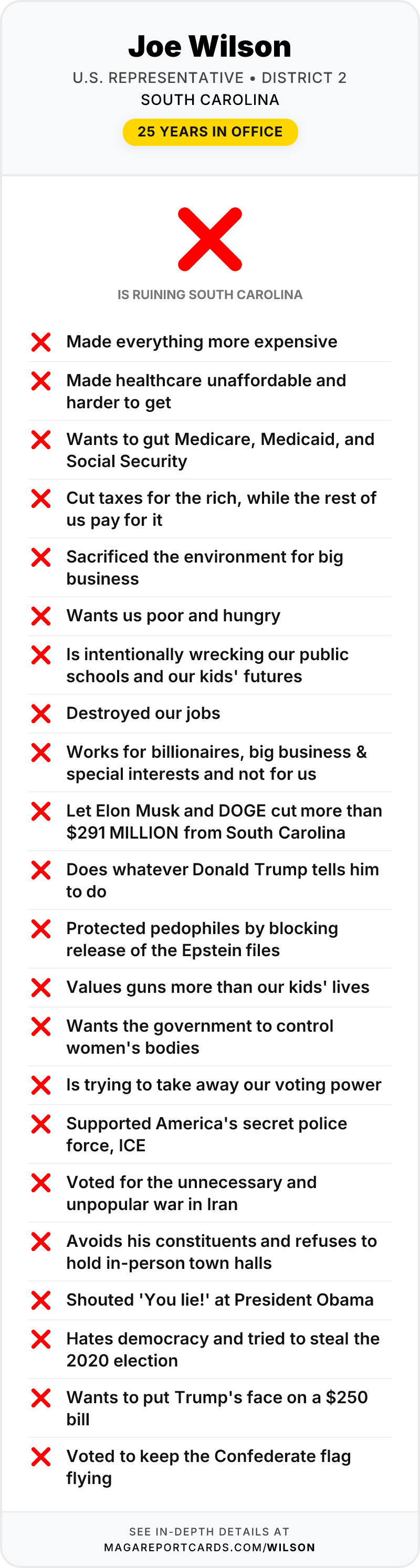
In April 2000, the South Carolina Senate voted 36 to 7 to bring the Confederate battle flag down off the Statehouse dome.
Joe Wilson was one of the seven.
Not one of seven who had doubts about the process. Not one of seven who wanted a different compromise. He was one of only seven state senators who voted to keep the flag flying over the building where South Carolina makes its laws. Thirty-six of his colleagues voted to take it down.
That was twenty-six years ago. What makes it worth writing about today is everything Wilson has done since.
He didn't just vote for the flag. He defended the Confederacy.
Plenty of politicians who voted the wrong way in 2000 said it was about tradition and left it there. Wilson went further. On comparisons between the battle flag and Nazi symbols — which he called odious — he told BBC News:
"That's offensive to me that they would take my heritage and make it into a Holocaust era type description. I find that very offensive, and it's not true."
And then, in the same breath, the line that follows him around:
"The Southern heritage, the Confederate heritage is very honourable."
CBS News, reporting on Wilson years later, noted he was a member of the Sons of Confederate Veterans. This wasn't a stray vote on a crowded calendar. It was a cause.
And he told his colleagues exactly why. In a speech to the South Carolina General Assembly in 2000 — a year before he was elected to Congress — Wilson said keeping the flag at the Statehouse was "very, very personal. And it's personal because it's my family," explaining: "For me, it began very early in that I was named for a Confederate general, General David Addison Weisiger."
He added, in that same speech, that Weisiger "was not a plantation owner; he was a bank cashier." Reuters later found what Wilson left out: Weisiger enslaved seven people in southeast Virginia in 1860, ranging in age from 5 to 45. Reuters contacted Wilson five times about its findings. He never responded.
What the flag was actually doing up there
South Carolina leaders raised the battle flag over the Statehouse dome in the early 1960s — to mark the Civil War's 100th anniversary and to register official opposition to the civil rights movement, as the Equal Justice Initiative put it. It was not a Civil War relic that had been quietly flying since 1865. It was a message, sent in the decade of sit-ins and school desegregation, by a legislature that had no Black members.
And the 2000 compromise Wilson voted against didn't even remove it. The bill took the flag off the dome and put a different version on a pole in front of the Statehouse, where it stayed for fifteen more years. The controversy went right on: in July 2009, after talks with the NAACP, the Atlantic Coast Conference pulled three future college baseball tournaments out of South Carolina.
So the seven lost — and even the winning side only moved the flag from the dome to the lawn.
It took nine people murdered in a church
On June 17, 2015, a white gunman who had posed with Confederate flags walked into Emanuel AME Church in Charleston and killed nine Black parishioners at Bible study, including state Sen. Clementa Pinckney.
Six days later, Wilson put out a statement:
"I stand with Senator Tim Scott in calling for the removal of the Confederate battle flag from the Statehouse grounds."
He named all nine of the dead and asked people to pray for their families. He called Sen. Tim Scott "the true face of South Carolina at this time." The flag came down from the Statehouse grounds on July 10, 2015 — fifteen years after Wilson voted to keep it up.
It's worth saying plainly what that sequence means. Wilson spent the 1999–2000 fight insisting the flag was honorable heritage and nothing to do with hate. He changed his public position only after nine of his own state's people were shot to death in a church by a man who wrapped himself in that flag. That is very late, and it took a great deal.
Still — he said it. The question is whether he meant it.
Eleven months later, he voted the other way
On May 19, 2016, the House took up a spending bill for the Department of Veterans Affairs. Rep. Jared Huffman offered an amendment to stop Confederate battle flags from being flown over the mass graves at VA-run national cemeteries on the two days a year such displays were permitted. Huffman's argument: "Symbols like the Confederate battle flag have meaning. They are not just neutral, historical symbols of pride. They represent slavery, oppression, lynching and hate."
The amendment passed, 265 to 159. Eighty-four Republicans voted for it.
Wilson voted no.
Eleven months after saying the flag should come off the Statehouse grounds in Columbia, he voted to keep flying it over graves in federal cemeteries.
And he kept voting that way
This is where the pattern stops being about one flag.
- July 22, 2020 — the House passed a bill to remove statues of Confederate figures from the U.S. Capitol and replace the bust of Chief Justice Roger Taney, author of the Dred Scott decision, with a bust of Thurgood Marshall. It passed 305 to 113. Every single no vote was a Republican. Wilson was one of them.
- June 29, 2021 — the House passed a similar bill to pull Confederate statues out of the Capitol, 285 to 120. Again, every no vote came from a Republican. Again, Wilson was one of them.
None of these votes cost a constituent a dollar. None of them cut a program in South Carolina's 2nd District. They were about what the country honors and where. Three times, given a free vote, Wilson chose the Confederacy.
He is not alone in that. Andy Harris was one of only nine members who voted against naming a post office after Maya Angelou — a bill that passed 371 to 9. And this past July, Dan Sullivan recited the Declaration of Independence on a stage feet from a Confederate battle flag, then his campaign posted photos that left the flag out. These are the votes and moments nobody makes you take.
The same instinct, over and over
Three years after the flag vote, Essie Mae Washington-Williams came forward as the daughter of Strom Thurmond. Wilson — a former page of Thurmond's — said he didn't believe her, called it "unseemly," and said she should have kept it to herself. The Thurmond family confirmed her account within days. Wilson apologized six days in, and still maintained she should never have gone public.
Less than six years after that, he shouted "You lie!" at President Obama during an address to Congress. The House formally disapproved of the outburst, 240 to 179.
The shape is always the same. The flag was "heritage" — his family's honor. A Black woman's account of her own father was a "smear" — another white man's honor. And the apology, when it comes, arrives only after the pressure does, with the original position left standing underneath it.
The bottom line
Joe Wilson spent years defending a flag that was raised over the Statehouse to oppose the civil rights movement. He said it should come down only after nine people were murdered in a Charleston church. Then he went back to Washington and voted three separate times to keep Confederate symbols on federal ground — over veterans' graves, and in the Capitol itself.
You can call the first one a product of his time. You cannot say that about 2016, 2020, and 2021.
He is also the man who, in February 2025, introduced a bill to print Trump's face on a new $250 bill. Twenty-five years in Congress, and this is the record.
We deserve better.
Sources
CBS News and the Institute for Southern Studies' Facing South (quoting BBC News) on the 2000 flag vote and Wilson's remarks; Wilson's own June 23, 2015 statement; the Equal Justice Initiative on the flag's history and removal; PBS NewsHour on the 2016 VA cemeteries amendment; House roll calls from the Office of the Clerk; Reuters' 2023 "Slavery's Descendants" investigation on Wilson's 2000 speech and his ancestors; and Talking Points Memo on the 2003 Washington-Williams episode. Photo: official congressional portrait, via Wikimedia Commons.