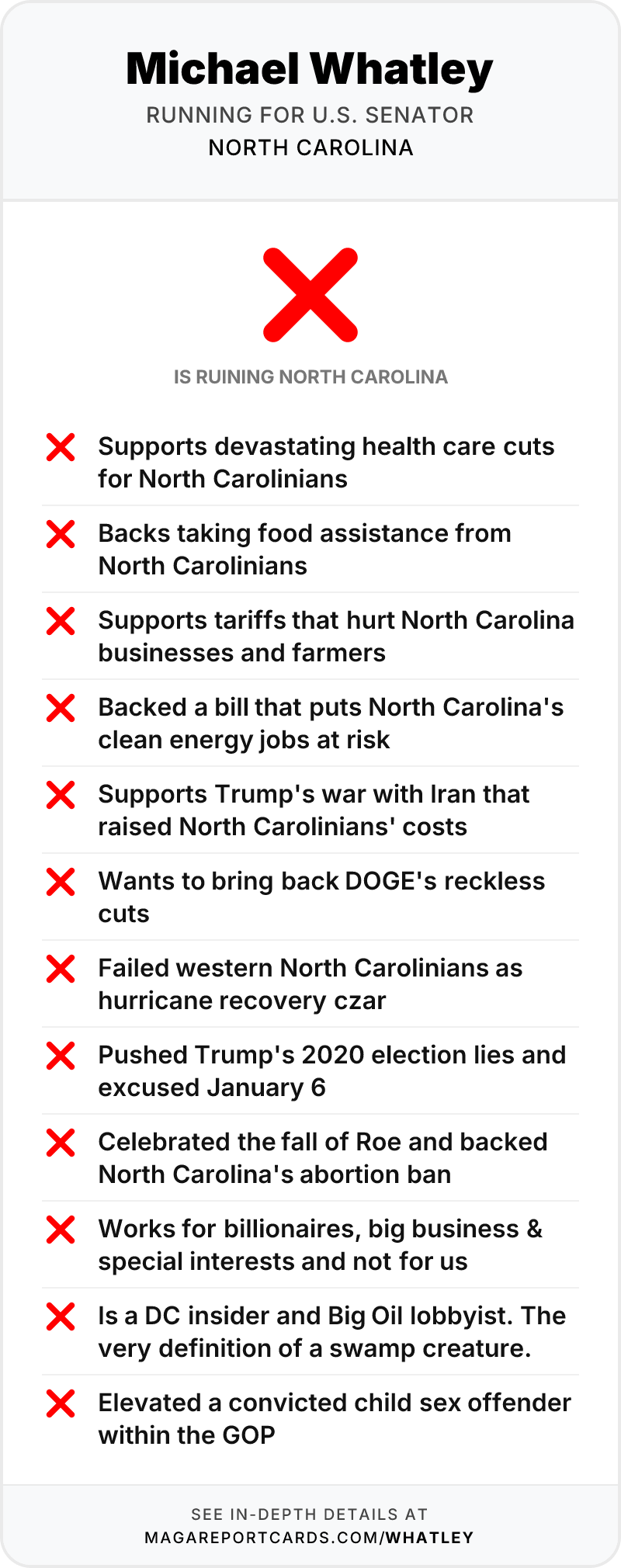
Michael Whatley wants to be North Carolina's next U.S. senator. When a Fox News host asked him this summer what he would tell President Trump to do next in Iran, given what the war was doing to oil prices and the cost of living, Whatley answered: "Stay the course." He added, "You've got to make sure that Iran is not going to have a nuclear weapon."
His own financial disclosures help explain why that might be easy for him to say.
Whatley has up to $2.1 million invested in the defense and energy industries, according to an American Journal News review of his personal financial disclosures. Both industries have done very well since the war began six months ago.
The war that raised your gas bill
The Iran war has disrupted oil shipments out of the Middle East and pushed gas prices up around the world. In North Carolina, central-state gas prices jumped roughly $1 a gallon in a single month last spring, and farmers were hit with rising fertilizer costs on top of it.
Whatley backed the war from the very first strikes in March. "I strongly support what President Trump has set out to do," he said then, predicting it would be a "limited mission." It was not. When a Daily Wire reporter later asked whether he still supported the war "given that economic impact here at home," Whatley answered: "Absolutely."
Polls show nearly 60% of voters oppose the war. Whatley has not wavered.
Who wins when gas goes up
Higher oil prices are a cost for North Carolina drivers. For American oil companies, they are a payday. U.S.-based producers can sell at the higher world price without having to deal with the shipping mess in the Middle East.
That is where most of Whatley's money is. He owns up to $1.6 million in oil and gas stock, including ConocoPhillips, Chevron, Shell and ExxonMobil, according to American Journal News. The value of the Shell shares he and his wife hold have risen nearly 12% since May.
Chevron was his biggest single holding as of late 2025. A Politico Influence analysis of his November 2025 disclosure, republished by the North Carolina Democratic Party, found Whatley and his immediate family own between $321,000 and $890,000 in Chevron stock, plus between $83,000 and $245,000 in ExxonMobil.
And when the bombs keep falling
The other half of the portfolio is defense. Whatley has nearly half a million dollars invested in defense and aerospace companies. His GE Aerospace holdings rose nearly 31% between May and August.
He also bought more shares of Park Aerospace after the war began. Park Aerospace is a supplier to U.S. missile defense programs, and a Seeking Alpha analysis called it a possible "hidden winner" as missile defense production surged. Its stock rose more than 60% between February and August.
So the candidate telling the president to keep the war going holds stock in the companies that profit when it keeps going, and he added to one of those bets after the shooting started.
This is the industry he worked for
None of this is new territory for Whatley. Before he ran the Republican National Committee, he was a lobbyist. His federal lobbying disclosures show he personally brought in at least $1.3 million for one firm managing accounts that included ExxonMobil, General Electric and the weapons maker Lockheed Martin. He later founded a firm, HBW Resources, that took in more than $8 million from clients including the American Petroleum Institute, the oil industry's biggest trade group.
We have already documented the lobbying career his campaign website leaves out, and the up to $445,000 in Duke Energy stock he and his wife held while Duke asked to raise North Carolina power bills. The Iran war fits the same pattern: Whatley's public positions keep lining up with his private portfolio.
His opponent, former Gov. Roy Cooper, has said he wants to end the war.
What the filings show
Michael Whatley, North Carolina's Republican Senate nominee, has publicly backed the Iran war since March and told Trump to "stay the course" even as it pushed up gas and fertilizer prices for North Carolinians. His disclosures show up to $2.1 million in defense and energy stocks, including up to $1.6 million in oil and gas, and he bought more Park Aerospace, a missile-defense supplier, after the war began.