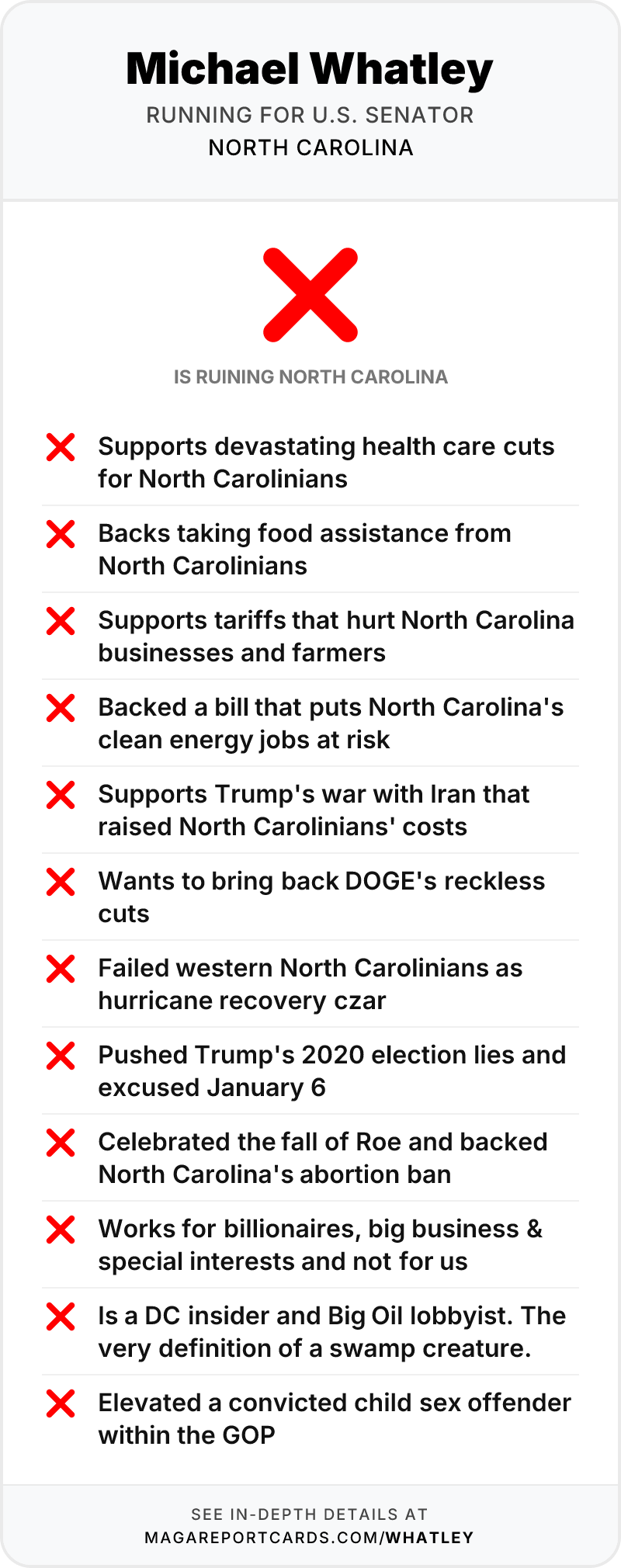
Michael Whatley wants to be North Carolina's next U.S. senator. His campaign website says he's for "reliable, affordable energy."
He also owns a lot of stock in the company trying to make your electricity less affordable.
The numbers
According to a financial disclosure filed in November 2025, Whatley and his wife own between $163,000 and $445,000 in Duke Energy stock, The North Carolina Independent reported.
Duke Energy is not one company among many in North Carolina. It is the electric utility for most of the state. If you live in Charlotte or Raleigh or Asheville and you plug something in, you are a Duke customer, and you don't get to shop around.
Here's what Duke has been doing while Whatley held that stock:
- November 2025 — Duke applies for an 18% residential rate increase.
- After objections, the request drops to 11.6%.
- July 2026 — a proposed settlement lands at about 9.5% over two years.
So in the same month Whatley disclosed a six-figure position in Duke Energy, Duke asked state regulators to raise what North Carolinians pay to keep the lights on by nearly a fifth.
Why this is a conflict, not a coincidence
Owning stock isn't a crime, and plenty of people hold utility shares in a retirement account without thinking about it.
But Whatley is not a passive bystander to energy policy. He is a former oil lobbyist — that's how the Associated Press described him when he took over the RNC — now running for a Senate seat where energy regulation is part of the job. His career has been spent in exactly the industry his portfolio is invested in.
That's the problem in one sentence: the higher your power bill goes, the better Duke Energy performs, and the better Whatley's holdings perform. His financial interest runs in the opposite direction from every ratepayer in the state he wants to represent.
And on the specific thing voters are feeling — a power bill going up nearly 10% over two years — his campaign has offered no plan. The website talks about "reliable, affordable energy" in the abstract. It doesn't say what he'd do about Duke's rate increases, because saying anything would require picking a side between his constituents and his portfolio.
He hasn't commented on the holdings.
This is the pattern, not an exception
North Carolinians have seen this movie with Whatley before.
Before politics he led a special interest-funded organization that ran astroturf campaigns for energy industry causes. Then Trump made him Helene recovery czar — and residents said he went absent while western North Carolina waited on aid.
The through-line is that when Whatley's interests and North Carolina's interests point in different directions, North Carolina waits.
What "affordable energy" should mean
Utility rates are one of the few costs a senator can genuinely affect — through federal energy policy, through oversight, through pressure on regulators and on the utilities themselves.
A senator who owns up to $445,000 of the monopoly utility is not a neutral party in that fight. Every North Carolinian paying a Duke bill deserves to know their senator's household gets a little richer when that bill goes up.
If Whatley thinks the 9.5% increase is too high, he can say so. If he thinks his Duke holdings are a problem, he can divest.
He's done neither. We deserve better.
Source
Reporting by The North Carolina Independent (July 2026).