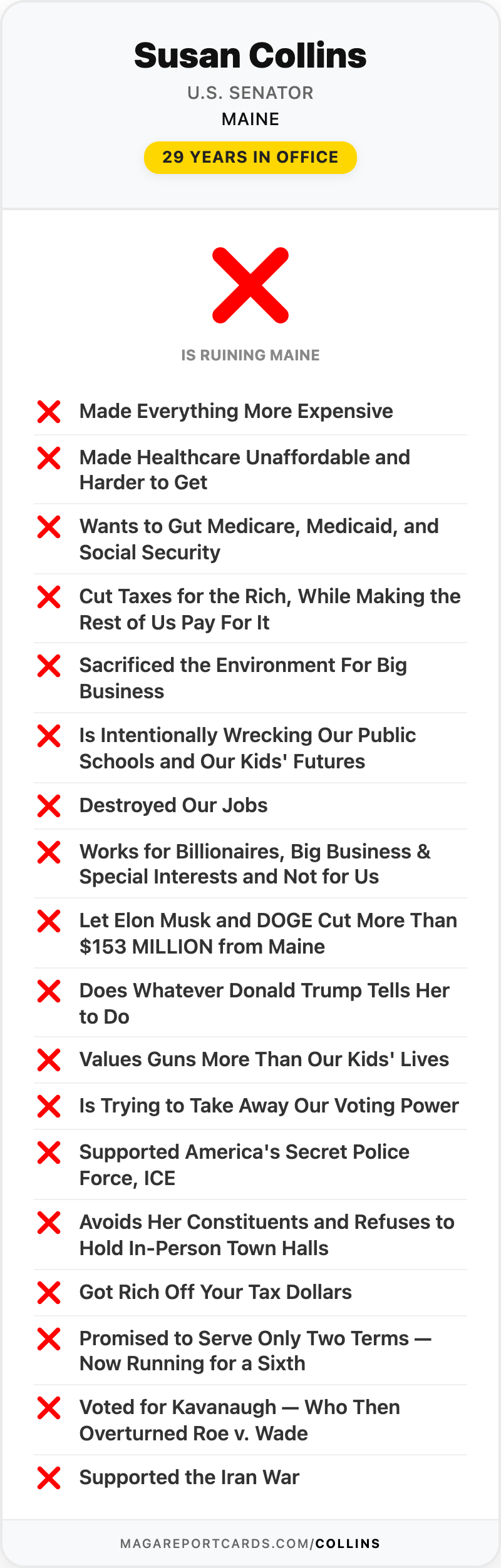
On Monday, Susan Collins' campaign sent Mainers an email asking for donations — as little as $5 — to fund a statewide tour running the length of the state, Kittery to Madawaska.
The pitch, as reported by the Daily Beast:
"Organizing a tour of this scale takes a lot of coordination, enthusiasm, and quite literally fuel."
Fuel. That's the word her campaign chose, in the year Mainers have been watching pump prices climb because of a war Collins spent two months voting to continue.
The 60 days
When Trump launched airstrikes on Iran in February 2026, Congress had a tool to stop it. The War Powers Act gives Congress 60 days to end a war a president starts without its approval.
Democrats forced vote after vote. Five times between March 4 and April 22, Collins voted against them, saying it "would send the wrong message to Iran and to our troops."
Then the 60-day deadline arrived on April 30. And on that day, Collins voted to end the war. She was one of only two Republicans to do so.
Her vote came too late to matter. The resolution failed 47–50. The war continued.
This is worth stating precisely, because Collins' campaign points to that April 30 vote as proof she opposed the war. What the record shows is that she voted with her party against five straight attempts to stop it, from March 4 through April 22, and broke ranks only in the last 48 hours of the window — voting yes on the 60th day, when the outcome was already set.
It's a familiar move. She voted against Trump's budget bill too, but only after her own procedural vote had already sent it to the Senate floor. She votes no when her no changes nothing. It reads as moderation and functions as consent.
And her family owns the upside
Here is the part that turns an awkward email into a real conflict.
Collins' annual financial report for 2025 shows her husband, Thomas Daffron, holds up to $150,000 in corporate securities issued by ConocoPhillips and Phillips 66 — petroleum companies whose fortunes rise when fuel prices do.
In fairness, Collins' office says Daffron's investment decisions are made exclusively by a third-party adviser, without his consultation. We take that at face value. Nobody is alleging Collins voted on Iran to move an oil stock.
But the arrangement is still the arrangement. For two months, a senator voted to keep going a war that pushed fuel prices up. Her household's portfolio was positioned to benefit from exactly that. And now the campaign is asking Mainers — who have no such hedge — to chip in $5 for gas.
Mainers paying at the pump absorbed a cost. The Daffron portfolio absorbed a gain. The email asks the first group to help with the second's travel budget.
This is the pattern voters keep finding
Collins' financial record has been a recurring problem, and not because opponents invented it:
- Her net worth was negative as recently as 2011. It is now up to $9.8 million. Her opponent's campaign puts her investment income at $342,520 a year — more than most Maine households earn from a full year of work.
- She failed to report up to $395,000 in stock trades — 24 transactions filed more than 100 days late between 2013 and 2018 — violating the STOCK Act, the same law she championed and helped pass in 2012.
- In 2026 she also failed to disclose a Pfizer purchase on time.
- Her opponent's campaign says she owns the eighth best-performing stock portfolio in the Senate.
- And she opposes a full ban on congressional stock trading, though 81% of Americans support one, including most Republicans.
We've written before about how the math on her "decisive" votes actually works. The shape is consistent: the public position is careful, the paperwork is late, and the portfolio does well.
Maine isn't the only place this happened
The Iran war's cost at the pump has been showing up in Republican districts all year, and members who voted to continue it have gotten creative about explaining the prices:
- Mike Flood called $4.06 gas "the hand you're dealt" after voting to keep the war going.
- Ashley Hinson took oil money and voted the same way.
- Jon Husted's Chevron ties sat alongside his Iran war votes.
Collins' version is distinguished only by the email. The others at least didn't ask constituents to underwrite the fuel.
What Mainers should ask
Collins is running for a sixth term after promising, back at the start, to serve only two.
Two questions are fair to put to her on the tour itself:
- If ending the war was the right vote on April 30, why was it the wrong vote in March? The facts didn't change on the 60th day. Only the consequences of her vote did.
- Will she divest the petroleum holdings, or at least support the stock-trading ban that 81% of Americans want? "A third party manages it" answers a question about intent. It does not answer a question about incentive.
Maine deserves a senator who pays the same price at the pump that Mainers do — and doesn't pass the hat for it.
Sources
- Vulnerable GOP Maine Senator Susan Collins Begs for Gas Money After Upholding Trump's War — Julia Ornedo, The Daily Beast, August 18, 2026.
- Collins' Iran war powers vote reversal — The Maine Monitor.
- Democratic ad attacks Collins on healthcare, Iran war — FactCheck.org.