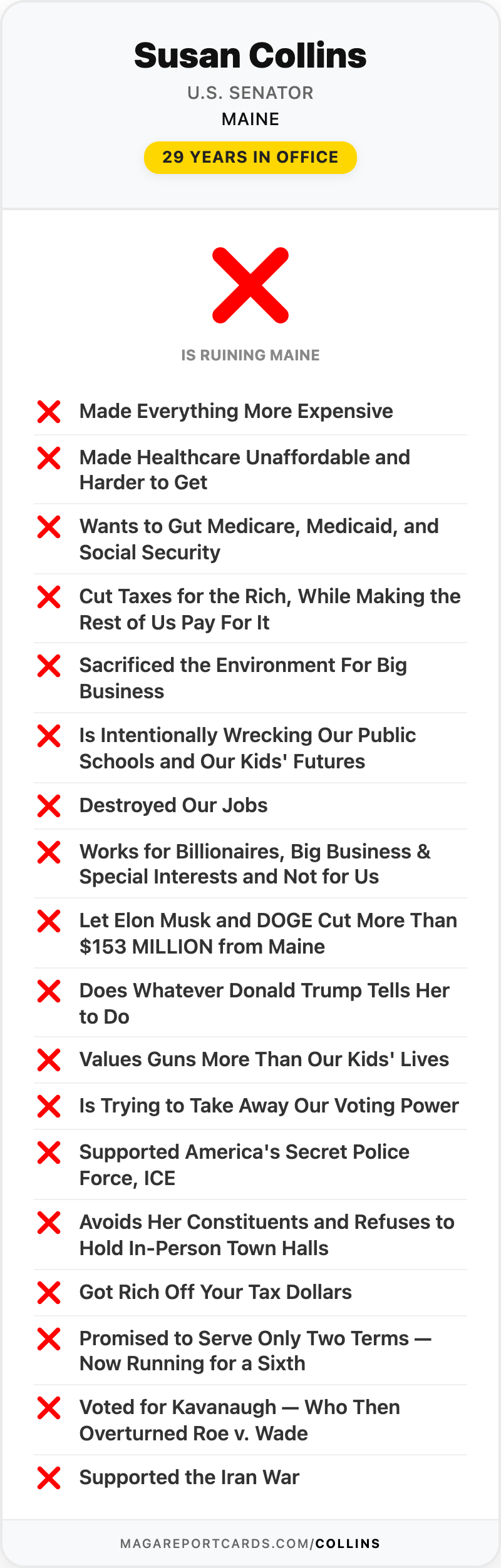
The oldest argument in Maine politics is whether Susan Collins is actually independent or just times her independence for when it can't change anything.
The Bangor Daily News decided to stop arguing about it and count. Reporters Benjamin Kail and Michael Shepherd went through roll-call data from VoteView covering all 10,076 votes Collins has cast since 1997, and isolated the ones where her vote alone would have changed the outcome.
The answer is genuinely complicated, and both sides of it are worth stating plainly.
What the numbers actually show
Collins has cast 200 deciding votes — 2% of every vote of her career.
Of those 200, 144 helped her own party. That's 72%. The other 56 delivered the outcome Democrats preferred.
Fifty-six is not nothing. It is, according to the BDN's review, the most party-breaking decisive votes cast by any senator over the span of Collins's tenure. By rate she ranks seventh, behind several senators with much shorter careers.
So the flat claim that Collins never breaks with Republicans when it counts is not supported by the data. She has, 56 times, over 29 years.
The problem is what happened to that number recently.
The trend line
Here is the BDN's count of decisive votes Collins has cast against her own party, administration by administration back to George W. Bush. Collins took office in 1997, under Bill Clinton, and the review does not break out those first four years:
- George W. Bush, two terms — 13
- Barack Obama, two terms — 16
- Donald Trump, first term — 9
- Joe Biden — 12
- Donald Trump, second term, so far — 4
The senator whose brand is independence has broken with her party decisively four times during what the Bangor Daily News calls a time of unprecedented expansion of White House power.
And on the specific category that has defined this Congress, the Maine Democratic Party's number is the one that stings: Collins has cast 19 deciding votes to confirm Trump nominees, and not one deciding vote against one.
The "too little, too late" list
Democrats' version of the argument is that Collins's famous "no" votes arrive after the outcome is already locked. They point to her votes against Todd Blanche, Justice Amy Coney Barrett, Defense Secretary Pete Hegseth, former Education Secretary Betsy DeVos, and a motion to advance an Affordable Care Act repeal — all cast, they say, once it was clear the result was decided.
Collins's team disputes two of those directly, and the objection is fair enough to record: they say she was the first Republican to come out against Blanche before his confirmation was secured, and the first in her party to oppose Obamacare repeal in 2017.
On Blanche in particular, though, the sequence is worth looking at. Collins voted to confirm Todd Blanche as deputy attorney general in March 2025. She announced her no vote on his attorney general nomination hours after the two Republicans with real leverage cut their deal and let him out of committee. He was confirmed anyway.
The clearest example of the pattern isn't a nominee at all. On Trump's budget bill, Collins voted against final passage — after casting the procedural vote that let the bill get to the floor. Her campaign now runs an ad saying she "stood up for Maine" on Medicaid. The ad leaves out the procedural vote, which a fellow Republican publicly thanked her for.
Her team's answer is that the procedural vote is what gave her the standing to push for an amendment. That is a real argument about how the Senate works. It is also, precisely, the mechanism critics are describing.
"Hall passes"
Kyle Kondik, managing editor of the nonpartisan Sabato's Crystal Ball at the University of Virginia's Center for Politics, gave the BDN the least partisan description of the phenomenon:
Some votes by vulnerable members of both parties "end up being hall passes, where somebody's vote is not actually needed."
Kondik also noted that hall passes are not unique to Collins, and that it is nothing new for critics to tie a lawmaker to an unpopular president. What has changed is that there is almost nobody left in her position — twenty years ago, he said, Congress had red-state Democrats and blue-state Republicans, and now it basically doesn't.
That is context, and it's true. It does not answer the question a Maine voter is actually asking, which is whether the 19-to-0 record on deciding votes for Trump nominees describes a moderate.
The number Collins's campaign offers instead
Her campaign points to a different statistic: in the first years of the last several administrations going back to Bush, Collins voted with the president's position between 85% and 95% of the time, regardless of which party held the White House.
They add a caveat that is fair enough to record. The Washington Post reported in December that 2025 saw 659 roll-call votes — more than any odd-numbered year this century. Her team's argument is that many of those were noncontroversial nominees who in earlier eras may have cleared by voice vote or unanimous consent, which inflates the Trump-alignment percentage with routine confirmations.
Her spokesperson, Blake Kernen, said Collins "takes every single vote seriously and carefully considers her decision to act in the best interest of Maine and America," and said she has often been recognized as the most bipartisan senator, in "stark contrast" to Democratic nominee Troy Jackson.
Jackson's spokesperson, Maggie Amjad, put the other side of it: "While Susan Collins has spent 30 years in Washington selling out Maine and putting billionaires first, Troy Jackson will stand up and fight for Mainers."
What this leaves Maine voters with
Two things are true at once, and the BDN's math is what makes it possible to say so:
- Collins really has broken with her party on decisive votes more than any other senator of her era. That is not a myth her office invented.
- The overwhelming majority of her deciding votes — 72% — went the Republican way, that rate of independence has fallen to its lowest point of her career under the current administration, and by the Maine Democratic Party's count she has never once been the vote that stopped a Trump nominee.
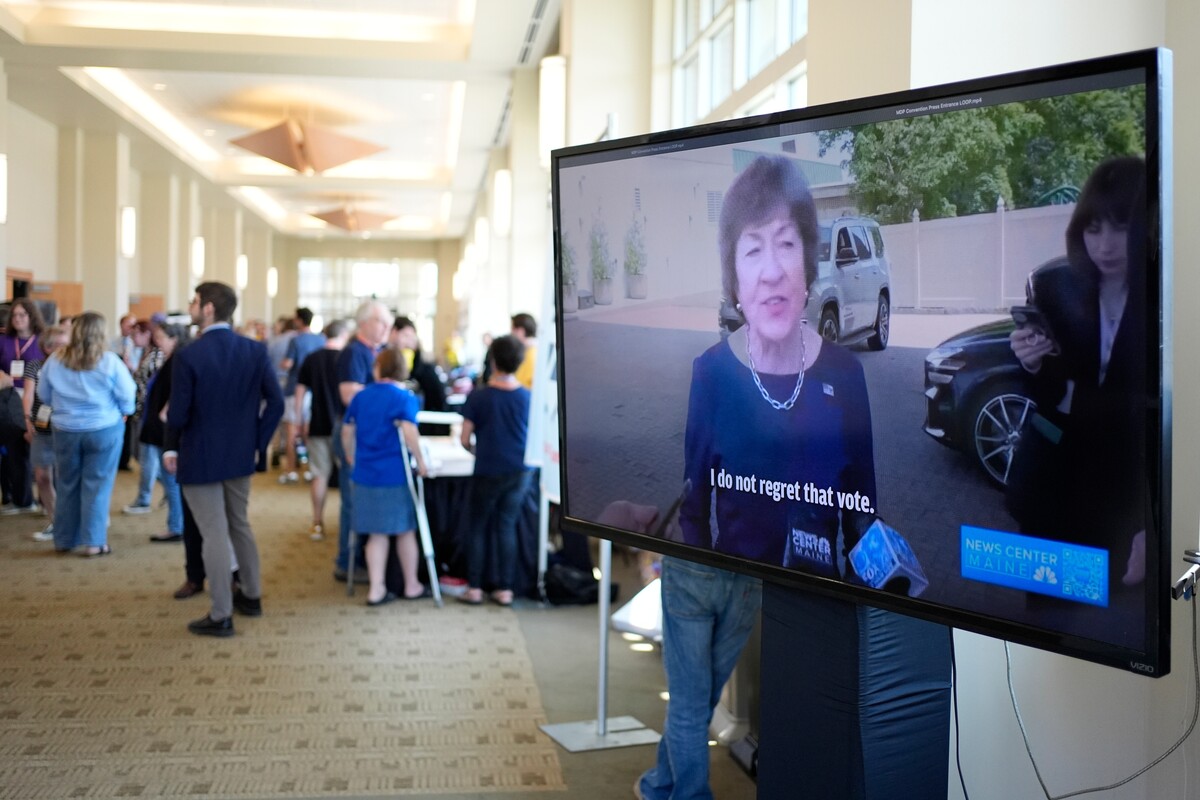
Maine's most consequential Collins vote is still the one that put Brett Kavanaugh on the Supreme Court on the assurance that Roe was settled law. He voted to overturn it. Asked in Maine this summer whether she'd do it again, she said yes.
Independence isn't a personality. It's a count. The count is public now.
Source
Does Susan Collins only vote with Democrats when it doesn't matter? We did the math. — Benjamin Kail and Michael Shepherd, Bangor Daily News, August 13, 2026.