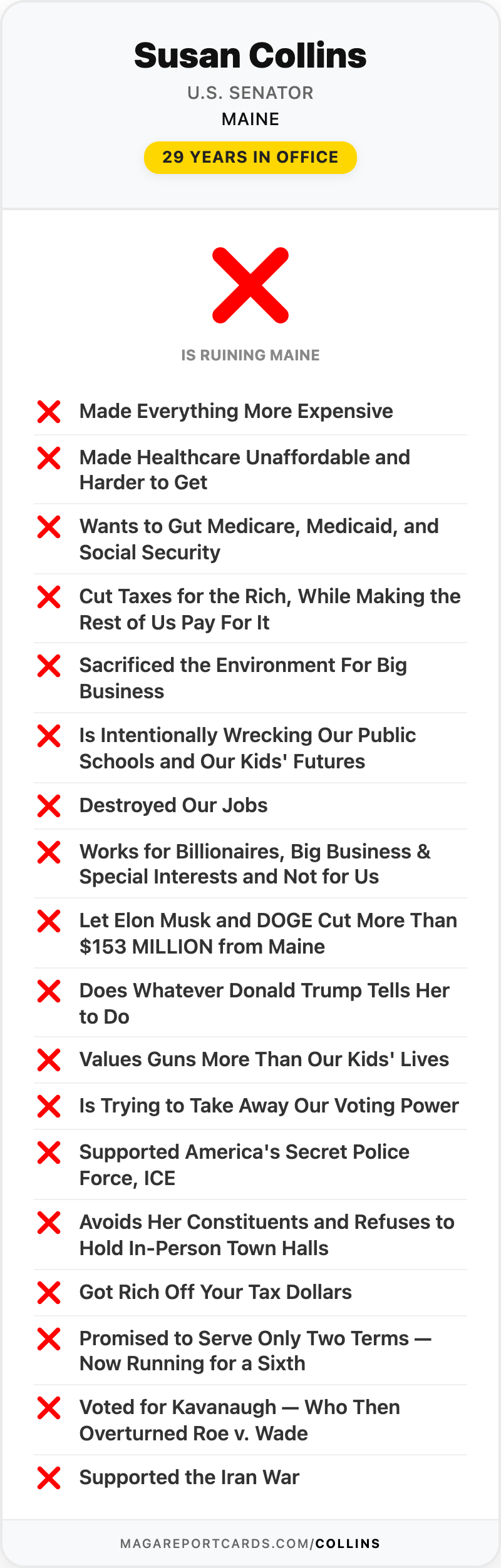
In October 2018, Susan Collins stood on the Senate floor and cast the vote that put Brett Kavanaugh on the Supreme Court. She was the swing vote. Without her, he doesn't get confirmed.
She explained her reasoning at length. She said Kavanaugh had assured her — under oath and privately — that Roe v. Wade was "settled law." She said he called it "precedent on precedent," because Planned Parenthood v. Casey had reaffirmed it. She said he told her it "should be extremely rare that it be overturned."
And she was explicit about her own red line. On 60 Minutes Overtime, she put it this way:
"I could not vote for a judge who had demonstrated hostility to Roe v. Wade because it would indicate a lack of respect for precedent."
Four years later, Kavanaugh joined the majority in Dobbs v. Jackson Women's Health Organization and overturned Roe.
When the draft opinion leaked in May 2022, Collins said it would be "completely inconsistent with what Justice Gorsuch and Justice Kavanaugh said in their hearings." In plain English: she said she had been misled.
Now she says she'd do it again
Collins is up for reelection this year — her first Senate race since Roe fell — and the question keeps following her around Maine.
In June, in Portland, she told reporters: "I do not regret that vote."
Then, after an event at a fire station in Randolph, Maine, she went further. Asked whether she would confirm Kavanaugh again, she said:
"I would vote for him again, yes, if that's what you're asking."
The remark was captured on audio by an operative for the Democratic super PAC American Bridge and reported by Lisa Lerer and Beth Reinhard in the New York Times on August 1, 2026.
Both things cannot be true
Line the three statements up:
- 2018: I could not vote for a judge hostile to Roe. He told me it was settled law.
- 2022: What he did is completely inconsistent with what he told me.
- 2026: I would vote for him again.
If the 2022 statement was sincere — if she genuinely believed a nominee had given her private assurances and then broken them — there is no version of "I'd do it again" that follows. You don't rehire the person you say deceived you.
Which leaves two possibilities, and neither is good.
Either the assurances never actually mattered. In which case her 2018 floor speech, the long explanation of precedent and stare decisis, the careful reasoning about why this particular nominee was safe — all of it was cover for a vote she was going to cast anyway.
Or the 2022 statement was for show. A statement of disappointment issued at the exact moment Maine women were realizing what had happened, from a senator who has spent a career being the Republican who feels bad about it.
Collins has never had to pick between those two answers, because she's never been asked to. Now she's answered anyway, on tape, outside a fire station in Randolph.
What it actually cost
This is not an abstract debate about judicial philosophy.
Dobbs ended the federal constitutional right to abortion. In the years since, states across the country have banned or severely restricted it. Women have been turned away from emergency rooms while miscarrying. Doctors have left states rather than risk prosecution. People travel hundreds of miles for care that used to be a legal right everywhere in America.
Collins is one of only two Senate Republicans who describes herself as supporting abortion rights. She had the single vote that determined whether the justice who would end Roe got a seat. She used it to confirm him.
Saying she'd do it again is the most consequential thing she has said in this campaign.
The pattern Mainers already know
This fits a shape that shows up over and over in Collins's record: the carefully worded objection, followed by the vote that makes it irrelevant.
She said she opposed Trump's Medicaid cuts — after casting the procedural vote that sent that budget bill to the Senate floor. She voted against the Iran war powers resolutions for 60 days, then voted for one only after the legal deadline had passed and the outcome no longer mattered. She votes no when no is free.
She has not held a public town hall in Maine in years, preferring invitation-only meetings — which is part of why it took a super PAC staffer with a recorder outside a fire station to get a straight answer out of her on the most important vote of her career.
Maine voters get to decide in November whether "I would vote for him again" is an acceptable answer. We deserve better.
Source
Lisa Lerer and Beth Reinhard, reporting for The New York Times, August 1, 2026, surfaced by the Maine Democratic Party. Collins's 2018 and 2022 statements as compiled by Newsweek.