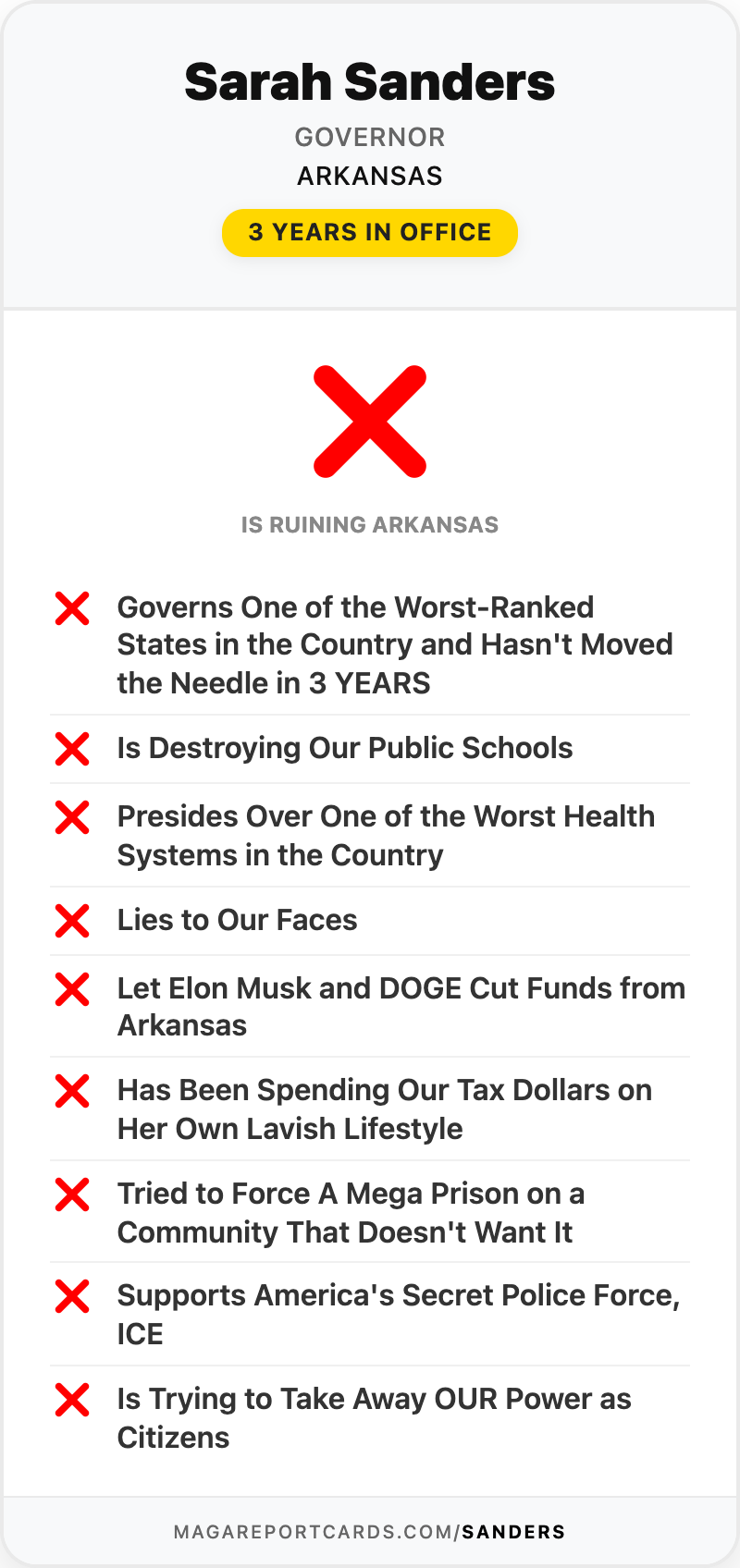
On Wednesday, October 28, Sarah Sanders stood with anti-abortion groups and announced that Arkansas had been named the "most pro-life state in America" for the seventh year in a row.
"Every life is a gift from our Creator, made in His image, and is worth defending," the governor said in her press release. "As Governor, I will continue fighting for every Arkansan, at every stage of life, and make our state the best place to live, work, and raise a family."
That ranking comes from Americans United for Life, and it grades states on the laws they pass, not on how many mothers and babies stay alive. On that second measure, Arkansas is near the bottom of the country. And one of the simplest fixes, a full year of Medicaid for new moms, is something Sanders has fought against for two years. Arkansas is now the only state in America that doesn't have it.
The numbers the award leaves out
The Arkansas Times pointed out the same day that Arkansas ranks second-worst among the states for infant deaths and fourth-worst for mothers dying, going by March of Dimes data.
In 2023, 290 Arkansas babies died before their first birthday, a rate of 8.2 for every 1,000 babies born. The Times compared that with North Dakota, where fewer than three babies die per 1,000 births. For mothers, Arkansas loses about 35 women for every 100,000 babies born, the Times reported. In California it's about 10.
The worst part is that most of the mothers' deaths don't have to happen. Arkansas's own maternal death review committee found that 92% of pregnancy-related deaths in the state from 2018 to 2020 were likely preventable.
When almost every death could have been stopped, the question is whether mothers can get to a doctor. In Arkansas, many of them lose the coverage that would pay for it two months after giving birth.
The only state left
Medicaid pays for more than half of the births in Arkansas, the Arkansas Advocate reports. For many of those mothers, that coverage ends 60 days after the baby is born. Federal law lets states keep new moms covered for a full year, and every state has taken that option except one. When Wisconsin passed it in February, Arkansas became the last state without it.
The gap is not small. In the last three months of 2025, 44% of Arkansas mothers on postpartum Medicaid lost that coverage, the worst rate since the state started tracking it, according to Arkansas Advocates for Children and Families. The advocates said they'd been told some of those women might find other insurance, but that the state has no data to show whether they do.
People who work with new moms say the danger doesn't end at two months. "Substance use disorders and mental health conditions don't resolve in two months," Stephanie Garner, who runs a family assistance group in Russellville, told lawmakers.
Republicans tried to fix it. Sanders's team stopped them.
This was never a Democratic idea that Republicans brushed aside. The bill to give new moms a full year of coverage, House Bill 1004, was written by a Republican, Rep. Aaron Pilkington of Knoxville, and carried in the Senate by another Republican, Sen. Breanne Davis of Russellville.
It passed the Arkansas House on April 1, 2025, with 71 votes from both parties. Eight days later it died in a Senate committee on a voice vote, after Sanders's own Department of Human Services testified against it.
Sanders and her Human Services secretary had spent the year before calling a full year of coverage "redundant" and "duplicative." Her maternal health task force left it out of its recommendations. Earlier in the 2025 session she signed her own maternal health law, which did not include the 12-month extension, and she said she didn't think the state needed to cover moms past 60 days. In the debate over HB 1004, others pointed out that her law had left the extension out.
The Arkansas Times put it plainly: the bill failed "under pressure from the governor's office not to pass it." A similar Republican bill in 2023 never even got a hearing.
Pilkington, the Republican who wrote both bills, didn't hide his frustration:
"I promised that I wouldn't leave these women behind, and I did all I could. The fact that I had to fight back against so many lies was the most disheartening part about this whole process. One day we'll get these women covered, and I'm sure people will ask what took so long."
What it would have cost
Sanders's Department of Human Services said adding ten more months of coverage would cost more than $11.2 million. But by the department's own math, the federal government would have paid more than $8.8 million of that. Arkansas's share would have been less than $2.4 million.
Compare that to what Sanders brags about. Her pro-life press release lists Act 622 of 2023, which put $5 million toward women with unplanned pregnancies. That's more than double the state's share of HB 1004.
And it's a rounding error next to the money Sanders does find. Her school voucher program is expected to cost more than $367 million this year.
"Every stage of life"
Americans United for Life says it ranks states on laws that protect "the unborn, the elderly, the disabled, and the terminally ill." Look at how Arkansas has treated those last groups this year.
At the end of May, the state told Arkansas's Area Agencies on Aging it would cut $612,000 from the eight agencies, money that helps pay for Meals on Wheels for homebound seniors. The cut was reversed the day after the Arkansas Times reported it, once people called their lawmakers.
Arkansas's waitlist for help caring for people with developmental disabilities is back above 2,400 people. Sanders's Republican predecessor cleared the same list in 2021 with more than $37 million, and we've reported how she hasn't called the session that would clear it again.
The women the ban forgot
Sanders's press release also celebrates the state's abortion ban, which allows an abortion only to save the mother's life. Women in Arkansas say that exception doesn't work in practice.
Emily Waldorf, the lead plaintiff in a lawsuit against the ban, started to miscarry at 17 weeks. The pregnancy could not survive, and her open cervix put her at risk of a life-threatening infection. She still could not get care in Arkansas. Her family and friends reached out to Sanders and her staff for help and got no response. Only after she hired a lawyer and begged hospital officials was she moved to a hospital in Kansas.
Sanders is named in that lawsuit. Her state is asking the court to throw the case out, and to stop her from having to answer questions under oath about what her office did when Waldorf's family called.
This is not the first time she has turned down help for Arkansas families with health care. She also cheered the federal budget bill whose rules the Trump administration used to reject Arkansas's Medicaid expansion, a program covering more than 200,000 people.
What the record shows
Sarah Sanders celebrated Arkansas being named the "most pro-life state in America" for a seventh straight year, in a state that ranks second-worst for babies dying and fourth-worst for mothers dying, where 92% of pregnancy-related deaths were found to be likely preventable. Arkansas is the only state that cuts new mothers off Medicaid at 60 days, and 44% of them lost that coverage at the end of last year. A Republican bill to fix it passed the House with 71 votes in 2025 and died in a Senate committee after her administration testified against it. The state's share of the cost would have been less than $2.4 million.
Source
For the 'most pro-life state in America,' Arkansas sure is burying a lot of women and babies — Arkansas Times, October 28, 2026