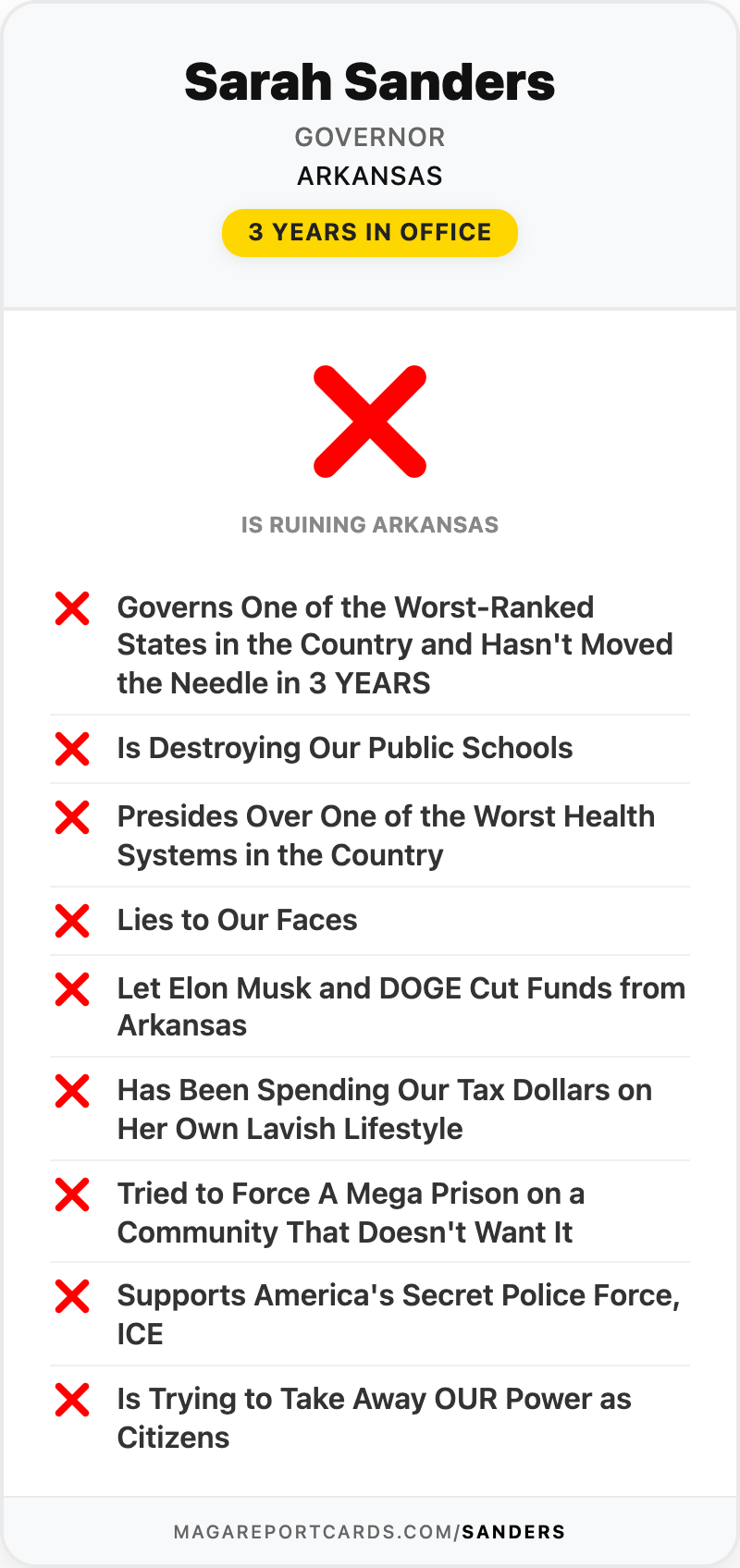
On Friday, July 31, Sarah Sanders' own office confirmed the news: the Trump administration will not renew Arkansas' Medicaid expansion.
The program is called ARHOME, and it covers more than 211,000 low-income Arkansans — working people, people between jobs, people whose jobs don't offer insurance. The waiver that keeps it running expires December 31. Arkansas had asked to keep it going through 2031. The federal government said no.
Here's the part the governor's office would rather you skim past. The reason her spokesman gave for the rejection is that ARHOME doesn't meet "budget neutrality" rules under the One Big Beautiful Bill Act — Trump's tax and spending law. That's the law Sarah Sanders spent a year cheering for.
She helped sell the bill. Arkansas is now getting the bill.
What's actually at stake
Arkansas was the first Southern state to expand Medicaid, back in 2013, and it did it in a way Republicans designed on purpose — using federal money to buy people private insurance instead of putting them on government coverage. It was pitched as the conservative alternative. It has survived a decade of attempts to kill it and easily won reauthorization in the Legislature earlier this year.
Doctors and hospitals credit it with cutting the number of uninsured Arkansans and cutting the cost hospitals eat when uninsured patients show up at the ER.
Now it's on the chopping block, and the people who actually run Arkansas health care are not being subtle about what that means.
"Any threat to people not having a payment source is a threat to hospitals, especially in rural areas where margins are razor thin. Hospitals can't absorb any more uncompensated care right now."
— Jodiane Tritt, Arkansas Hospital Association
Camille Richoux of Arkansas Advocates for Children and Families told the Arkansas Advocate that losing the expansion would be "devastating" — for patients, for rural hospitals, and for the health workers whose paychecks depend on that revenue.
And it gets worse before it gets better. Centene, one of just two insurance companies running ARHOME plans, announced in July that it's walking away in 2027. Arkansas is losing its federal waiver and one of its two insurers at the same time.
She cheered the law that's now being used against her state
When Trump's One Big Beautiful Bill was moving through Congress, Sarah Sanders had exactly one loud public objection to it — and it wasn't the Medicaid cuts. It was a provision that would have blocked states from regulating artificial intelligence. She wrote a Washington Post op-ed about it. She joined 17 Republican governors in a letter asking Congress to strip it out. When the Senate pulled it, she called the result "a monumental win":
"This is a monumental win for state leaders, President Trump's One, Big, Beautiful Bill, and the American people."
She went to the mat over AI. She said nothing like that about the Medicaid provisions that are now taking coverage away from 200,000 of her own constituents.
By November 2025 she was applying for $1 billion out of a new $50 billion federal rural health fund — money created by that same bill, specifically to soften the blow of the Medicaid cuts that same bill made. Her comment at the time:
"There's an expectation that every state will get at least $500 million. We certainly think we've met the criteria to do that, but I'm hopeful that we will go above and beyond and get additional funding beyond that."
Think about what that sentence really admits. She knew the law was cutting deeply enough that Arkansas would need a rescue fund. She backed it anyway, then went looking for a check to cover the hole.
Eight months later, the same law is the stated reason her state's biggest health coverage program just got denied.
She spent years trying to do this to Arkansans herself
None of this is happening to Sarah Sanders. Some of it is happening because of her.
Arkansas was the first state in the country to impose work requirements on Medicaid expansion during Trump's first term. The result: more than 18,000 Arkansans lost coverage before a federal judge blocked it in 2019. It didn't get people jobs — a 2019 New England Journal of Medicine study found that, and a 2023 Congressional Budget Office analysis pointed at Arkansas as the proof that work requirements don't work.
Sarah Sanders looked at that record and asked for a rerun. In January 2025 she submitted a new waiver to bring work requirements back, with this explanation:
"Our goal is never to take services away from those who need it but to help people stand on their own two feet so they don't have to count on the government."
Her goal is "never to take services away from those who need it." Eighteen thousand Arkansans could have told her how that goes.
She got her wish anyway. The One Big Beautiful Bill overrode state requests and wrote in its own national mandate — 80 hours a month of work, school, or volunteering — starting January 1, 2027. The Urban Institute estimated that even under a version Arkansas handles relatively well, 37% to 46% of expansion enrollees could still lose coverage by 2028.
That paperwork machine is already spinning up. Arkansas DHS started compliance checks on July 1.
So Arkansans are now facing three things at once: work requirements, an insurer walking out, and the expansion program itself losing federal approval. Allison Orris, who directs Medicaid policy at the Center on Budget and Policy Priorities, told reporters that anything creating this much confusion and uncertainty "will have an impact on how people interact with the program and coverage."
That's the polite version. The plain version is that when coverage gets confusing enough, people fall off it — which, conveniently, is also how you get a smaller Medicaid budget.
Arkansas hospitals were already breaking
This is landing on a health system that is already failing, in a state Sarah Sanders has run since 2023.
- Eight Arkansas hospitals have closed their labor and delivery units since 2020. Only 22 of Arkansas' 75 counties still have one. Some women drive an hour or more to give birth.
- Of the rural labor and delivery units still open, 44% are at risk of closing, according to the Arkansas Center for Health Improvement in June.
- Jacksonville's only hospital closed its emergency room in April — about three years after it opened.
- Camden's Ouachita County Medical Center ended labor and delivery in January and filed for bankruptcy after running $8.5 million in debt.
And Arkansans are paying more for less. Premiums on the state marketplace jumped more than 20% this year after Congress let the Affordable Care Act subsidies expire at the end of 2025. The average monthly premium for a mid-level silver plan in Arkansas hit $774 in 2026 — a $301-a-month jump from 2025, according to KFF.
Now take 200,000 people's coverage and dump it into that.
The "pro-life" governor with the last-place record for moms
Here's the other thing worth remembering while Sarah Sanders talks about protecting "quality, affordable healthcare."
Arkansas is the only state in America that still refuses to extend Medicaid coverage for new mothers from 60 days to a full year after birth. Every other state does it. Wisconsin — the last holdout besides Arkansas — passed it in February, leaving Arkansas alone at the bottom.
A bill to fix it failed in the 2025 legislative session under pressure from the governor's office. Meanwhile, 44% of Arkansas' postpartum mothers lost their Medicaid coverage in the last quarter of 2025 — the worst retention rate since the state started reporting it. Arkansas reliably ranks among the worst states in the country for maternal deaths, and the vast majority of those deaths are preventable with better access to care.
That's the record of the person now in charge of figuring out what replaces ARHOME.
What happens next — and who decides
The Legislature doesn't come back until January, and Sanders isn't calling a special session. Her spokesman says she'll "work with her partners in the legislature to build a sustainable model." Read the room she's building it in: Senate President Pro Tempore Bart Hester says he doesn't think the Legislature will support continuing Medicaid expansion at all.
"The feds can't afford it. We can't afford it. It's just not the government's role to provide healthcare to people, outside of those that are the absolute [neediest]."
— Sen. Bart Hester, R-Cave Springs
There's also a detail most Arkansans have never heard: Arkansas is one of a handful of states with a trigger law that ends the expansion program automatically if federal Medicaid funding gets reduced.
Former state Medicaid Director Ray Hanley says just abandoning 200,000 people isn't realistic. "I think there is a bipartisan interest in not letting that happen," he said. "It would be political suicide."
Maybe. But notice what he's counting on. Not principle — fear of voters. The only thing standing between 200,000 Arkansans and a coverage cliff is whether Sarah Sanders and the Legislature think we'll punish them for it.
Arkansas already ranks 49th of 50 states for overall health and dead last in the nation for food insecurity. We are the hungriest state in America. Sarah Sanders has had three and a half years to change that trajectory. Instead she cheered on a federal law that gutted Medicaid, asked Washington for a bailout fund to patch the hole it made, and now says she'll build something "sustainable" out of the wreckage — sometime next year, with a Legislature whose top senator says health care isn't the government's job.
We deserve better.
Source
Arkansas healthcare providers alarmed by potential end of state's Medicaid expansion — Andrew DeMillo, Arkansas Advocate, published in the Arkansas Times, August 4, 2026. Photo by John Sykes/Arkansas Advocate.