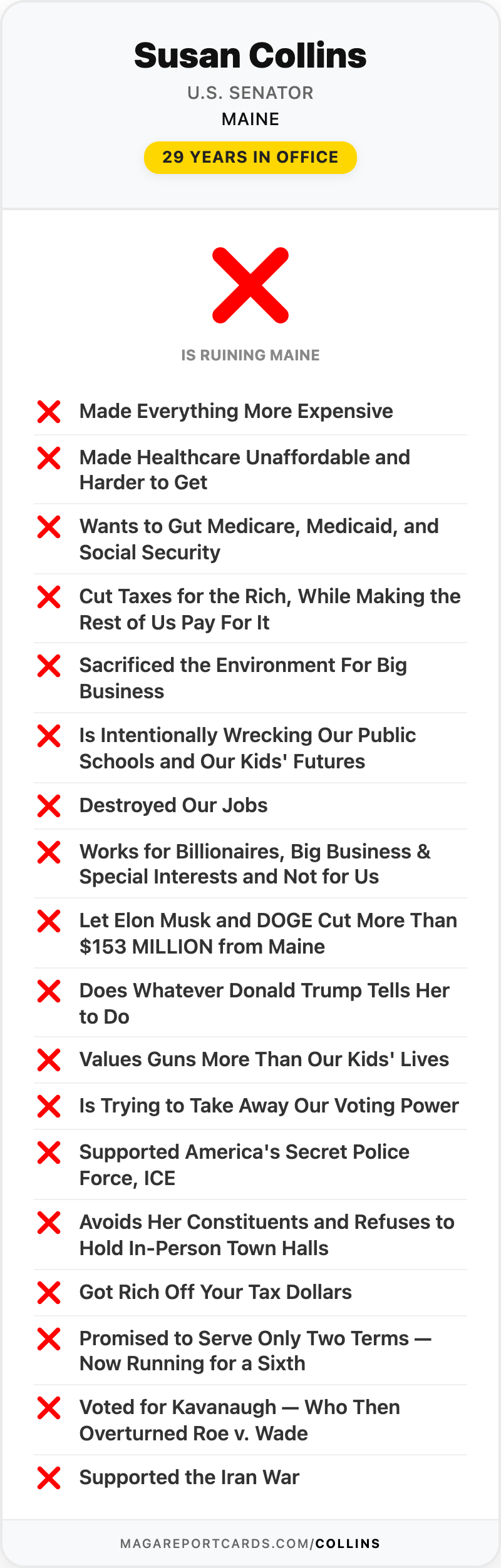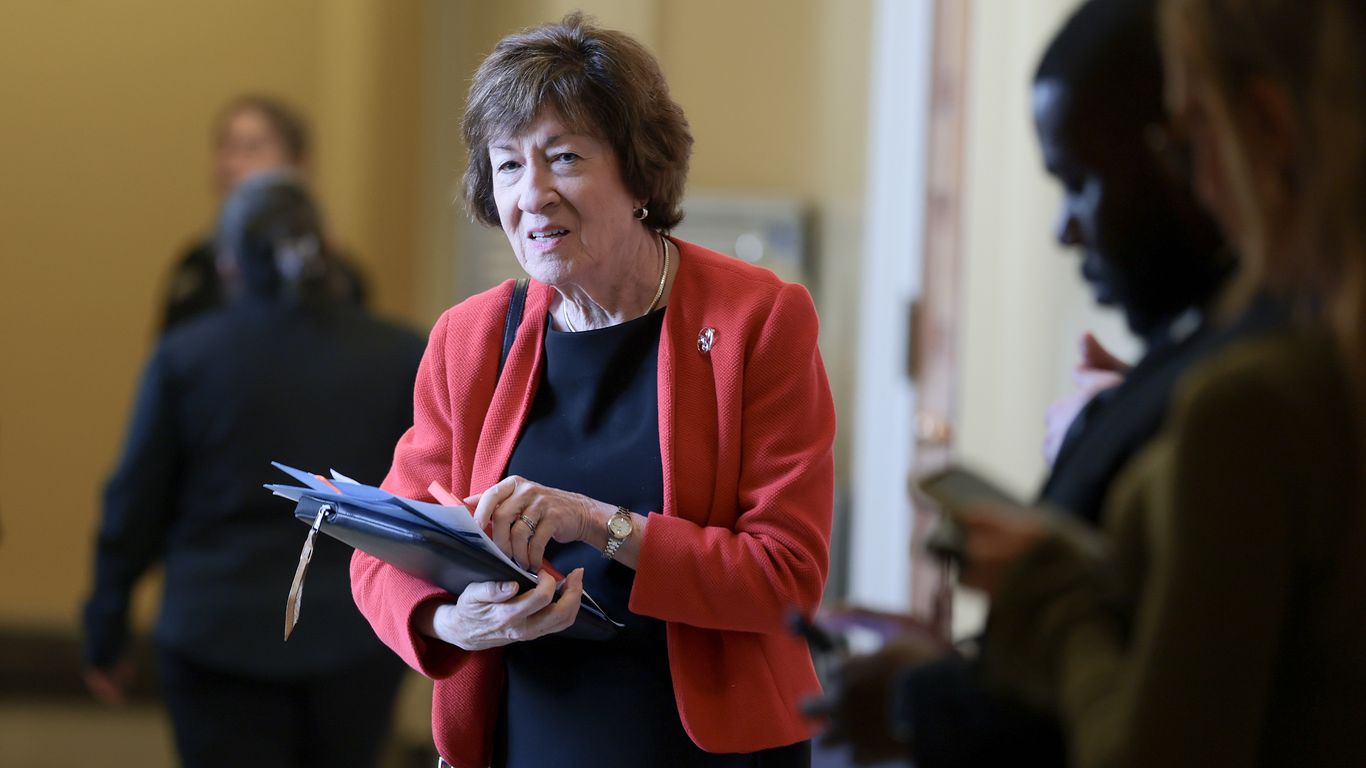
On Tuesday afternoon, Susan Collins put out a statement saying she will vote against Todd Blanche for attorney general.
Her reason: "While I believe Mr. Blanche is a capable lawyer, the Department of Justice has become increasingly political. Mr. Blanche has taken several actions that have further eroded the Department's independence, and that is the basis for my vote to oppose his confirmation."
Read that again. The Justice Department "has become" political. It "has become" that way while Todd Blanche was running it — as deputy attorney general, and then as acting attorney general.
And Susan Collins is the one who voted to put him there.
She already confirmed him once
On March 5, 2025, the Senate voted on Todd Blanche's nomination to be deputy attorney general — the number two job at the Justice Department. He got the job 52 to 46.
Collins voted yes.
This was not a mystery hire. Blanche was Trump's personal criminal defense lawyer. He was lead defense attorney in the hush-money trial, and he defended Trump in the two federal cases brought by Special Counsel Jack Smith. That was the entire objection at the time: you should not hand the Justice Department to the president's own defense attorney.
Collins voted yes anyway.
A month earlier, on February 4, 2025, she also voted to confirm Pam Bondi as attorney general, 54 to 46. Bondi was pushed out in April 2026, and Trump made Blanche acting attorney general.
So when Collins says the Justice Department "has become increasingly political," she is describing a building she helped staff. Every single thing she now lists as disqualifying happened on the job she voted to give him.
The timing tells you everything
Here is what actually happened on Tuesday, August 4, in order.
Tuesday morning: The Senate Judiciary Committee advanced Blanche's nomination on a 12–10 party-line vote. That was the last real chokepoint.
It only got there because two Republicans folded first. Sens. John Cornyn and Thom Tillis had been holding the nomination up. They wanted written promises about two things: a $1.8 billion "anti-weaponization fund" at DOJ, and a deal shielding Trump from IRS audits. Late Sunday night, Blanche handed them two documents. On Monday they said they were satisfied. Sen. John Curtis, who also had concerns, said Tuesday he'd support Blanche too.
Tuesday afternoon, 4:30 PM: Collins announces she's a no.
She waited until the people with actual leverage had already used theirs — and given it away. Then she stepped forward.
Axios put the math plainly: "Collins' vote won't sink Blanche's nomination on its own." With Mitch McConnell still absent from the Senate, Blanche can lose two Republicans and still be confirmed. Collins is one. It takes two more — and the only Republicans still undecided are Bill Cassidy and Lisa Murkowski.
A floor vote could come as early as Saturday.
This is the whole act
Mainers have seen this movie enough times to know how it ends.
- Trump's budget bill. Collins voted to advance it out of her own Appropriations Committee, and let the motion to proceed go through, before casting a "no" on final passage. It passed anyway, 51–50, on the Vice President's tiebreaker. Her campaign ad now brags that she "stood up for Maine" on Medicaid.
- The Iran war. For 60 days she voted against every attempt to stop it. Once the War Powers Act deadline passed and the vote no longer had teeth, she voted yes. It failed 47–50.
- Pete Hegseth. She voted no. So did Murkowski and McConnell. Vance broke the tie and Hegseth was confirmed 51–50.
- Brett Kavanaugh. She cast the deciding vote to confirm him on his private assurance that Roe was settled law. He overturned it. Asked this summer if she'd do it again, she said yes.
TIME described her protest votes as "as strategic as they are symbolic." That's the polite version.
The pattern is simple. She votes no when no is free.
What she's letting through
The things Collins listed in her own statement are real, and they are serious. She named four:
The $1.8 billion fund. The Justice Department created a $1.8 billion "anti-weaponization" fund. As NPR's Ryan Lucas explained on Morning Edition, that was $1.8 billion of taxpayer money the DOJ said could be handed out to, in essence, anyone — "That includes rioters who attacked the Capitol on January 6 and beat up cops." Blanche says he cancelled it. Legal experts told NPR the document isn't actually legally binding. And ABC reported the agreement contains no language preventing the fund from being recreated under a different name.
The audit immunity deal. A tax deal covering Trump, two of his sons, and the Trump Organization. Cornyn himself said it gives Trump benefits no other American taxpayer could get. Blanche's letter "narrowed" it. As NPR put it, those benefits "still very much remain in place."
Abortion pills. At his July 15 confirmation hearing, Ted Cruz asked Blanche to review the DOJ opinion that currently allows abortion medication to be mailed nationwide. Blanche answered: "Yes, I will." That opens the door to using an 1873 law to block those pills in every state — including Maine.
Prosecuting senators. Collins pointed to the Justice Department's attempts to indict two sitting U.S. senators, Mark Kelly and Elissa Slotkin.
And more than 1,200 former Justice Department employees signed a letter urging senators to reject him. Stacey Young, whose group Justice Connection sent it, put it this way: "Since his confirmation as Deputy Attorney General, Todd Blanche has shown time and again that his guiding star is fealty to the President, not the Constitution."
Every one of those things is an argument for stopping this nomination. None of them is an argument for waiting until the committee has already voted.
Nobody's buying it
The replies to the news were not kind. Under the post announcing her no vote, one person wrote that Collins "got confirmation he's gonna pass, and there's no actual political danger for her if she votes no. It's all theater." Another: "She waited until they had enough votes to play this lying card. That's what she does."
And this one: "She knows she needs this to win her election. If she weren't up for reelection this year, she'd be voting yes to confirm him."
That last point isn't just a hunch. Collins is the only Republican senator running for reelection this year in a state Trump lost. She is on the ballot in November. She has not held a public town hall in Maine in years, so Mainers rarely get to ask her about any of this in person.
What a real no looks like
There was a version of this where Collins's opposition mattered. She could have said months ago, when Cornyn and Tillis were holding the line, that she was a hard no — and made the math impossible before Blanche got a chance to paper over the problems with two non-binding letters.
She could have voted no on Blanche in March 2025, when he was a president's defense lawyer being handed the second-most-powerful job at the Justice Department and the damage hadn't been done yet.
Instead she voted yes then, and she's voting no now, seventeen months and one wrecked institution later, on a vote that by her own party's count doesn't decide anything by itself.
She will send out a press release about it. Her campaign will put it in an ad. And Todd Blanche will very likely be confirmed anyway.
We deserve better.
Source
Laura Weiss of Punchbowl News broke Collins's statement on August 4, 2026. Additional reporting from Axios, ABC News, and NPR. Photo: Anna Moneymaker/Getty Images.