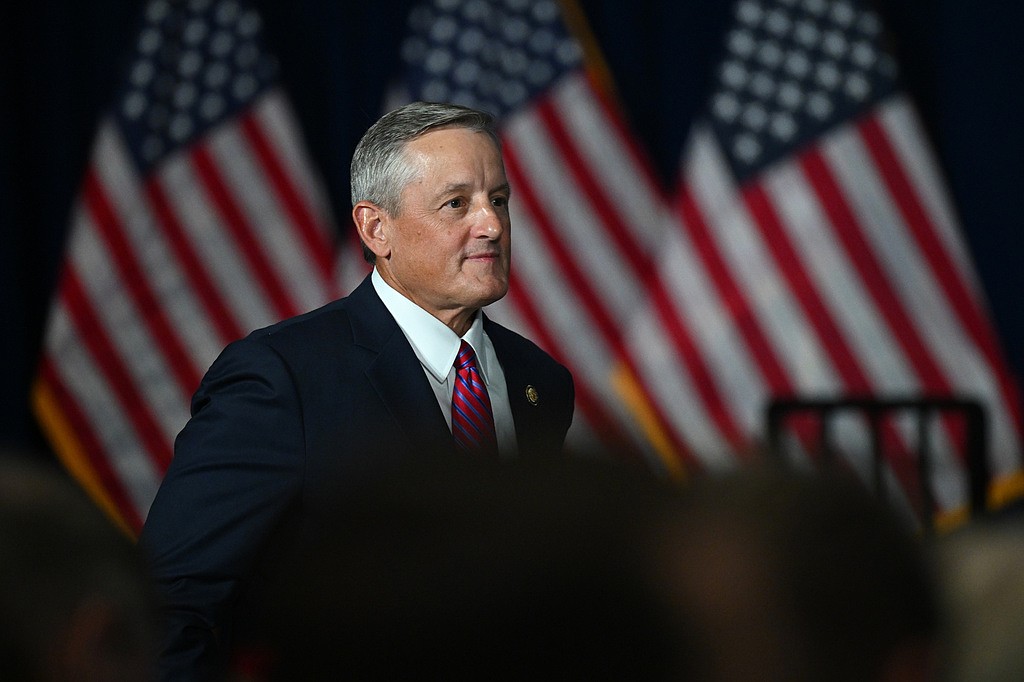
Visiting Southern Arkansas University in Magnolia this month, Bruce Westerman told Arkansans that the data centers going up around them are getting a "bad rap."
"So the water is not near as big an issue as people like to make it out to be."
And on the power bill:
"If it's done properly, data centers could be a tremendous boost to the economy and help lower people's electric bills. Now, that's not the story people are reading on the social media, but I think you have to really get down into the technical details to understand what's going on with data centers and how they can be beneficial."
Whose job is it to make sure it's "done properly"? He pointed at the state:
"So, the Public Service Commission and the utilities, and everybody involved, has to be on their A game in doing this."
Arkansans did not have to wait to see how that goes. The charge is already on their bills.
The charge that showed up in June
In June 2026, Entergy Arkansas — which serves about 738,000 customers in 63 of Arkansas's 75 counties — added a new rider to residential power bills. By the company's own account, it adds about $5.77 a month for a household using 1,000 kilowatt-hours, offset by a $1.55 decrease from a federal nuclear tax credit, for a net increase of roughly $4.22.
The rider exists because of a 2025 state law, the Generating Arkansas Jobs Act. Before it, a utility had to wait until a power plant was finished and actually serving customers before charging anyone for it. The new law lets utilities start collecting while the plant is still under construction.
It pays for three Entergy generation projects, and none of them is finished:
- Ironwood Power Station, a gas plant in Hot Spring County
- Jefferson Power Station, a gas plant in Jefferson County
- Arkansas Cypress Solar, a $1.6 billion solar field and battery facility in Jefferson County
All three are in Westerman's district. And Cypress Solar is being built to cover the power demand of Google's $4 billion data center in West Memphis — which is not in his district.
So his constituents are hosting the power plants and paying part of the construction bill up front. The data center, and its jobs, go somewhere else.
His own party is asking the questions he isn't
Three days after that story ran, Arkansas legislators had Entergy officials in front of them, and they were not in a reassuring mood.
Republican state Sen. Mark Johnson, co-chair of the Joint Energy Committee, pulled out his own Entergy bill. It had $22.81 added to it from the rider.
"I'm the chairman of this committee. I've served on it since I've been in the General Assembly, and this whole thing, starting with the Generating Arkansas Jobs Act and subsequently — it boggles my mind sometimes to figure this out."
Johnson had a simple question about why customers are fronting the money at all:
"Well, for 100 years we've been doing it this way, why is it suddenly not going to work to use the traditional model, where if you're a private company, a regulated utility, you get a guaranteed rate of return determined by the PSC, and you pay your own upfront costs."
Republican Sen. Matt McKee pressed on the exact thing Westerman waved away — whether the data center is really paying its own freight. Entergy says Google covers all costs under a pledge it calls "Fair Share Plus." McKee wanted to know why, then, regular customers are still being charged for Cypress Solar:
"Help me understand the process of why that benefits ratepayers, because unfortunately I don't think that's how most ratepayers look at that."
Google will pay Entergy $2.1 billion over 20 years in connection with West Memphis. Those payments are not specifically going toward the $1.6 billion Cypress Solar project.
The contract Entergy sued a newspaper over
Westerman's whole fix rests on contracts: "the key is going to be to have good contracting with the data companies and make sure that they're paying their fair share for the additional energy and that they're in a contract where they can't get out of it before the economic lifespan of the new equipment is paid for."
Arkansans were not allowed to read that contract. The Public Service Commission approved a special rate deal between Entergy and Google in December 2025, and the terms stayed largely secret. The public learned anything at all only because the commission released documents by mistake to a woman who had filed a Freedom of Information Act request, and she handed them to a reporter.
When the Arkansas Democrat-Gazette published what was in them — that Google is paying $526 million toward Cypress Solar, about a third of its cost — Entergy went to federal court and asked a judge to stop the paper from publishing anything more, and to make it delete what it had already posted.
Judge Lee Rudofsky, a Trump appointee, refused. He said a monopoly utility's arrangements with a giant power customer "are matters that an ordinary Arkansas citizen may very well want to be aware of," and that it "would take a lot to get me to do a prior restraint." Entergy dropped the case on September 16.
That is the state of "good contracting" in Arkansas: a secret deal, disclosed by accident, that the utility went to federal court to re-conceal. None of it came up in Magnolia.
Arkansas doesn't have the rule that 25 other states have
There is a standard tool for the thing Westerman says the Public Service Commission should be handling: a large-load tariff, a rate class that makes enormous customers cover the cost of the grid built for them.
The Edison Electric Institute — the utility industry's own trade group — keeps a running list. As of its September 11, 2026 update, 25 states have approved at least one large-load tariff and seven more have one pending. Arkansas is on neither list — while the same document catalogs the Google and AVAIO projects under Entergy Arkansas.
Entergy has a large-load rate in Louisiana. Mississippi and Oklahoma have their own. SWEPCO, which serves the western end of Westerman's district, filed for a large-load contract tariff in Texas. Arkansas got none of it.
That is what being off your A game looks like, and Westerman told the room it was a story problem.
Republicans in his own district have already hit pause
While Westerman was explaining that the concerns were overblown, Republicans back home were voting to stop.
Five Arkansas county quorum courts have imposed data-center moratoriums, and every one of them has a Republican majority. Union County, in Westerman's district, passed a one-year pause in June; the city of Russellville, also in his district, adopted a six-month pause in July. Independence County went five years, unanimously.
Independence County Justice of the Peace Brad Covington, a Republican, put it plainly: "We would not be able to support the needs of a data center, nor would we want to. It's not something that the citizens want or need."
These are not people reading the wrong things on social media. They are Republican county officials who looked at the same industry Westerman is defending and decided they wanted more answers first.
"Equivalent to like a golf course"
On water, Westerman was specific:
"The amount of water that they use, even like a hyperscale center, is equivalent to like a golf course, because they're not discharging the water. They're circulating it, cooling it, recirculating it."
Google publishes that exact comparison — and Google's own numbers are much bigger than his. Its 2026 environmental report prints a column headed "Golf course equivalents" for every data center it owns. Its largest U.S. site, in Council Bluffs, Iowa, consumed 1,346 million gallons in 2025, which Google scores at 9.0 golf courses, not one. Across all its data centers the figure is 10,523 million gallons — 70.2 golf courses. Consumption rose 34% in a single year, and most of what those data centers drink is potable drinking water.
The mechanism he described is backwards, too. In evaporative cooling — the most common kind — roughly 80% of the water drawn is evaporated and never returns to the watershed. "They're not discharging the water" is not a reason the water is safe. Not discharging it is what consuming it means.
Genuinely closed-loop, air-cooled sites do exist and use almost no water. They also burn more electricity. The Department of Energy's national data center report says so plainly: "While air-cooled chillers use no water, they use more energy." That is the trade-off his answer erases — on a grid where new generation is exactly what his constituents are already being billed for.
He is not the first Republican to tell a room the water question is overblown. Eric Burlison told a Missouri forum that "what the business is doing doesn't matter" after backing a data center hundreds of his constituents opposed.
Who is paying him
Westerman is not a neutral analyst of "the technical details." In the 2026 election cycle, 23 political action committees belonging to electric utilities, power producers and their trade associations gave his campaign $128,000, according to Federal Election Commission records.
That includes $10,000 from Entergy's corporate PAC, the parent of the utility now billing Arkansans for Cypress Solar. It includes $10,000 from American Electric Power, whose SWEPCO subsidiary serves western Arkansas, and $10,000 from the Edison Electric Institute. Amazon, Microsoft and Meta's PACs gave too.
And the line he delivered in Magnolia is Entergy's line. Entergy officials have argued publicly that adding data centers to the grid lowers costs for all of its users. Westerman repeated it to a room of Arkansans as a technical insight they were too online to grasp.
We have written this pattern before: five Republicans who took utility money and handed data centers the grid, and Byron Donalds, who promised Floridians a new law meant their bills wouldn't rise — a claim PolitiFact rated Half True, because the law directs a process, not a result.
What he has actually done in Congress
Westerman's answer was that this belongs to state regulators. One week later, on September 16, he voted on it federally.
H.R. 9340, the Ratepayer Protection Act, passed the House 417–3. Westerman voted yes. Read what it does: it requires state regulators to "commence consideration" of, and then "make the determination" on, a standard holding data centers of 100 megawatts or more responsible for the full incremental cost of the generation, transmission and distribution built to serve them.
Consider. Not adopt. States have to think about it, and a state that has already held a proceeding is exempt outright. It stalled in the Senate the next day. "It's not enough to tell states to consider making data centers pay for grid updates," Sen. Martin Heinrich said in blocking it. "Rather than voluntary pledges or suggestions to states, Congress needs to pass real legislation with real teeth."
Westerman chairs the House Natural Resources Committee. H.R. 9939, which would bar AI data centers on federal lands, was referred to his committee on July 23, 2026 and has not moved. His own sponsored legislation includes no bill on data centers and ratepayers.
To be fair to his argument
Westerman's economics are not invented. A large, steady, around-the-clock customer really does improve a generating fleet's efficiency, and a 2026 analysis found that data centers modestly lowered average U.S. retail rates between 2015 and 2024 for that reason. It is worth knowing that two of its three authors work at the electric power industry's own research institute, that it has not been peer-reviewed, and that it warns its finding reverses if utilities overbuild for demand that never arrives.
Entergy and Google both say the West Memphis deal protects existing customers and delivers more than $1.1 billion in net benefits to Arkansans.
Even the researchers most critical of these deals agree the outcome turns on the terms. Ari Peskoe, who runs Harvard's Electricity Law Initiative, puts it this way: "If the deal is structured the right way, large loads like data centers can put downward pressure on rates. But if they're structured incorrectly, they can raise rates for everyone."
Which is the point. Westerman's claim was conditional — "if it's done properly" — and he then handed the condition to the state and told everyone the story they were reading was wrong. Peskoe's own team, after reviewing nearly 50 rate proceedings, found it "all but impossible" to verify a utility's promise that data center costs stay walled off from everyone else's bills.
What it adds up to
Bruce Westerman told Arkansans that data centers get a "bad rap," that they could help lower electric bills, and that making sure of it was the Public Service Commission's job. Entergy Arkansas had already begun charging its roughly 738,000 customers about $4.22 a month for three unfinished power plants — all three in his district, one of them a $1.6 billion solar farm built to serve a Google data center in someone else's — under a deal the commission approved in secret and the utility sued a newspaper to keep that way. Arkansas is not among the 25 states with a rule making huge customers pay for the grid they require. Twenty-three electric-power PACs gave him $128,000 this cycle, $10,000 of it from Entergy. His federal answer was a vote for a bill asking states to consider it.
Source
Jason Hopkins, "Westerman says data centers get 'bad rap,' and issues can be resolved when everyone is 'on their A game'", Hot Springs Sentinel-Record, September 12, 2026. Photo: AP/Jessica Tobias. His water remarks are also reported in "Westerman visits SAU, talks lithium, data centers and nuclear power", Magnolia Banner News, September 12, 2026.
Additional reporting: Ainsley Platt, "Arkansas lawmakers question utility on data center projects, impact on ratepayers", Arkansas Advocate, September 15, 2026. Donor figures are the author's tabulation of Federal Election Commission Schedule A receipts for Westerman's campaign committee, 2026 cycle.