On Tuesday, Nov. 3, a blue wave gave Democrats control of both the U.S. House and Senate. Some of the Senate upsets came in states Trump won by double digits two years ago.
West Virginia didn't flip. Every Republican on this site who was on the ballot here won. But look closer and the picture changes. Republicans lost a dozen seats in the state House, two in the state Senate, and three of the four delegates from a county that has voted Republican since 2016. Their three winners in Congress all won with smaller shares of the vote than last time, down 9 to 12 points. And in one district, voters elected a man whose posts his own party had condemned.
Here's the good, the bad and the ugly.
The good: the supermajority lost its shortcut
West Virginia's constitution says a bill has to be read on three different days before the Legislature votes on it. But a party with 80 of the 100 seats in the House of Delegates can suspend that rule and move a bill faster.
Going in, Republicans held 91 of those 100 seats. It's one of the biggest supermajorities in the country, and it meant they could suspend the rule any time they wanted.
Now they can't. Democrats flipped 12 seats, according to West Virginia Watch's count, and their caucus will grow from 9 members to 21 in January. That leaves Republicans with 79, one short of the 80 they need.
"Those days are gone," House Minority Leader Sean Hornbuckle told the Watch. "I believe this will lead to a better product in our government."
The state Republican chairman, Del. Josh Holstein, played it down. "Even if we aren't able to suspend constitutional rules, we will still be able to easily pass our agenda," he said.
Eight of the 12 new Democrats are women. In a Legislature with fewer women than any other in the country, the number of women in the House will go from 12 to 19.
Here's where some of the wins came:
- Jefferson County. Two years ago, this Eastern Panhandle county voted for Republicans almost all the way down the ballot. On Tuesday, Democrats beat three of its four Republican delegates: Democrats Regina Dyer, Jenny Thacker and Lucia Valentine unseated Republican Dels. Wayne Clark, Chris Anders and Bill Ridenour. Democrats also won two Republican seats on the county commission, and both Democrats running for Congress carried the county. A local Democrat said voters were angry about a power line project, data centers and a planned bottling plant, and didn't think their officials were telling them everything.
- The state Senate. Democrats will hold 4 of the 34 seats next year, up from 2. In Morgantown, Del. John Williams beat Republican Sen. Mike Oliverio 55% to 41.4%. He knocked more than 5,000 doors and ran on affordability and against data centers. In Kanawha County, Richie Robb beat Sen. Anne Charnock, whom Gov. Patrick Morrisey appointed to the seat in 2025.
- St. Albans. Marisa Jackson, who got to know the Legislature speaking up for her two children with disabilities, beat Republican Del. Walt Hall.
- Wood County. Democrat Dennis Rempel, a retired federal worker, won by about 151 votes in Parkersburg, according to AP results reported by West Virginia Watch. As of the day after the election, the AP had not called it. It's the first time since 2012 that Wood County will send a Democrat to the statehouse. How Republicans lost it is a story of its own. In May, three super PACs funded by out-of-state billionaires spent $145,000 to beat the Republican chairman of the House Finance Committee, Vernon Criss, in the primary. He had proposed a cap on payments from the Hope Scholarship, the state's school voucher program. Criss then ran as a write-in and drew 261 votes, more than the margin.
- House District 50. The House seat that disgraced former Republican Del. Elliott Pritt gave up went to Democrat Mat Anderson, a special education teacher, with more than 51% of the vote. Pritt resigned in July after he was arrested on federal charges of enticing a minor.
Republicans still control both chambers by wide margins. West Virginia Watch columnist Andrew Donaldson called the House result "a small but meaningful procedural victory" that gives Democrats a way to slow the supermajority down.
The bad: they won, by less
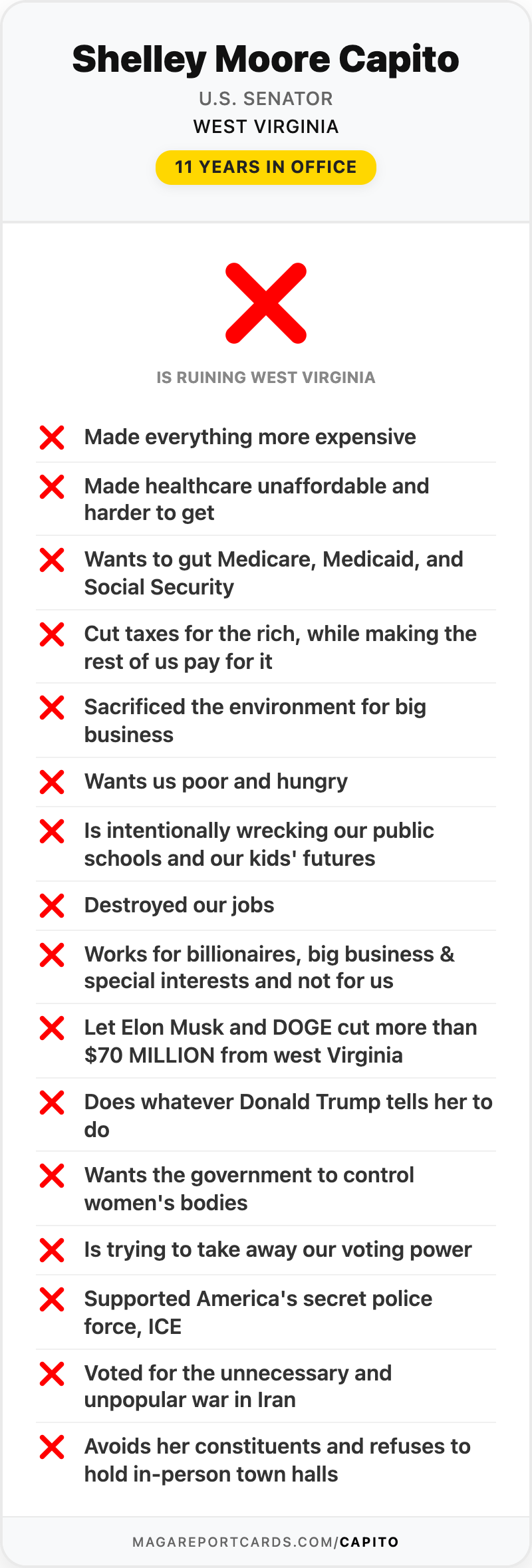
Shelley Moore Capito won a third term in the Senate with 58.3% to Democrat Rachel Fetty Anderson's 37.9%, a lead of 93,116 votes with 99% counted as of Nov. 27. Six years ago, she won with 70.3%, a 43-point lead. This time her lead was 20 points, less than half as big. Data centers were a big issue in West Virginia races this year. John Williams ran against them in Morgantown, and voters in Jefferson County were angry about them. Right after the election, Capito's bill to speed up energy projects headed for a Senate vote. The Natural Resources Defense Council warns it would limit what West Virginia can do to protect its own water.
The two Republicans in the House both won. Both won by less:
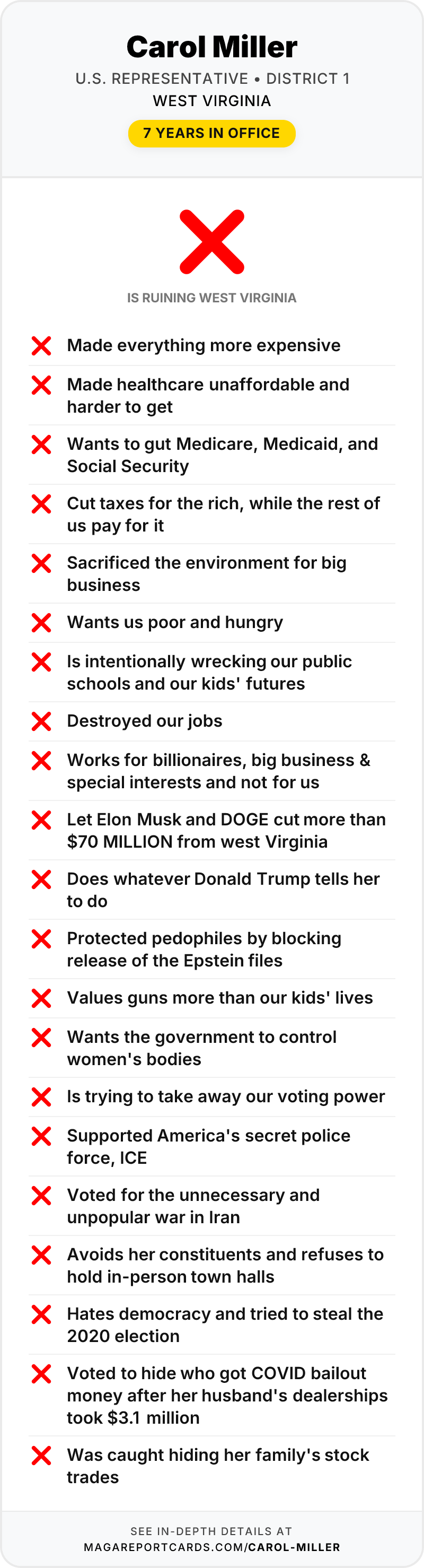
- Carol Miller won a fifth term in southern West Virginia's 1st District with 57.1%, down from 66.4% two years ago. Her Democratic opponent, Vince George, called her "Cardboard Carol" for not being there for the people she represents. On election night, Miller promised to keep fighting "to improve access to rural healthcare." She sits on Ways and Means, which wrote the tax title of Trump's budget bill, and spoke for it on the House floor without once mentioning Medicaid. West Virginia's Center on Budget and Policy called that bill the largest cut to Medicaid and SNAP in the programs' history.
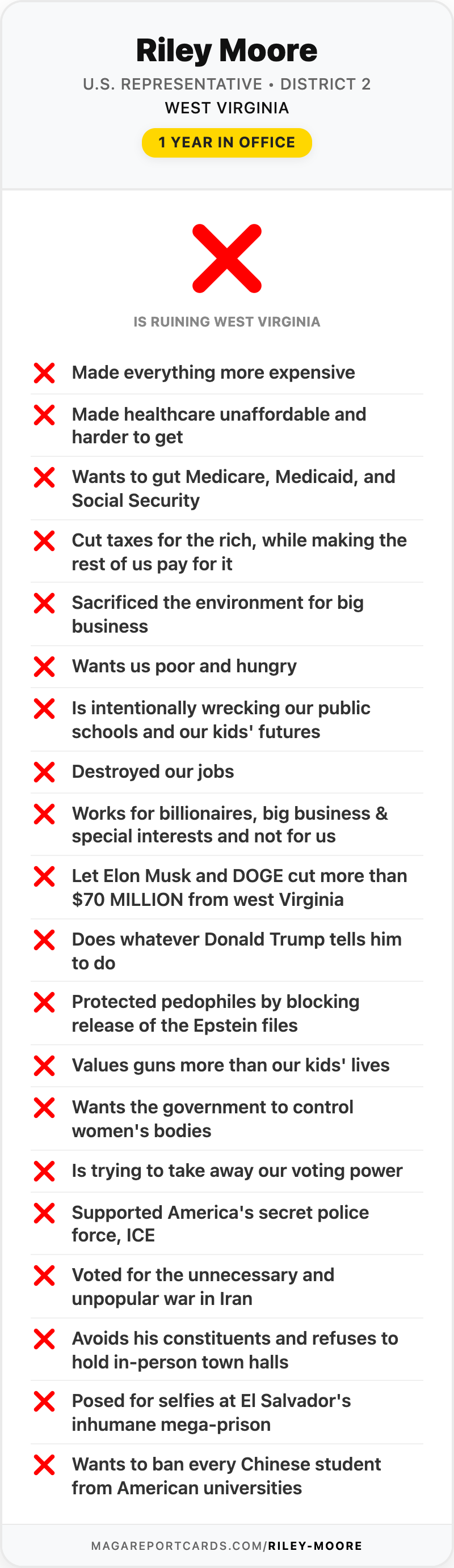
- Riley Moore won a second term in northern West Virginia's 2nd District with 59.4% to Democrat Ace Parsi's 40.6%, down from 70.8%. On election night, he said he was proud of his work "to advance critical infrastructure investments." He also headed the House Republican task force in charge of turning DOGE's cuts into law. Then, in June, he held up a jar of brown tap water from a McDowell County home and asked for $50 million in clean water money. The Appropriations Committee he sits on, run by his own party, voted him down.
The ugly: the 91st District
The 91st District covers southern Berkeley County, in the Eastern Panhandle. It's heavily Republican. Since 2024, three Republicans have been elected or appointed to its House seat. All three made headlines.
The one who was arrested
In November 2024, voters elected Republican Joseph de Soto. The next month, he switched to the Democratic Party, then was arrested and charged with threatening to harm or kill Republican lawmakers. In January 2025, the House voted to vacate his seat. It said he couldn't take the oath at the Capitol while he was on home confinement and barred from the building by protective orders.
The one who was appointed
The House sent the job of picking his replacement to the county's Republican committee. Gov. Morrisey appointed one of its picks, Republican Ian Masters. Masters later denied that he was behind an antisemitic comment made by a private Instagram account that used his name.
The Democratic Party sued. It argued that state law at the time required the seat to go to a Democrat, because de Soto was a registered Democrat when the seat came open.
On Nov. 13, the state Supreme Court threw the case out. It didn't decide who was right about the law. It ruled that the Democrats lacked standing, because the court couldn't order the fix they asked for. Seating de Soto would mean unseating Masters, and without a vacancy, the governor had no seat to fill with a Democrat. Lawmakers have since changed the law: an appointment now has to come from the party the official belonged to when they were elected.
The one who won on Tuesday
Masters didn't run again. In the May primary, Republican Chris Clagett ran unopposed.
In September, West Virginia Watch reported what Clagett had written on social media. In January, he posted on X: "Maybe because black women are the most ill-mannered, ill-behaved, loud-mouthed demographics on the face of the Earth." He also reportedly called the Confederate flag "beautiful," and he targeted Muslims in other posts. He confirmed on a local radio show that he wrote them. "Context is everything," he said.
His own party condemned the posts. "It is not reflective of the values of our party nor the values of our candidates running for office," said Holstein, the state Republican chairman. House Speaker Roger Hanshaw said that if voters sent "that attitude" to the House, "it will be a lonely place." West Virginia Watch reported that Clagett could be left off House committees if he won.
But under state law, it was too late for the party to put anyone else on the ballot, even if Clagett had quit. He didn't. His Democratic opponent, David Michaels, ran on higher pay for teachers and better infrastructure for a fast-growing county, and had almost four times as much cash on hand a week before the election.
On Tuesday, Clagett won the seat. In January, he'll be sworn in as a member of the Republican supermajority.
The rest of the ugly
A few more results from the night:
- A fix for a problem that doesn't exist. Voters passed Amendment 1 79.5% to 20.5%. It writes into the state constitution that only U.S. citizens can vote. State law already says that. The lead sponsor, Republican Sen. Patricia Rucker, said the law wasn't enough because "laws can change." The West Virginia Citizen Action Group said the amendment "perpetuates long-debunked conspiracy theories and scapegoats our immigrant neighbors."
- The $5 million primary. In May, more than $5 million poured into the Republican primaries for the Legislature, much of it from out-of-state donors with ties to Gov. Morrisey and the school voucher movement. Only 21% of registered voters showed up. It was the first year the Republican Party closed its primary to independent voters, and Secretary of State Kris Warner, a Republican, said turnout was the lowest in more than a decade. He has asked his own party to reconsider.
What the results show
Democrats flipped 12 seats in West Virginia's House of Delegates, growing from 9 members to 21 and leaving Republicans one seat short of the 80 they need to skip the three-day reading rule. They also doubled their state Senate seats from 2 to 4. Shelley Moore Capito won with 58.3%, down from 70.3% in 2020. Carol Miller won with 57.1%, down from 66.4%, and Riley Moore won with 59.4%, down from 70.8%. And in Berkeley County's 91st District, voters elected Chris Clagett, a Republican who wrote that Black women are "the most ill-mannered" people "on the face of the Earth."
Source
Live coverage: 2026 West Virginia general election — West Virginia Watch staff, November 4, 2026.