In the first week of January 2025 — before Donald Trump had even been sworn in — Border Patrol agents from the El Centro sector drove several hundred miles north into California's San Joaquin Valley and spent three days making arrests.
They called it Operation Return to Sender. Agents in unmarked SUVs picked people up outside a Home Depot in Bakersfield and at a gas station where field workers eat breakfast. The agency said it made 78 arrests and touted the capture of two alleged child rapists and more than 30 pounds of marijuana. Community groups disputed the number.
Border Patrol usually works within 100 miles of a border, and the interior is normally ICE's job. Customs and Border Protection told Valley Public Radio that its jurisdiction runs all the way to the Oregon border. As Bruno Huizar of the California Immigrant Policy Center told the station, "The border patrol often ignores that 100-mile boundary and rejects any geographic limitation on the agency's authority."
The effect on the farms was immediate. Peter Belluomini, who grows lemons, mandarins and navel oranges east of Bakersfield and was mid-harvest on all three, watched his contracted crew evaporate. "Instead of 30 people, there were like five," he said. "The rest were hiding at home."
A landscaper named Ernesto Campos was detained for four hours. Video shared by KGET shows an agent threatening to break his truck window — "I'm going to have to break the window. It's your fault." Campos is a U.S. citizen. He was held until agents confirmed it.
The United Farm Workers said two of its members were detained, neither with a criminal record.
What the congressman said
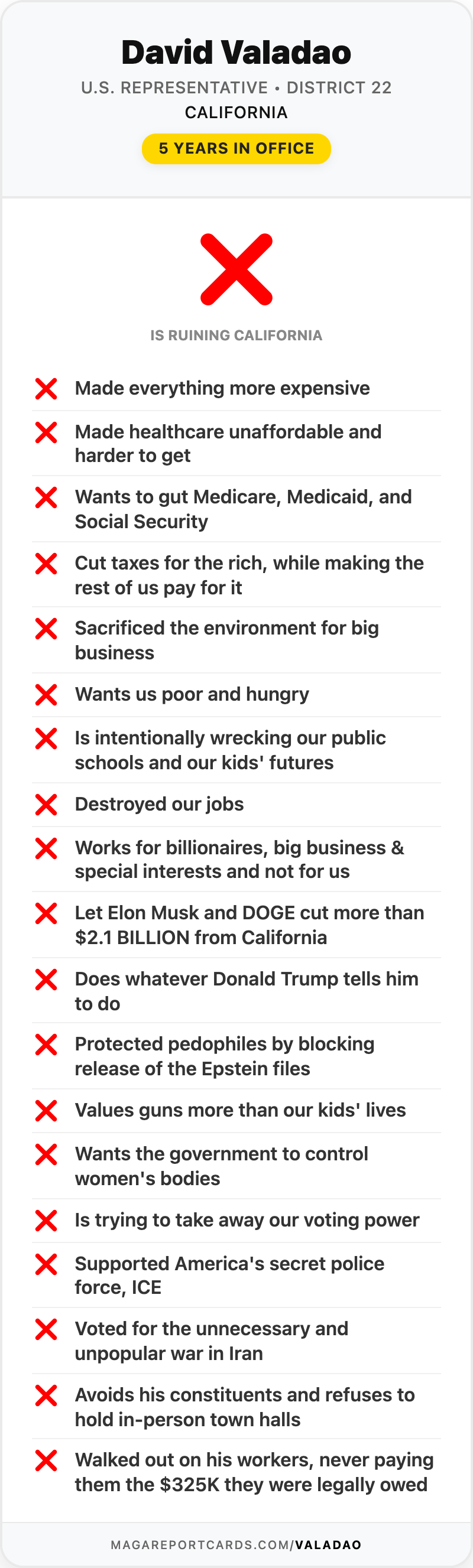
David Valadao represents parts of Kern, Tulare, and Kings counties. He put out a statement that week:
"I think we can all agree known criminals should be expelled from the United States, but it is crucial that future operations are communicated clearly to avoid causing any further alarm among our farmworkers."
Read the ask. It is not that the raids stop. It is not that agents identify themselves, or carry warrants, or stay out of the parking lots where people wait for work. It is that future operations are communicated clearly — that somebody give the district a heads-up.
He calls them "our farmworkers." He asked for a better-run version of the thing that scared them.
Who he is, and why this is his fight if it's anyone's
Valadao is not a generic Republican on immigration. He is, by his own description, the only dairyman in Congress, and his own family's story is an immigration story.
His father Eduardo grew up in the Portuguese Azores, the youngest of eight, working his family's dairy. A few years after immigrating to California, Eduardo and his wife Maria bought their first cows, and later their own land in Hanford. David grew up bucking hay and feeding the cows before school.
More than 65% of his district is Latino, according to the California Target Book. His district's economy is farm labor. His first television ad this year shows him walking through a tree-nut farm under the words "David Valadao is on our side."
The people who milk the cows and pick the mandarins are the people Border Patrol was loading into vans.
The bill he signed
To his credit, Valadao has never joined the deport-everyone caucus. He has put his name on the bills that would actually fix this. Two of them, in this Congress alone.
On May 7, 2025, he cosponsored H.R. 3227, the Farm Workforce Modernization Act of 2025 — the bill that would give farmworkers already doing the work a legal way to keep doing it.
On July 15, 2025, he cosponsored H.R. 4393, the DIGNIDAD Act — a path to legal status for undocumented immigrants who've been here for years, paired with tougher border enforcement and work requirements.
Now look at what has happened to them.
The Farm Workforce Modernization Act was referred to committee on the day it was introduced. Congress.gov shows no action since. Fifteen months. It has 11 cosponsors.
The Dignity Act went to the House Judiciary Committee's Subcommittee on Border Security and Enforcement on July 16, 2025. Nothing has happened to it since — no hearing, no markup, no vote, in thirteen months, in a chamber his own party controls. It has 39 cosponsors out of 435.
Cosponsoring a bill costs nothing. It is a signature on a list. Neither of these bills has ever been scheduled for so much as a hearing by the Republicans who run the committees.
The bill he passed
Eleven months later, a different immigration bill moved.
On June 9, 2026, the House passed S. 2, the Secure America Act — roughly $70 billion for Homeland Security, Customs and Border Protection and ICE, available through September 30, 2029. The two biggest lines in it are $31 billion for ICE and $13 billion for CBP, both written for immigration enforcement.
It passed 214 to 212. Not one Republican voted no. At that margin every single Republican yes was a deciding vote — including Valadao's. The next day it became Public Law 119-98.
That is the whole comparison. The bill that would legalize the people who work his valley's fields has sat in a drawer for over a year. The bill that pays for the agents who raid them took one afternoon and passed by two, with his vote.
"Communicated clearly"
Go back to what he asked for in January 2025 and measure it against what came after.
He wanted advance notice of enforcement operations. What Congress funded instead was a much larger version of the operation, with money that runs to the end of fiscal 2029. The same agency is already paying contractors to scan what people post.
None of that comes with a phone call to the Kern County Farm Bureau.
Valadao's Democratic opponent this year, Randy Villegas, is the son of Mexican immigrant farm laborers. He put the argument this way: "Everybody and anybody knows somebody who works in agriculture in the valley. And anybody in the valley will tell you that workers and agriculture are struggling right now because of Valadao and this administration."
Valadao has consistently declined CalMatters' interview requests, and his spokesperson said he was not available to answer questions for its July 2026 story on his race.
He is not the loudest Republican on immigration. He may be the most consequential one, because in a district where more than two in three people are Latino and the economy runs on farm labor, he keeps casting the vote that decides.
Source
Joshua Yeager and Cresencio Rodriguez-Delgado, "In wake of border patrol raids in California's Central Valley, a clearer picture emerges," Valley Public Radio (KVPR), January 16, 2025 — the source of Valadao's statement and the arrest figures. Raid tactics from Sergio Olmos, "A surprising immigration raid in Kern County foreshadows what awaits farmworkers and businesses," CalMatters, January 10, 2025. Harvest impacts from Caleb Hampton, "Kern County immigration sweep halts citrus harvest," Ag Alert, republished by Valley Voice, January 16, 2025.