Somebody on Reddit used the handle Tired_Thumb. Over two months, they left three comments that mentioned ICE. Two of them included the letters "ACAB" — an old protest slogan that stands for "all cops are bastards." One of them shared a phone number for an agent, pulled off a public records website, with the link to that website pasted right underneath.
For that, the federal government has spent six months trying to learn their name.
First the Department of Homeland Security sent Reddit an administrative subpoena asking for the poster's name, address and billing records. It didn't say what law had been broken. When a legal nonprofit fought back, the government dropped that subpoena — and came back with a grand jury subpoena, which carries more weight, asking for another month of the person's activity.
Nobody has been charged with anything. The government just wants to know who they are.
That story comes from a Wall Street Journal investigation published August 3, 2026, by Hannah Critchfield and Shane Shifflett. And Tired_Thumb, as the Journal put it, is far from alone.
A round-the-clock dragnet
Here is what the Journal found.
ICE now runs a nonstop digital operation that scans the public internet — Facebook, Instagram, X, and close to 20 platforms in all, including Reddit, Discord, Snapchat and LinkedIn — looking for speech the agency decides is dangerous to its mission. Not just threats to agents. Also, in the government's own contracting language, "activities that could disrupt ICE's operations."
Private contractors do the work. They write daily reports and build files on people. Those files can include a person's name, location, date of birth, workplace, Social Security number, vehicle registration and criminal history.
The money grew fast. ICE spending on surveillance technology and consultants hit $258 million during President Trump's first full year back in office — a 57% jump from the year before, according to the Journal's analysis of federal budget data. The agency has signed at least six contracts to scan public records for "threats," paying out nearly $50 million since 2020, with more than half of that money committed since last January.
One of those contracts went to a small Virginia software firm called Amivero — more than $8 million to monitor social media. Amivero handed the actual work to Guidehouse, a big consulting company that also works on defense and intelligence. Neither company would talk to the Journal.
The government's shopping list for this program asks contractors to pull DMV records and police reports, map out who a flagged user knows, and use machine learning for something called "anticipatory threat intelligence" — software that guesses at threats before anything happens.
To find out who anonymous critics are, DHS has sent hundreds of subpoenas to social media companies.
Reddit said no. The government kept going.
Between July and December of last year, DHS sent Reddit administrative subpoenas for the information behind 11 accounts that had posted "content critical of federal actions."
Reddit looked at them and concluded these users were doing something the First Amendment protects. The company objected to every single one. DHS eventually withdrew all of them.
"Privacy is central to how Reddit operates," said Ben Lee, the company's chief legal officer, adding that Reddit routinely objects to government requests that are "overbroad or threaten users' privacy or civil rights, including their First Amendment rights."
So the government switched tools. It started using grand jury subpoenas instead, which are harder to fight.
The Journal identified 10 people — nine Americans and one Canadian — who tried to stop the government from unmasking them. Judges upheld four of the grand jury subpoenas. The government gave up on three cases. Three are still going.
No charges have been filed in any of them.
That pattern is the whole story. As civil-rights attorney Lauren Regan told the Journal:
"They're not actually filing any criminal charges where we can challenge the vagueness, the overreach and the abuse of that statute. If they just want to use this as an intimidation tactic, it's not even a fair fight."
What actually counts as "doxxing"
The administration has been rewriting a word.
In September 2025, President Trump signed a national security memo called NSPM-7. It lists "organized doxing campaigns" alongside swatting, rioting, looting, trespass and assault as the kinds of acts that can get a group labeled a domestic terrorist organization. It specifically names ICE agents in Los Angeles as an example.
Congress never voted on any of that. It's a presidential memo. As Government Executive reported, the structure "allows the president to direct law enforcement and national security agencies, with little opportunity for congressional oversight." Thirty-one members of Congress wrote to Trump in October 2025 warning of "serious constitutional, statutory and civil liberties risks." Nothing changed.
The ACLU called the memo "a fever dream of conspiracies, outright falsehoods," and warned that it "stitches together a few disparate, serious acts of actual or attempted criminal conduct with First Amendment-protected beliefs and protests against the president and his policies."
From there, the definition kept stretching. DHS has argued that filming law enforcement doing their job in public and posting the video counts as doxxing.
It even applied that logic to a newspaper. When the Minnesota Star Tribune named Jonathan Ross as the ICE agent who shot and killed Renee Good — a 37-year-old U.S. citizen and mother of three — in Minneapolis on January 7, DHS Assistant Secretary Tricia McLaughlin responded with this:
"The Star Tribune should be absolutely ashamed of themselves for their reckless behavior, and they should delete their story immediately."
Ross has not been charged. The Star Tribune did not delete the story.
Here's the thing about all of this: the Supreme Court drew this line back in 1969. In Watts v. United States, the Court threw out a conviction and wrote that "the language of the political arena, like the language used in labor disputes, is often vituperative, abusive, and inexact." Real threats aren't protected. Angry political talk is. That's not a new or controversial idea. It's 57 years old.
Two agents, a printed screenshot, and a form to sign
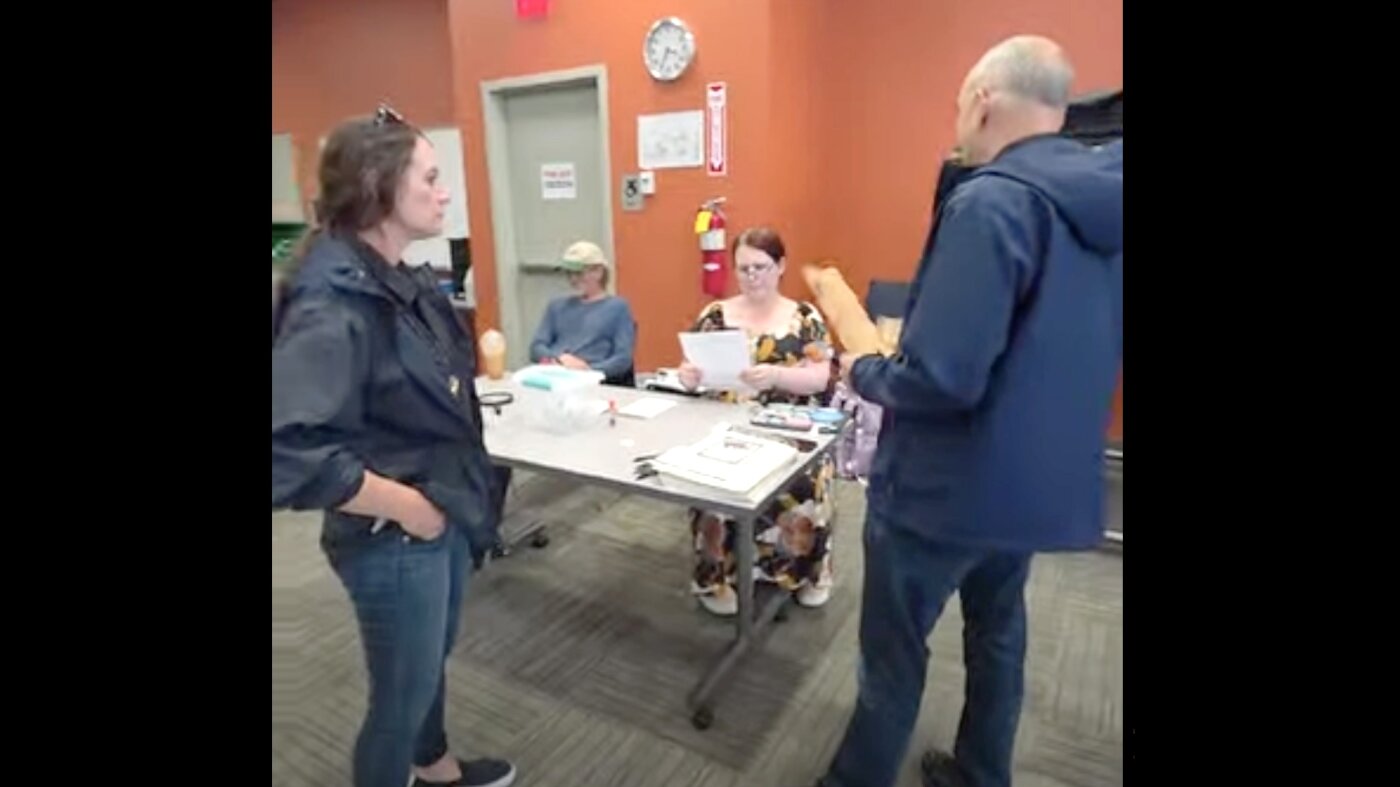
On Election Day in New York — June 23, 2026 — a poll worker named Paigelynne Gonyea was working at the Central Library in Syracuse when she got a voicemail from a man who said he was a Homeland Security special agent.
He said agents had just been by her apartment. He said they were calling about a post "where you doxxed an ICE agent back in January."
Then two agents with ICE badges walked into the polling place. They carried a file on her with her name, address, date of birth, height, weight and eye color, plus printed screenshots of her posts. They asked her to sign a notice from ICE's Office of Professional Responsibility. It said, in capital letters at the top, "YOU MAY BE IN VIOLATION OF FEDERAL LAW," and directed her to "promptly remove and/or discontinue the aforementioned behavior."
What had she posted? On January 8, the day after Renee Good was killed, she wrote this:
"The ICE agent who shot and killed Renee Good in broad daylight has been identified as Jonathan Ross by the Minnesota Star Tribune. I think today is a great day for Jonathan to be indicted!"
That's it. A newspaper's reporting, repeated, plus an opinion that a man should face a grand jury.
Gonyea refused to sign. She refused to delete the post. DHS later told NPR she had published an ICE officer's address online — but has not produced any evidence of that, and Gonyea says she has looked through her own accounts and can't find any address.
A local Republican election commissioner confirmed to NPR that the badges were real. He called the whole thing "a comedy of errors" and said it was "a mistake" for agents to enter a polling site at all. Federal law bars armed federal officers from polling places — NPR notes it's unclear whether these two were armed — and New York has a state law barring immigration agents from voting sites, period.
Perry Grossman of the New York Civil Liberties Union put it plainly:
"If this is the kind of speech that the administration, that DHS wants to go after, then they are trying to fundamentally redefine the First Amendment and the scope of permissible public debate. And that is wrong. That is ridiculous."
According to the Journal, the agents who visited Gonyea delivered that same letter to several other people that day. One recipient sued. A special agent tracked down David Streever while he was on vacation — five months after Streever emailed then-acting ICE director Todd Lyons following the killing of Alex Pretti, an ICU nurse shot by federal agents in Minneapolis on January 24, and called Lyons "a monstrous human being." Streever says DHS is retaliating against protected speech and that it will chill the public.
The number they won't show you
DHS's whole defense rests on a statistic: an 8,000% increase in death threats against ICE officers since Trump took office.
Go read the press release it comes from. It's dated January 26, 2026. It contains one voicemail transcript and the number. No counts. No baseline. No time period. No methodology. Nothing you could check.
We've been here before with this agency. A September 2025 executive order claimed assaults on ICE agents were up "more than 1,000 percent." NPR and Colorado Public Radio went and pulled five years of federal court records to check. Comparing charges for assaulting a federal officer through mid-September 2025 against the same stretch a year earlier, they found about a 25% rise — not 1,000%.
When reporters asked DHS to show its work, the department "repeatedly declined to provide any justification." It sent back links to its own earlier press releases repeating the same number.
Bob Pence, a 30-year FBI veteran, told NPR why that matters:
"There are a number of ramifications, if the public can't believe what law enforcement is saying then law enforcement probably can't depend on the cooperation of citizens to report information to them accurately."
By January 2026, the same DHS press release that carried the 8,000% figure had bumped the assault claim up to "more than 1,300%."
Congress wrote the check
None of this built itself. It runs on money, and money comes from Congress.
In June, Senate Republicans passed S. 2 — the "Secure America Act" — at 4:42 in the morning by a vote of 52 to 47, handing ICE and Border Patrol nearly $70 billion. Combined with the mass-deportation money approved the year before, that's close to a quarter of a trillion dollars.
They moved it through a fast-track budget process that needed only a simple majority, which let them strip out the guardrails that normally ride along with funding bills — required oversight of detention conditions, transparency rules forcing ICE to report basic data to the public, and civil-rights protections in enforcement. Those protections aren't in the law. That was a choice, and you can read the full breakdown in our post on the senators who voted yes.
Be clear about the timeline, because it matters. This vote did not create the dragnet — the Amivero contract was signed in September 2025, and attorneys started seeing the subpoena spike that same month. The surveillance operation was already running.
What these senators did was vote, on June 5, 2026, to pour another $70 billion into the agency running it — five months after federal immigration agents killed Renee Good in Minneapolis, and Alex Pretti weeks after her — and to do it in a way that left out the transparency requirements that would make a program like this visible to the public in the first place.
The Senate: 52 to 47
Fourteen of the senators who voted yes have report cards on this site:
- Alabama — Tommy Tuberville
- Alaska — Dan Sullivan
- Arkansas — Tom Cotton
- Florida — Ashley Moody
- Idaho — Jim Risch
- Kansas — Roger Marshall
- Maine — Susan Collins
- Mississippi — Cindy Hyde-Smith
- Nebraska — Pete Ricketts
- Ohio — Jon Husted
- South Dakota — Mike Rounds
- Tennessee — Marsha Blackburn and Bill Hagerty
- West Virginia — Shelley Moore Capito
The House: 214 to 212
Four days later, on June 9, 2026, the House passed the same bill by 214 to 212 and sent it to the president, who signed it the next day as Public Law 119-98.
Look closely at that roll call, because the margin hides something. It was two votes — but not because Republicans were split. Every single Republican who cast a vote voted yes. Not one voted no. Three didn't vote at all: Tom Kean Jr. of New Jersey, and Nancy Mace and Ralph Norman of South Carolina. The 212 no votes came from 211 Democrats and one independent.
It was close because it was unanimous on one side and near-unanimous on the other.
A hundred and ninety of the House members who voted yes have report cards here:
- Alabama — Robert Aderholt, Gary Palmer, Mike Rogers, Dale Strong
- Alaska — Nick Begich
- Arizona — Andy Biggs, Juan Ciscomani, Eli Crane, Paul Gosar, Abraham Hamadeh, David Schweikert
- Arkansas — Rick Crawford, French Hill, Bruce Westerman, Steve Womack
- California — Ken Calvert, Vince Fong, Young Kim, Tom McClintock, Jay Obernolte, David Valadao
- Colorado — Lauren Boebert, Jeff Crank, Gabe Evans, Jeff Hurd
- Florida — Aaron Bean, Gus Bilirakis, Kat Cammack, Mario Diaz-Balart, Byron Donalds, Randy Fine, Scott Franklin, Carlos Gimenez, Mike Haridopolos, Laurel Lee, Anna Paulina Luna, Brian Mast, Cory Mills, Jimmy Patronis, John Rutherford, Maria Elvira Salazar, Greg Steube
- Georgia — Rick Allen, Andrew Clyde, Mike Collins, Clay Fuller, Brian Jack, Rich McCormick, Austin Scott
- Idaho — Russ Fulcher, Mike Simpson
- Illinois — Mike Bost, Darin LaHood, Mary Miller
- Indiana — Jim Baird, Erin Houchin, Mark Messmer, Jefferson Shreve, Victoria Spartz, Marlin Stutzman, Rudy Yakym
- Iowa — Ashley Hinson, Mariannette Miller-Meeks, Zach Nunn
- Kansas — Ron Estes, Tracey Mann, Derek Schmidt
- Kentucky — Andy Barr, James Comer, Brett Guthrie, Hal Rogers
- Louisiana — Clay Higgins, Mike Johnson, Julia Letlow, Steve Scalise
- Maryland — Andy Harris
- Michigan — Tom Barrett, Jack Bergman, Bill Huizenga, John James, Lisa McClain, John Moolenaar, Tim Walberg
- Minnesota — Tom Emmer, Brad Finstad, Michelle Fischbach, Pete Stauber
- Mississippi — Mike Ezell, Michael Guest, Trent Kelly
- Missouri — Mark Alford, Eric Burlison, Bob Onder, Jason Smith, Ann Wagner
- Montana — Troy Downing
- Nebraska — Mike Flood, Adrian Smith
- New Jersey — Jeff Van Drew, Chris Smith
- New York — Andrew Garbarino, Nick LaLota, Nick Langworthy, Mike Lawler, Nicole Malliotakis, Claudia Tenney
- North Carolina — Chuck Edwards, Virginia Foxx, Pat Harrigan, Mark Harris, Richard Hudson, Brad Knott, Addison McDowell, Tim Moore, Greg Murphy, David Rouzer
- North Dakota — Julie Fedorchak
- Ohio — Troy Balderson, Mike Carey, Warren Davidson, Jim Jordan, David Joyce, Bob Latta, Max Miller, Michael Rulli, David Taylor, Mike Turner
- Oklahoma — Stephanie Bice, Josh Brecheen, Tom Cole, Kevin Hern, Frank Lucas
- Oregon — Cliff Bentz
- Pennsylvania — Rob Bresnahan, Brian Fitzpatrick, John Joyce, Mike Kelly, Ryan Mackenzie, Dan Meuser, Scott Perry, Guy Reschenthaler, Lloyd Smucker, Glenn Thompson
- South Carolina — Sheri Biggs, Russell Fry, William Timmons, Joe Wilson
- Tennessee — Tim Burchett, Scott DesJarlais, Matt Van Epps, Chuck Fleischmann, Diana Harshbarger, David Kustoff, Andy Ogles, John Rose
- Texas — Brian Babin, John Carter, Michael Cloud, Monica De La Cruz, Beth Van Duyne, Jake Ellzey, Pat Fallon, Brandon Gill, Craig Goldman, Lance Gooden, Ronny Jackson, Nathaniel Moran, August Pfluger, Keith Self, Pete Sessions, Randy Weber, Roger Williams
- Utah — Mike Kennedy, Celeste Maloy, Blake Moore
- Virginia — Ben Cline, Morgan Griffith, Jen Kiggans, John McGuire, Rob Wittman
- Washington — Michael Baumgartner
- West Virginia — Carol Miller, Riley Moore
- Wisconsin — Scott Fitzgerald, Glenn Grothman, Derrick Van Orden, Bryan Steil, Tom Tiffany, Tony Wied
- Wyoming — Harriet Hageman
One name is missing from that list on purpose. Kevin Kiley of California, who the clerk's roll call lists as an independent rather than a Republican, voted no. He is the only member tracked on this site outside the Democratic caucus who did.
Twenty-four other House Republicans voted yes and don't have pages here yet.
Not one of the 204 members listed above made the money conditional on ICE telling the public what it collects, or on whom.
So who is watching the surveillance program? On paper, the ICE Privacy Office, in consultation with the DHS Privacy Office. The Journal reports the ICE Privacy Office is down to two full-time staffers.
Two people. Overseeing a $258-million-a-year surveillance operation with hundreds of subpoenas and files on American citizens.
And when members of Congress did go looking, it was one party doing the asking. Rep. Maxwell Frost and 11 other Democrats wrote to DHS in February asking what data the department collects on protesters. Lyons wrote back on April 21. He denied ICE keeps a database of protesters — but acknowledged that ICE collects "essential biographic and biometric information and situational details" on people it believes may be interfering with its operations, and keeps those records even when nobody is arrested.
ACLU attorney Scarlet Kim noticed what the letter left out: "He did not deny that, essentially, that information would not be placed in other existing databases."
The Republicans who control both chambers wrote the checks and stripped the guardrails. The questions about what ICE is collecting on Americans came from the minority.
Why this should bother you even if you never post about ICE
You might think none of this touches you. Look at the actual conduct that drew federal attention here.
A Reddit comment with the letters "ACAB" in it. An Instagram post saying an agent should be indicted, quoting a newspaper. An angry email to an agency head. Filming officers in public.
That is the ordinary stuff of American political argument. It is exactly what the Supreme Court described as "vituperative, abusive, and inexact" — and protected.
Danielle Citron, a law professor at the University of Virginia who studies privacy and cyberstalking, pointed out the part that ties it all together:
"We're seeing the weaponization of privacy in ways that privilege the powerful, and in particular, law enforcement. Law enforcement who are serving the public, they're hiding their names. They're hiding their faces. If they had their names on badges and they weren't wearing masks, you might see less of this activity."
That's the trade being made. Agents get anonymity. You get a file.
And notice how little the government has to do to win. It doesn't need convictions. It doesn't even need charges. It needs you to see two agents walk into your workplace holding a printout of your Instagram, and decide it isn't worth posting again.
Some of what the government is looking at is genuinely ugly. One woman the Journal spoke to had compared ICE officers to Nazis on X in January and written that "All ICE Agents need to be put down like the dogs they are." That's a vile thing to write, and nobody has to defend it.
But look at what happened next. Roughly four months later, plainclothes ICE agents showed up at her home, told her not to post like that again, and left. She was never charged. She has curbed what she says online.
If the government believed that post was a real threat, there is a courtroom for that. It went to her doorstep instead. And that tells you which outcome it was after.
That's not law enforcement. That's a warning system, paid for with public money, aimed at the public.
Source
- Hannah Critchfield and Shane Shifflett, "How ICE Is Weaponizing Social Media Against Its Critics", The Wall Street Journal, August 3, 2026.
- Photo: federal agents inside the Syracuse polling place where Paigelynne Gonyea was working, June 23, 2026. Video by Gracious Golden via Facebook; screenshot by NPR.